Tabelog 100 #95
Our verdict
Kishimen Amano puts Nagoya-style flat wheat noodles inside Osaka’s Umeda commuter rhythm, where lunch efficiency and evening looseness create two different readings of the same counter-and-table format. Its Tabelog 100 Udon WEST 2024 selection gives the room a credential beyond convenience, while the menu’s udon and oyako-don focus keeps the appeal grounded rather than ceremonial.

Pearl is the En Primeur Club membership app, where members save venues, book tables and use the concierge.
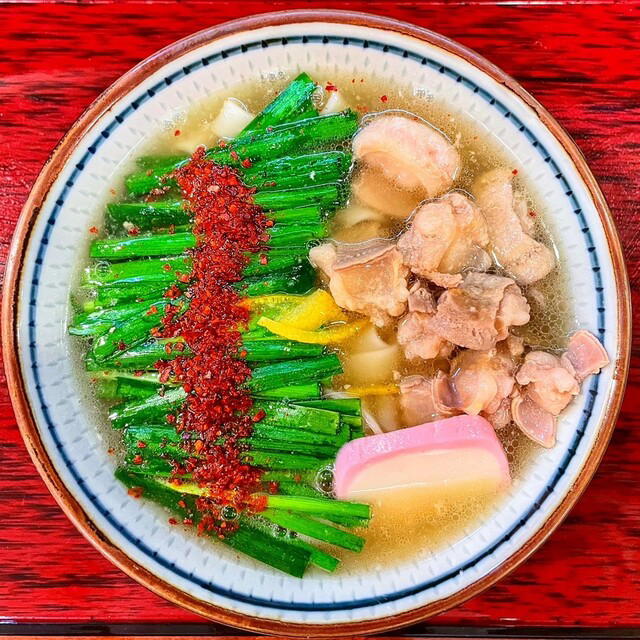
The menu
What to order
- Miso stewed udon
- Kamo zaru kishimen
- Duck kishimen
- Tempura kishimen
- Miso nikomi udon
Osaka does not ask diners to slow down. The city moves in commuter pulses: office workers cutting through from train lines, shoppers between stores, solo diners seeking a seat without negotiation. In that flow, Kishimen Amano fits a specific Osaka genre: the serious noodle shop hidden in plain sight, compact, functional, recognized enough for a detour, and casual enough that the meal never becomes an event.
The useful lens is timing, not luxury. Lunch in Osaka rewards speed, clarity, and price discipline; dinner lets the same noodle-and-rice format turn more social in a low-friction way. That split matters because everyday noodle shops in Japan often carry two identities: by day, precise hunger-solvers; by night, easy dining rooms where commuting and eating blur.
Flat wheat noodles in a city built on faster lunches
Kishimen is associated more directly with Nagoya than Osaka, giving the room its first point of interest. Osaka’s noodle imagination tends to move between udon softness, dashi culture, and practical quick meals. Flat wheat noodles sit differently: regional rather than trend-led, and logical in Osaka, where a dense urban network compresses many Japanese eating habits.
Kishimen Amano’s Tabelog Hyakumeiten recognition for 2024 places it in a selective noodle conversation, not a generic quick-meal category. The credential matters because the setting can mislead first-time visitors: a casual commercial context may look like pure convenience, yet the recognition shows the shop has a signal beyond ordinary lunch-counter utility.
The menu frame is narrow by design: udon, wheat noodles, and oyako-don. In Osaka, where food choices can overwhelm, this focused noodle-and-rice format gives the meal clear grammar. Lunch is practical: a solo diner can read the room, order without ceremony, and leave. Dinner changes less through theatrical service than through pace; the same categories can feel warmer when the room is not fighting the office clock.
Osaka has plenty of adjacent quick-meal competition, including casual stops such as curry restaurant BRUNO HEP NAVIO ten, Cantegrande Curry San hiroba ten, le Boulanger de monge Umeda hankyuu ten, ECHIRE MARCHE AU BEURRE, and Al Roikku Hankyu umeda honten. Kishimen Amano is not competing with tasting-menu Osaka. It answers the traveler’s practical question: where can a modest meal carry enough local texture to beat convenience alone?
The lunch-dinner divide is the real story
At lunch, the appeal is structural. The format gives solo diners a clean path through the meal, while the focused menu keeps the room from feeling like a banquet hall disguised as a noodle shop. Osaka’s central dining culture understands solo diners, but not all places treat solo eating as dignified. Here, the proposition accepts that a good meal may last less than an hour and still be properly considered.
Evening shifts the equation. The same food categories suggest a room suited to a gentler after-work pace, not only refueling. It is a familiar Japanese city transformation: the efficient lunch stop becomes a place for a bowl and a rice dish before the trip home. For travelers, dinner better explains how Osaka eats after the workday loosens; lunch better captures value and rhythm.
The compact scale matters. The room is best understood as everyday public dining rather than a destination built around privacy or ceremony. That is the point: approachable Japanese dining with an award signal, not a hushed occasion room.
That distinction fits a wider Osaka itinerary. Travelers building an Osaka food day can pair this noodle stop with Our full Osaka restaurants guide, then decide whether the evening belongs to cocktails via Our full Osaka bars guide or a hotel base through Our full Osaka hotels guide. The city rewards modular eating: one focused bowl, one sweet stop, one bar, one late train.
How to place it inside an Osaka food day
The strongest case for Kishimen Amano is editorial rather than sentimental. It shows that Osaka’s eating culture lives not only in market alleys, high-end counters, or neon restaurant streets, but also in ordinary urban corridors where daily geography sets tempo. The value is not escape from the city’s infrastructure; it is working inside it with enough specificity to avoid interchangeability.
For visitors comparing noodle culture across Japan, this is a useful corrective. Osaka is often reduced to a few famous street-food references and late-night appetite, yet practical city dining is equally instructive. A recognized udon and wheat-noodle address in Osaka shows how the city eats between appointments, trains, and shopping: less theatrical than postcard Osaka, often more revealing.
The broader EP Club map helps frame that choice. Other casual Osaka entries show how broad the city’s casual-to-polished range becomes beyond one dish category. For non-restaurant planning, Our full Osaka wineries guide and Our full Osaka experiences guide round out the city view.
Comparable browsing might include other focused dining rooms across Japan, where narrow formats and everyday settings often carry more meaning than a grand room. For Japanese food culture abroad, similarly compact formats show how specific ideas travel when they leave Japan.
The verdict is simple: treat Kishimen Amano as a precision stop, not a grand night out. Lunch gives the cleanest expression of Osaka efficiency; dinner adds a softer after-work register. Either way, the draw is regional noodle specificity, a compact public room, and a recognized udon credential inside one of Osaka’s busiest dining ecosystems.
Frequently asked questions
Where do I go for Kishimen Amano?
Osaka.
When can I go to Kishimen Amano?
Check current opening times directly before visiting Kishimen Amano.
Is Kishimen Amano expensive?
Pricing at Kishimen Amano is listed as JPY 1,000 - JPY 1,999 JPY 1,000 - JPY 1,999.
What is Kishimen Amano known for?
Kishimen Amano is known for udon, wheat noodles, and oyako-don in Osaka, with Tabelog Hyakumeiten recognition in 2024.
Peers You’d Cross-Shop
Comparable venues at a glance for context.
| Venue | Cuisine | Price | Awards | Notes |
|---|---|---|---|---|
| Kishimen AmanoThis venue (the venue you are viewing) | Nagoya-style miso udon and kishimen | $10–20 | Tabelog 100 #95 | Not listed |
| curry restaurant BRUNO HEP NAVIO ten | Japanese Curry House | $10–20 | Tabelog 100 #8 | JPY 1,000 - JPY 1,999 JPY 1,000 - JPY 1,999 |
| Cantegrande Curry San hiroba ten | Curry House | $10–20 | Tabelog 100 #62 | JPY 1,000 - JPY 1,999 JPY 1,000 - JPY 1,999 |
| le Boulanger de monge Umeda hankyuu ten | French Bakery | $1–10 | Tabelog 100 #55 | JPY 999 - JPY 999 View spending breakdown |
| ECHIRE MARCHE AU BEURRE | French butter-focused patisserie & bakery | $10–20 | Tabelog 100 #52 | JPY 999 - JPY 999 |
| Al Roikku Hankyu umeda honten | Premium Crepe & Provence Gelato Cafe | $1–10 | Tabelog 100 #98 | JPY 999 - JPY 999 |
Recognition history
Dated appearances from independent guides and award organizations, with the underlying list record or original source where available.
Tabelog 100 #95 · No. 95
Tabelog · Tabelog 100 - Udon - WEST - 2024