Our verdict
Sivatha Road is Siem Reap's most consequential commercial artery, threading through the city's restaurant corridor and connecting the Old Market quarter to the newer dining and bar precincts that have taken shape over the past decade. What began as a straightforward commercial strip has evolved into a navigational reference point for anyone mapping the city's eating and drinking scene. Regulars treat it less as a destination than as a spine from which everything branches.

Pearl is the En Primeur Club membership app, where members save venues, book tables and use the concierge.
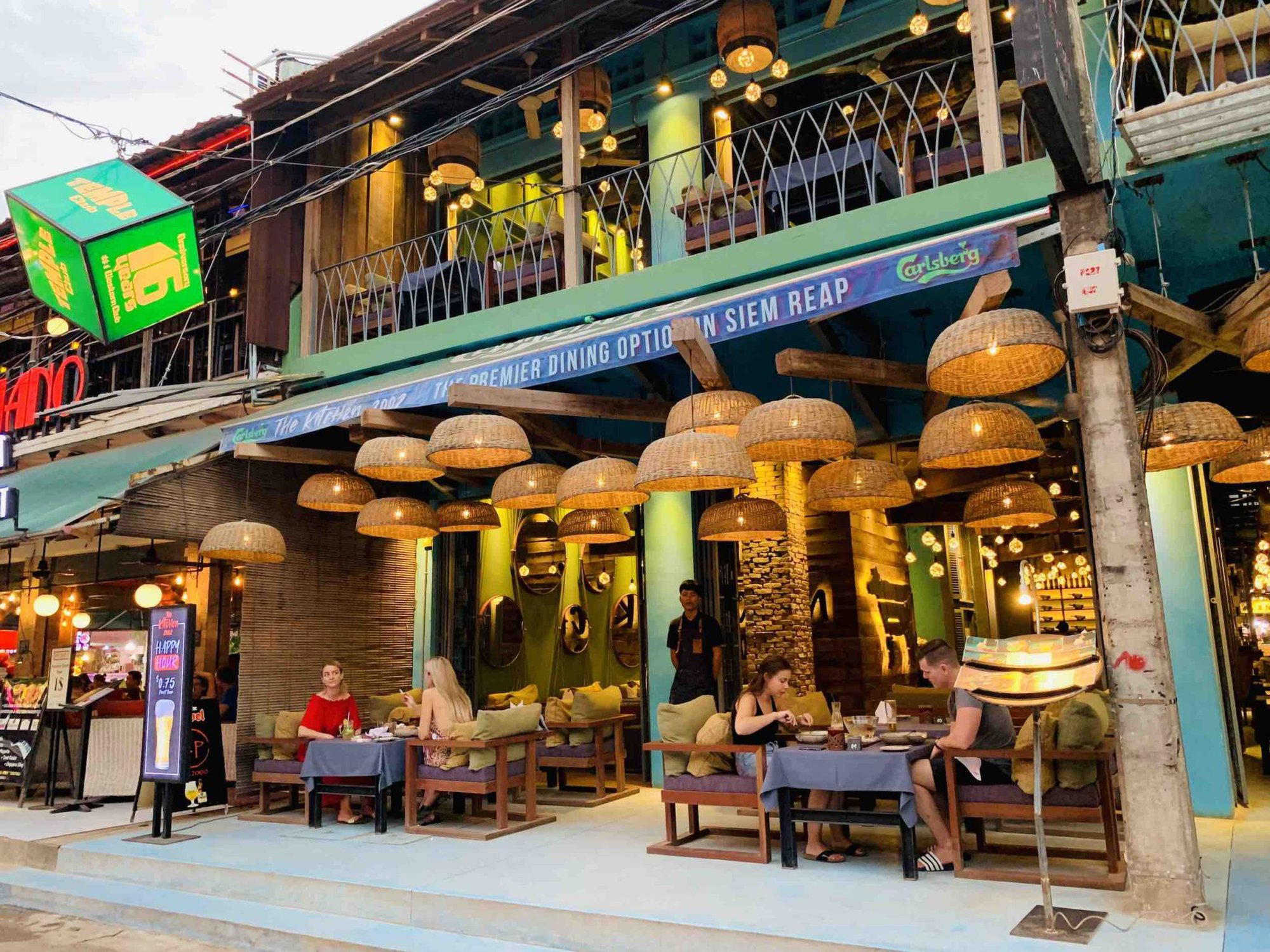
The Street That Organises Siem Reap's Dining Scene
In Siem Reap, the question is rarely which restaurant to choose. It's which stretch of which road you want to be on when the light drops and the evening cools. Sivatha Road answers that question for a significant portion of the city's dining population. Running through the commercial heart of Krong Siem Reap, it functions as the connective tissue between the Old Market area and the broader hospitality corridor that has taken shape over the past ten to fifteen years. Walk it at dusk and you're mapping the city in real time: kitchens opening, motorbike traffic thinning, tables filling on ground-floor terraces that spill onto the pavement.
The road doesn't belong to any single cuisine or price bracket. That breadth is precisely what regulars prize. Siem Reap's restaurant scene has diversified considerably since the early 2000s, when post-Angkor dinner options were thin. Today the city supports everything from high-concept Khmer tasting menus to casual noodle counters and European imports, and Sivatha Road sits at the intersection of most of those categories. For visitors making multiple trips to Angkor over several days, the road becomes a kind of edible calendar: one evening for Khmer, one for something lighter, one for a bar seat and smaller plates.
What Keeps People Coming Back
The regulars on Sivatha Road, whether they're long-stay volunteers, heritage tourists on a second or third visit, or expatriates based in the city, tend to organise their evenings around the road's rhythm rather than any individual address. This is a street where the walk is part of the decision. You pass a terrace, assess the crowd, check the menu board, keep moving or sit down. The low-friction approach to choosing suits a city where the pace of travel is already deliberate, calibrated around sunrise temple visits and afternoon heat.
That loyalty to the corridor rather than to a single table is also a function of what the street offers across different price tiers. Siem Reap's dining economy has not consolidated around a single premium tier the way Bangkok or Singapore has. Accessible mid-range options exist directly alongside more composed, chef-led formats, and Sivatha Road reflects that structure. A returning visitor might spend three consecutive evenings on the same stretch eating at three entirely different price points without feeling any mismatch. The street absorbs all of it without the kind of segmentation you'd find on a London or Sydney restaurant strip.
The Broader Siem Reap Dining Context
To understand Sivatha Road properly, it helps to understand how Siem Reap has positioned itself within the wider Cambodian dining conversation. The city competes with Phnom Penh for culinary ambition, but the two cities have diverged. Phnom Penh has developed a denser, more urban restaurant culture, with venues like Iza in Phnum Penh and Le Royal at The Raffles anchoring different segments of a sophisticated capital market. Siem Reap, by contrast, remains more tourism-dependent, which has historically limited how far local restaurants can push in terms of format or price. But that constraint has also produced a particular kind of resourcefulness: restaurants here must appeal to a visitor audience without patronising it.
The result, visible along Sivatha Road, is a scene that skews toward quality-to-value signals rather than prestige signals. Venues that have earned sustained recognition in this city tend to do so through consistency and accessibility rather than through chef pedigree alone. That pattern extends across Siem Reap's wider restaurant corridor, encompassing venues like Chanrey Tree, Damnak Meas, and AHA Umber, each of which occupies a distinct position within the city's dining range. For a more complete picture of how these venues relate to one another, the full Siem Reab restaurants guide maps the scene by neighbourhood and category.
Social enterprises have also taken meaningful root in Siem Reap, more so than in most Southeast Asian cities of comparable size. HAVEN in Sala Kamreuk Sangkat and the Bayon Pastry School both operate training-restaurant models that feed back into local hospitality education, a sector that remains critically underfunded relative to the volume of tourism the city handles. These venues attract regulars precisely because the reason to return goes beyond the plate. That kind of loyalty, built on mission alignment rather than pure culinary aspiration, is a Siem Reap characteristic rather than a Sivatha Road characteristic specifically, but the road's mixed-use character makes it a useful place to observe the pattern.
For context on how Siem Reap's higher-end formats compare to the wider region, venues like Cuisine Wat Damnak represent the city's most ambitious Khmer fine dining proposition, while resort dining at Amansara Resort Dining Room operates in an entirely separate competitive tier. Across Cambodia, comparable scenes have developed in Battambang, where Jaan Bai Restaurant has established itself as a training-restaurant reference point, and in Sihanoukville, where Maybe Later occupies its own coastal niche. The national dining conversation is more varied than the Siem Reap-Phnom Penh binary suggests.
International comparison points, while stylistically distant, are useful for framing ambition. Tasting-menu formats at venues like Le Bernardin in New York City or communal dining experiments like Lazy Bear in San Francisco represent the upper register of what a dining street experience can become when a city's restaurant culture matures around a specific format. Siem Reap is not there yet, but the trajectory along its central corridors suggests the appetite exists, particularly among younger Cambodian chefs returning from training abroad.
Other venues around the broader corridor worth tracking include Il Forno, which covers the European end of the spectrum, Embassy in Svay Dankum Sangkat, and Lum Orng Restaurant in Sla Kram Sangkat. Each sits within easy reach of Sivatha Road and extends the corridor's range into adjacent neighbourhoods. For travellers willing to move slightly further afield, Shinta Mani Wild in Kampong Seila represents what happens when Cambodian hospitality operators position squarely for the international conservation-tourism market.
Planning Around the Road
Sivatha Road requires no advance booking in the way a tasting-menu counter does. The nature of the strip is walk-in, self-directed, and leading approached with a loose agenda rather than a fixed reservation. That said, the city's most sought-after tables elsewhere in Siem Reap do require planning, and arriving without a strategy during peak temple season (November through March) means competing for tables across the board. The practical move is to anchor one or two evenings around confirmed reservations at more structured venues and leave Sivatha Road itself as the free variable: the place you end up when the plan changes or the night extends.
Frequently asked questions
Where is Sivatha Rd located?
Sivatha Rd is located at Krong Siem Reap, Cambodia, Siem Reab.
Is Sivatha Road in Siem Reap suitable for repeat visitors beyond the temple circuit?
Regulars on Sivatha Road include expats based in Krong Siem Reap and heritage tourists returning for second or third visits, which points to a scene with staying power beyond first-time temple tourism. The road functions as a social and dining reference point for people already familiar with the city. That repeat-visitor base tends to be more selective about where they spend an evening, making the strip a useful gauge of what holds up over multiple visits.
What dish is Sivatha Rd famous for?
Sivatha Road is not anchored to a single signature dish. The strip in Krong Siem Reap runs a range of formats, from Khmer home-cooking to international plates aimed at heritage tourists and longer-stay visitors. The draw is breadth rather than a single destination item.
How far ahead should I plan for Sivatha Rd?
No advance booking is required. Sivatha Road in Siem Reap operates as a walk-in corridor by nature, with venues absorbing foot traffic throughout the evening. Arriving at dusk, as the light drops and the street activates, is the practical approach rather than scheduling around a reservation window.
Cuisine-First Comparison
| Venue | Cuisine | Price |
|---|---|---|
| Sivatha RdThis venue (the venue you are viewing) | Indian & Cambodian | Not listed |
| Bayon Pastry School | French Pastry & Bakery Cafe | $1–10 |
| Chanrey Tree | Traditional Khmer Cuisine | $10–20 |
| Damnak Meas | Cambodian | Not listed |
| AHA Umber | Modern Cambodian Fusion Tapas | $20–30 |
| Il Forno | Authentic Italian Trattoria | $10–20 |
Continue exploring
More in Siem Reap
Restaurants in Siem Reap
All restaurants in Siem Reap →
Bars in Siem Reap
All bars in Siem Reap →
Details
- Casual Hangout
- Family
- A La Carte
- Buffet
- Vegetarian Friendly
- Vegan Options
- Gluten Free Options
- Halal