
Signature sits on Avenue Henri Barbusse in Saultain, a commune in France's northern Hauts-de-France region where serious dining tends to operate quietly, away from metropolitan attention. The restaurant's address places it within reach of Valenciennes, a city with a longer culinary tradition than its industrial reputation suggests. For the context of what this part of northern France produces from its land, the address alone rewards investigation.
Pearl is the En Primeur Club membership app — saves, bookings, and concierge access live there. Same editors, same standards.
- Address
- 77 Av. Henri Barbusse, 59990 Saultain, France
- Phone
- +33620963491
- Website
- restaurant-signature.fr
- Directions
- Get directions
 Saves & bookings on Pearl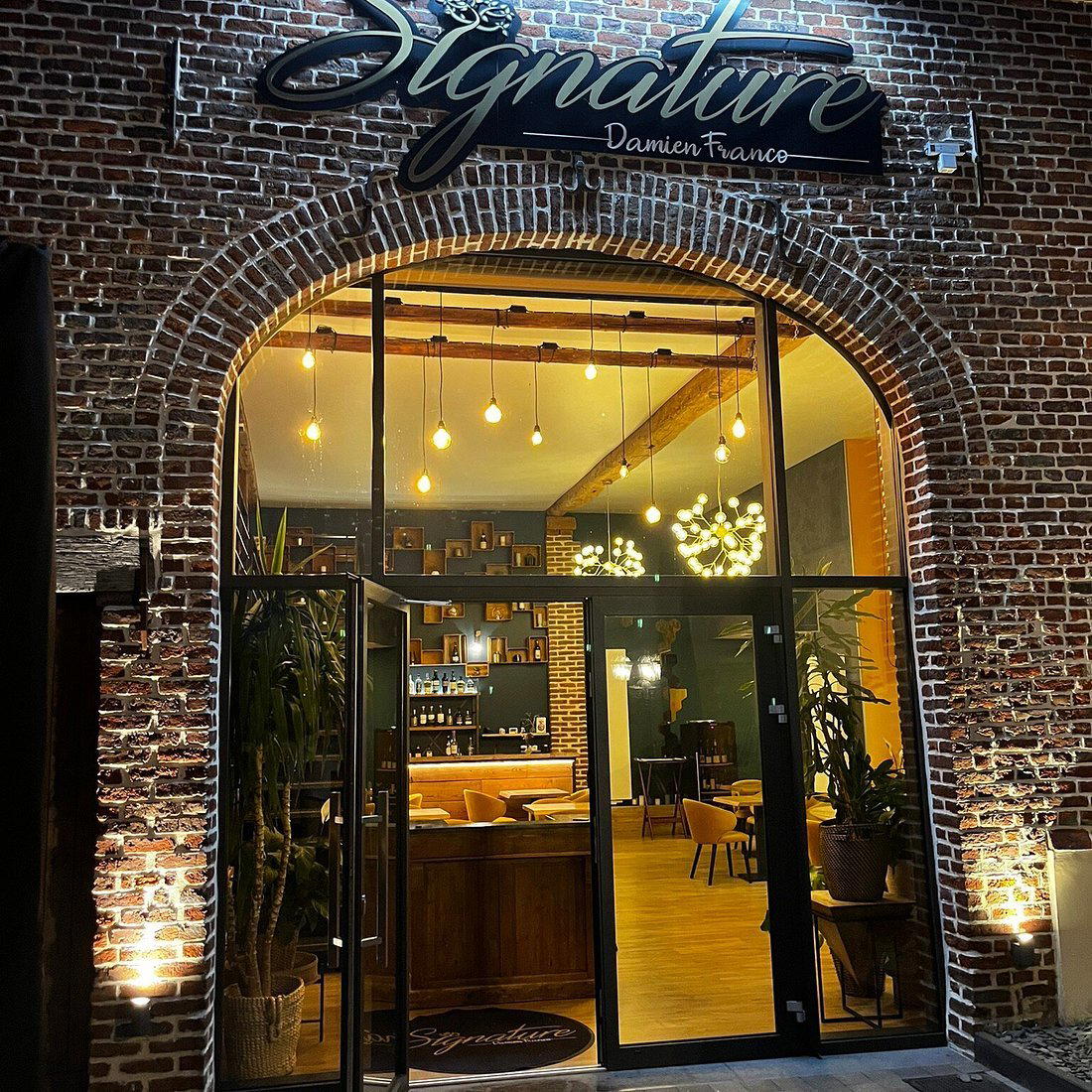
Northern France, Quietly
The Hauts-de-France region does not announce itself the way Burgundy or Provence does. There are no internationally traded appellations attached to its fields, no marquee names that anchor a food tourism itinerary. What it has, particularly in the agricultural corridor around Valenciennes and the communes that ring it, is serious land: sugar beet plains, chicory cultivation, endive forcing caves, and a tradition of market gardening that predates the industrial era that later obscured it. Saultain sits inside that agricultural belt, and a restaurant addressing itself as Signature on Avenue Henri Barbusse is operating in a place where the supply chain is direct, seasonal, and often unremarked upon by the wider food press.
That geographical context matters more here than it might in a Paris arrondissement, where ingredient sourcing is a competitive differentiator among dozens of ambitious kitchens. In a commune of this scale, the question of where the food comes from is structural rather than promotional. The relationship between kitchen and local producer is a logistical fact before it becomes an editorial point.
What Northern France Puts on the Table
French regional cooking in the north has historically been defined by its distance from Mediterranean abundance. The pantry runs to root vegetables, freshwater fish from the Scarpe and Escaut river systems, aged cheeses from Maroilles country to the east, game from forests that stretch toward Belgium, and a butter tradition that preceded and outlasted every dietary trend from Paris. These are not ingredients that photograph easily or travel well as concepts. They require a kitchen willing to work with density and depth rather than brightness and lightness.
The broader category of serious northern French restaurants has never attracted the concentration of three-star ambition that you find along the Lyon-Paris axis, at addresses like Troisgros - Le Bois sans Feuilles in Ouches or Paul Bocuse - L'Auberge du Pont de Collonges in Collonges-au-Mont-d'Or. Nor does it chase the coastal sourcing narratives of Christopher Coutanceau in La Rochelle or La Marine in Noirmoutier-en-l'Île. The ambition in this part of France tends to be expressed through craft and consistency rather than destination-dining spectacle. Restaurants like Assiette Champenoise in Reims and Au Crocodile in Strasbourg illustrate how the north and northeast of France have sustained serious dining cultures without defaulting to the coastal or alpine frameworks that attract foreign attention.
Signature operates within that broader pattern. The address in Saultain positions it as a neighbourhood-rooted restaurant rather than a destination built around extracting visitors from major cities. That is not a limitation. Restaurants that serve a local population week after week, rather than a rotating audience of first-time visitors, tend to develop a different relationship with their supply chains. Repeat clientele creates the economic conditions for kitchen discipline and producer loyalty that destination-dining formats rarely sustain.
The Sourcing Logic of Small-Commune Restaurants
In the Valenciennes metropolitan area, the shortest distance between field and plate is often measured in single-digit kilometres. The endive that defines northern French winter cooking, grown in heated cellars from chicory roots harvested in autumn, arrives at kitchens in this region with a freshness that even well-supplied Paris addresses cannot match. The same applies to the abbey-tradition cheeses of Thiérache and Avesnois, which are produced within reasonable distance of Saultain and which appear on serious local tables in a condition that weeks of distribution logistics would compromise.
This is the sourcing argument for eating in a place like Saultain rather than waiting to encounter northern French ingredients filtered through a capital-city kitchen. Restaurants at addresses like Bras in Laguiole and Auberge du Vieux Puits in Fontjoncouse built their reputations precisely on this logic: that cooking from a specific, deeply known territory produces a form of specificity that broader, sourcing-agnostic kitchens cannot replicate. The northern French equivalent of that argument has been made less loudly, but the underlying conditions are comparable.
For contrast, consider how Mirazur in Menton has articulated its kitchen garden as a competitive and philosophical anchor, or how Alléno Paris au Pavillon Ledoyen approaches extraction and fermentation as a technique for intensifying French terroir. These are high-investment, high-profile versions of a sourcing argument that plays out at smaller scale in communes across provincial France. Signature, at its Saultain address, is part of that provincial continuum.
Regional Dining in Context
Hauts-de-France has attracted less editorial attention than Alsace, which produced Auberge de l'Ill in Illhaeusern, or the Mediterranean coast, which anchors names like AM par Alexandre Mazzia in Marseille and L'Oustau de Baumanière in Les Baux. The region's dining identity has been shaped more by proximity to Belgium, by its brewing and charcuterie cultures, and by a working-class food tradition that is harder to package for international audiences than wine-country gastronomy. That relative obscurity means less competition for the reader's attention and, frequently, fewer inflated prices.
The Valenciennes area specifically carries a culinary reputation that extends beyond its national industrial identity. The city has supported serious cooking at various price points for decades, and the satellite communes have absorbed restaurant culture that would, in a more touristic region, concentrate in a single designated quarter. Saultain's position on that map reflects the dispersed nature of serious eating in the French provincial north: you find it where the clientele is, not where the guidebook suggests you look.
For readers building an itinerary across northern French dining, our full Saultain restaurants guide covers the local context in more detail. Readers comparing approaches to French fine dining at a national scale will find useful reference points at Flocons de Sel in Megève, Georges Blanc in Vonnas, and, for a transatlantic comparison of French culinary lineage, Le Bernardin in New York City and Atomix in New York City.
Planning a Visit
Saultain sits within the Valenciennes metropolitan area in the Hauts-de-France department. The town is accessible from Valenciennes by car in under ten minutes, and Valenciennes itself connects to Lille, Brussels, and Paris by TGV and regional rail. For visitors arriving from outside the region, Lille-Lesquin airport serves as the closest commercial hub. The restaurant is recommended for reservations and follows these hours: Mon: Closed; Tue: 12–1:30 PM, 7:30–9:30 PM; Wed: 12–1:30 PM; Thu: 12–1:30 PM, 7:30–9:30 PM; Fri: 12–1:30 PM, 7:30–9:30 PM; Sat: 7:30–9:30 PM; Sun: Closed.
At-a-Glance Comparison
Comparable venues nearby, for context on price, style, and recognition.
| Venue | Cuisine | Price | Notes |
|---|---|---|---|
| SignatureThis venue — the venue you are viewing | Modern French Neo-Gastronomic | $$$ | Not listed |
| La Cense | Modern French Gastronomy | $$$ | Lambersart |
| Comptoir 44 | French Bistronomique | $$$ | Vieux Lille 2 |
| Le Barbue d'Anvers | Traditional Northern French & Belgian Estaminet | $$$ | Vieux Lille 4 |
| Saturne | Modern French with Nordic Influences | $$$ | 2nd Arrondissement |
| Restaurant Café de la Paix | Classic French Brasserie with Seafood | $$$ | Centre Erlon-Ouest |
Recognition history
Dated appearances from independent guides and award organizations, with the underlying list record or original source where available.
Michelin Plate
Michelin
Continue exploring
More in Saultain
Restaurants in Saultain
Browse all →
Hotels in Saultain
Browse all →
Wineries in Saultain
Browse all →
At a Glance
- Elegant
- Cozy
- Sophisticated
- Date Night
- Special Occasion
- Open Kitchen
- Local Sourcing
Current opening hours
- Monday
- Closed
- Tuesday
- 12–1:30 PM, 7:30–9:30 PM
- Wednesday
- 12–1:30 PM
- Thursday
- 12–1:30 PM, 7:30–9:30 PM
- Friday
- 12–1:30 PM, 7:30–9:30 PM
- Saturday
- 7:30–9:30 PM
- Sunday
- Closed
Hours can change for holidays and private events. Last verified .
Cosy and warm atmosphere in a renovated barn with colorful elegant decor, high beams, red-brick walls, and glass panels revealing the open kitchen.