Royal Hainaut

1 Michelin Key
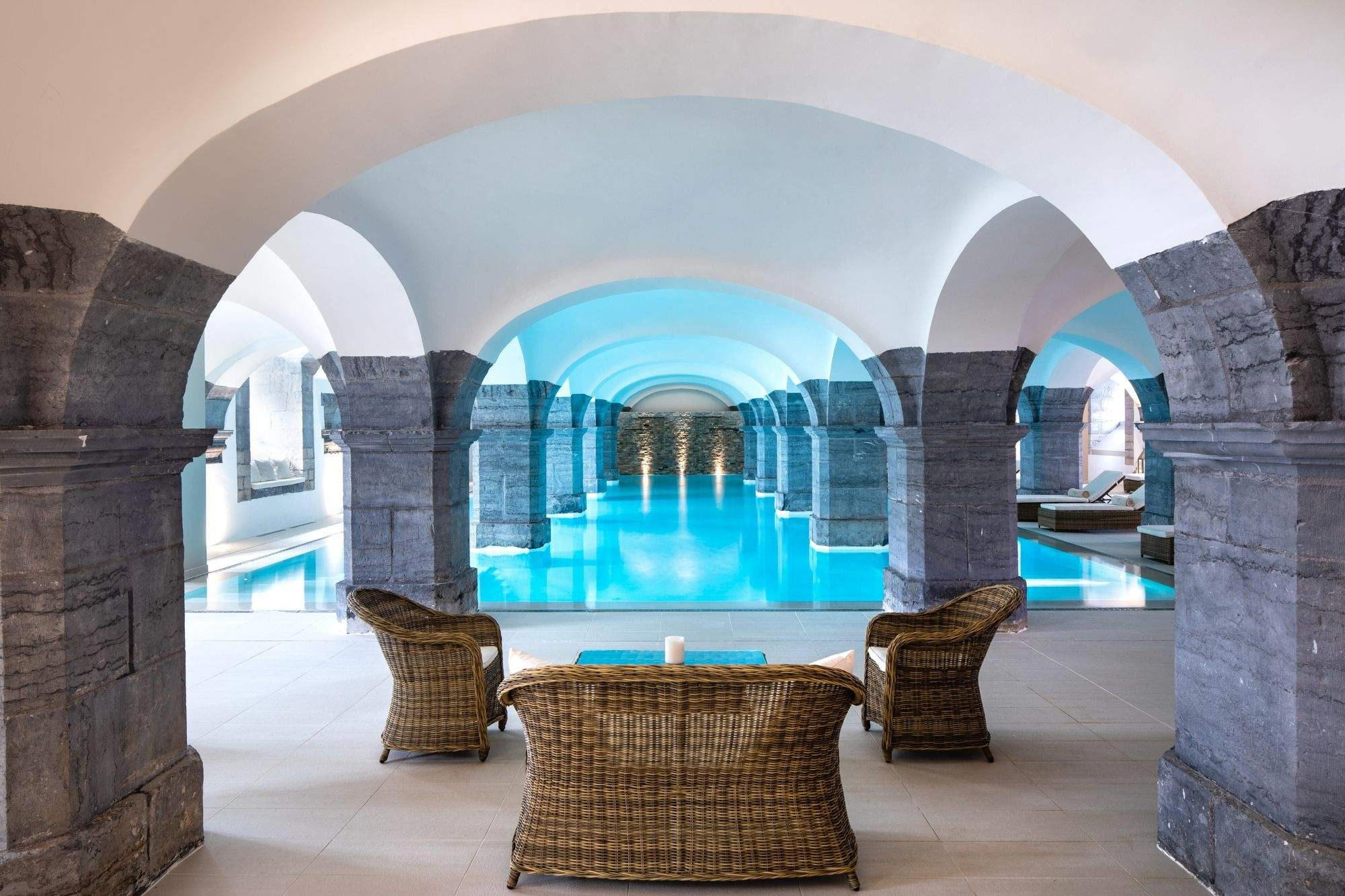
A Michelin Key-awarded spa hotel in northern France, Royal Hainaut occupies a 1751 hospital commission by Louis XV, its palatial proportions now housing 79 rooms with seven-metre ceilings, blue stone vaults, and an underground spa. Rates from around $810 per night position it as the reference address for premium stays in Valenciennes, a city that serves as a practical base for exploring Hauts-de-France.

Pearl is the En Primeur Club membership app, where members save venues, book tables and use the concierge.
A Royal Commission Repurposed
France has a long tradition of converting monumental civic architecture into hotels, and the results range from the merely decorative to the genuinely transformative. Royal Hainaut belongs to the latter category. The building at 6 Place de l'Hôpital Général in Valenciennes was constructed in 1751 as a hospital, commissioned under Louis XV, and its proportions were never intended to be domestic. The Cour d'Honneur alone communicates institutional gravity: symmetrical facades, generous stone, and the kind of scale that a private patron would never have sanctioned. That origin story shapes everything about the hotel's spatial identity, and it explains why no amount of interior decoration could produce the same effect in a purpose-built property.
Adaptive reuse of heritage buildings is now a recognised tier within European luxury hospitality. Properties that convert abbeys, palaces, and government buildings into hotels occupy a specific competitive bracket, distinct from both the grand hotel tradition and the modern design hotel. Royal Hainaut sits in this bracket, and its 2024 Michelin Key recognition reflects how that category is being formally assessed by the guides for the first time. For context, Michelin introduced its hotel key system precisely to surface properties where the physical experience itself, not just the restaurant on site, justifies the classification. Earning one key in the inaugural cycle places Royal Hainaut alongside a select cohort of French hotels where architecture and spatial quality are treated as primary criteria.
What the Building Actually Delivers
The architectural record of an eighteenth-century hospital commission produces specific features that are difficult to replicate or simulate. Seven-metre-high ceilings are the most immediately legible: they change the acoustic character of a room, alter the quality of natural light, and impose a verticality that makes even a moderately sized room feel expansive. Blue stone vaults, visible in several of the rooms and corridors, are a material signature of the Hainaut region specifically. Blue stone, quarried from the limestone belt that runs through southern Belgium and northern France, was the prestige building material of the area's ecclesiastical and civic architecture. Its presence here is not a design choice imposed by a renovation team; it is the original fabric of the building, retained rather than invented.
The hotel accommodates 79 rooms and suites across this framework. Suites are positioned to overlook the Cour d'Honneur, which means their primary view is the original hospital courtyard, a composition of stone and geometry that reads very differently from a garden or a cityscape. The spatial logic here rewards guests who take the time to understand what they are looking at: the proportions of the courtyard were designed to facilitate movement of people at scale, not to frame a picturesque view, and yet the result is a kind of austere beauty that contemporary design would struggle to produce deliberately.
The Spa and the Cellar Logic
Spa occupies the building's original cellar, and this placement is more consequential than it might initially appear. Cellar spaces in eighteenth-century institutional buildings were engineered for thermal stability, humidity control, and structural insulation. These are precisely the conditions that contemporary spa design attempts to engineer artificially. The indoor pool benefits from stone walls and vaulted ceilings that regulate temperature and sound in ways that a purpose-built basement spa cannot easily replicate. There is a category of luxury spa experience that depends on atmosphere as much as on treatment quality, and the cellar setting at Royal Hainaut delivers that atmosphere through original material rather than through simulation.
This approach to spa design has precedents elsewhere in French heritage hospitality. Properties like Domaine Les Crayères in Reims and Les Sources de Caudalie in Bordeaux have built their wellness offer around site-specific conditions rather than imported spa formats. Royal Hainaut's cellar spa sits in that tradition: the architecture does the work that design budgets elsewhere have to spend heavily to approximate.
Valenciennes as a Base
Northern France carries a reputation problem in the minds of travellers oriented toward the south, and Valenciennes specifically tends to sit below the radar of most international itineraries. That positioning has practical advantages. The city sits in the Hauts-de-France region, within reasonable distance of Lille, the Belgian border, and the broader network of towns and landscapes that define this historically layered part of the country. The region's Flemish heritage, its industrial history, and its late-nineteenth-century architectural legacy make it genuinely distinct from either Parisian or Mediterranean France.
For travellers using Royal Hainaut as a base, Valenciennes functions as an access point rather than a destination in the resort sense. The city has a covered market, a fine arts museum with a collection that reflects the region's proximity to Flemish painting traditions, and a civic fabric that rewards walking. None of this requires the hotel to manufacture a local programming offer; the city itself provides the context, and the hotel's location on Place de l'Hôpital Général places guests within the historical centre. See our full Valenciennes restaurants guide for dining options across price points in the city.
Placing Royal Hainaut in the French Luxury Hotel Map
The French luxury hotel market spans a wide range of formats and price positions. At one end sit the grandes maisons of Paris and the Riviera: Cheval Blanc Paris, Hotel Du Cap-Eden-Roc in Cap d'Antibes, The Maybourne Riviera, and La Réserve Ramatuelle, where rates reflect location premiums and international demand. Royal Hainaut occupies this regional position. At approximately $810 per night, it sits at the upper end of what northern France supports commercially, without attempting to compete on the price axis with the Riviera or the Alps.
The comparison that matters more is within the heritage-conversion category itself. Properties like Château du Grand-Lucé in Le Grand-Lucé, Castelbrac in Dinard, and Château de Montcaud in Sabran all share the same essential proposition: a building with genuine historical weight, converted with enough care to let the architecture do the persuading. Royal Hainaut's 2024 Michelin Key places it in the portion of that group that has received formal external validation, which matters for travellers calibrating expectations without prior knowledge of the property. Further afield, Royal Champagne Hotel and Spa in Champillon and Baumanière Les Baux-de-Provence show how heritage properties in France can anchor regional travel at this price tier.
For travellers more familiar with the southern French château circuit, properties like La Bastide de Gordes, Villa La Coste, and Château de la Gaude in Aix-en-Provence represent a different aesthetic register: warmer light, Provençal stone, and wine-country programming. Royal Hainaut is the northern counterpart to that tradition, colder in palette, more civic in its architectural language, and less dependent on landscape as a selling proposition.
Planning a Stay
The hotel's address at 6 Place de l'Hôpital Général places it in central Valenciennes, accessible by rail from Lille (roughly 30 minutes) and within two hours of Paris by TGV to Lille followed by a regional connection. Booking directly through the hotel's own channels is the standard approach for a property in this tier; lead times vary by season, but northern France's lower international profile compared to Paris or the Riviera means availability tends to be more predictable than at destination hotels in high-demand regions. Rates at approximately $810 per night reflect the Michelin Key positioning and the heritage conversion premium, though the regional context means this price point delivers spatial scale that the same rate would not secure in Paris or the Côte d'Azur.
How It Stacks Up
Comparable venues nearby, for context on price, style, and recognition.
| Venue | Cuisine | Price | Awards | Notes |
|---|---|---|---|---|
| Royal HainautThis venue (the venue you are viewing) | Historic 18th-century hospital renovated into a 4-star museum hotel | $200–300 | 1 Michelin Key | Not listed |
| Le Grand Duc | Renovated 19th-century bourgeois mansion with modern comforts | $100–200 | Michelin Selected | Avenue de Condé |
| La Villa Saint-Germain des Prés | Refined boutique hotel blending Parisian elegance with modern comforts in a historic neighborhood setting. | $300–500 | Michelin Selected · Gault & Millau Exceptional Hotel | Saint-Germain-des-Prés |
| Château de Courcelles | 17th-century château with French gardens and period authenticity | $300–500 | Michelin Selected · Relais Chateaux Award | Courcelles-sur-Vesle |
| Grands Boulevards Experimental | Boutique lifestyle hotel in historic 18th-century building | $300–500 | 1 Michelin Key · Vogue 2026 Vogue Best Hotels in Paris | Grands Boulevards |
| Norman Hôtel & Spa | Intimate luxury boutique evoking 1960s Parisian chic. | $200–300 | 1 Michelin Key · Vogue 2026 Vogue Best Hotels in Paris | 8th Arrondissement |
Recognition history
Dated appearances from independent guides and award organizations, with the underlying list record or original source where available.
Michelin 1 Key
Michelin
Full recognition history (3 entries)
Michelin 1 Key
Michelin
Michelin 1 Key
Michelin
Continue exploring
More in Valenciennes
Hotels in Valenciennes
All hotels in Valenciennes →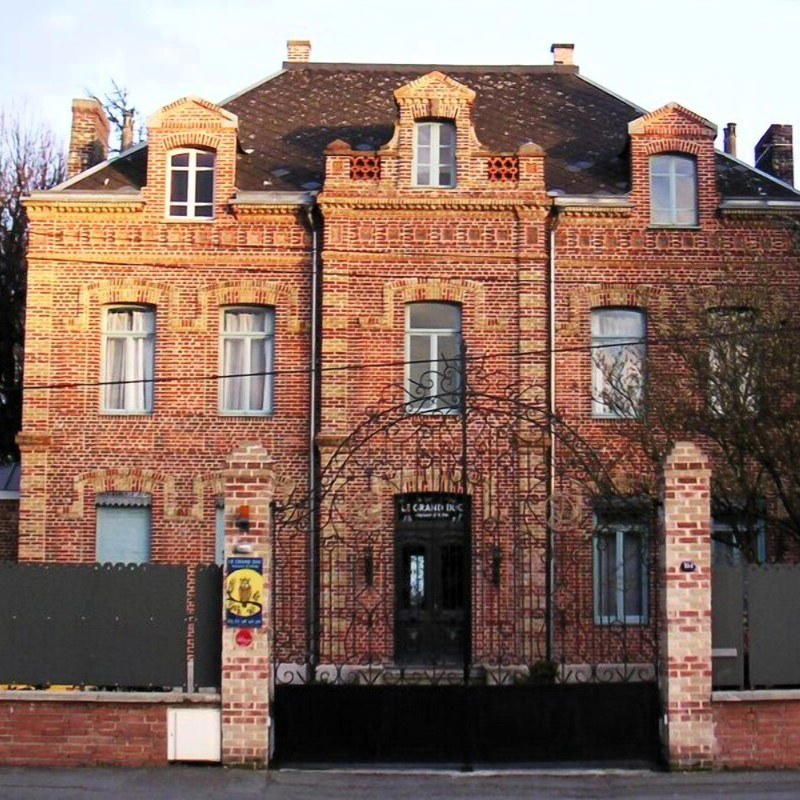
Bars in Valenciennes
Browse all →
Restaurants in Valenciennes
All restaurants in Valenciennes →
Wineries in Valenciennes
Browse all →
Details
- Elegant
- Sophisticated
- Classic
- Ornate
- Romantic Getaway
- Business Trip
- Weekend Escape
- Historic Building
- Terrace
- Pool
- Spa
- Fitness Center
- Room Service
- Concierge
- Wi Fi
- Wheelchair Accessible
Refined baroque chic with high ceilings, elegant lighting, and serene spa atmosphere praised for peace and luxury.