Our verdict
Shalom Makkabi sits on Ginnheimer Landstraße in Frankfurt's Ginnheim district, representing a strand of community-rooted dining that operates well outside the city's fine-dining circuit. The address places it in a residential quarter where regulars return out of habit rather than occasion, and the kitchen's identity is tied to tradition rather than trend.

Pearl is the En Primeur Club membership app, where members save venues, book tables and use the concierge.

The menu
What to order
- Grill Platter
- Grilled Salmon
- Lamb Chop
- Kotletkis
- Hummus with Falafel
- Homemade Lemonade
A Residential Address, A Different Kind of Frankfurt Dining
Frankfurt's dining conversation tends to gravitate toward the Sachsenhausen waterfront, the banking district's expense-account tables, or the handful of rooms chasing Michelin recognition. Ginnheim sits apart from all of that. The neighbourhood is low-key by design, a residential quarter on the city's western edge where the restaurants that survive do so on repeat custom rather than tourist traffic or corporate entertaining. Shalom Makkabi on Ginnheimer Landstraße 49 belongs to that fabric, and understanding what makes it worth attention requires reading it through that lens first.
Community-anchored restaurants in German cities operate under a different set of pressures than destination dining rooms. They are not competing with Aqua in Wolfsburg or Schwarzwaldstube in Baiersbronn for the international palate. They are competing for the loyalty of a postcode. That competition is in some ways harder: there is no awards shortlist to fall back on, no visiting critic to generate a spike in bookings. The kitchen earns its place by consistency and by offering something the neighbourhood cannot find elsewhere within walking distance.
The Physical Container and What It Signals
The EA-GN-13 editorial lens is worth applying here because, at this address, the space almost certainly does the communicative work that branding and press coverage do for higher-profile rooms. In Frankfurt's community dining tier, interiors tend to be functional rather than designed, shaped by decades of incremental decision-making rather than a single architectural vision. Tables are placed for density and conversation, not theatre. Lighting is warm enough to be welcoming without being atmospheric in the curated sense. These are spaces where the room recedes so the meal and the table can advance.
That kind of interior logic is not accidental, and it should not be read as a lesser choice. Some of Frankfurt's most deliberate dining rooms, such as the stripped-back dining spaces you find in contrast to the formal grandeur of Vendôme in Bergisch Gladbach, make a point through restraint. At the neighbourhood level, restraint is the default, and a venue that has maintained a presence on a residential street earns its own kind of credibility through durability rather than design awards.
Where Shalom Makkabi Fits in Frankfurt's Broader Dining Map
Frankfurt carries a particular culinary duality. On one side, there is a confident fine-dining tier: rooms with serious wine lists, tasting menus, and the kind of kitchen rigour you find at JAN in Munich or CODA Dessert Dining in Berlin. On the other side, the city's immigrant-community restaurants carry a different authority, one rooted in specificity of tradition rather than technical ambition. Shalom Makkabi operates in the space where those two strands rarely intersect, where the food is tied to a cultural identity rather than a culinary movement.
Frankfurt's Jewish community has a long and complicated history in the city, and restaurants carrying that identity are rare enough that their presence is notable in itself. The name signals a connection to Jewish cultural life through the Makkabi sports and cultural association, which has roots across Central and Eastern Europe. In that context, Shalom Makkabi is not simply a restaurant on a residential street; it is one of the few addresses in the city where food and community memory are explicitly linked. That context belongs in any serious reading of what the address offers.
For comparison across Frankfurt's broader neighbourhood dining circuit, venues like Ambassel and Ariston also operate in the community-anchored tier, each tied to a specific culinary and cultural identity. The pattern across all of them is similar: longevity built on regulars, kitchens that resist trend-chasing, and spaces that prioritise function over statement. ALEJANDRO'S and atm by Deli&Grape represent different positions in Frankfurt's mid-range, where the design and the concept are more deliberately crafted. Shalom Makkabi sits on the other side of that divide.
What the Address Implies for the Visit
Ginnheimer Landstraße is a direct tram or bus ride from the city centre; the neighbourhood is accessible without being a detour destination. That matters for how you frame a visit. This is not a room you book months ahead or dress for; it is a room you include because of what it represents in Frankfurt's dining plurality, and because the experience of eating in a community restaurant rather than a destination one is genuinely different in texture and in tempo.
Across Germany's dining scene, the most formally decorated rooms, places like Victor's Fine Dining by Christian Bau in Perl, Waldhotel Sonnora in Dreis, or Restaurant Haerlin in Hamburg, operate within a legible premium framework that international visitors understand immediately. Venues like Shalom Makkabi require a different frame. The value is in specificity, in the cultural and social context that the address carries, rather than in a format the Michelin Guide or 50 Best would recognise. That is not a lesser thing. It is a different thing, and often a more interesting one for a visitor who has already covered Frankfurt's formal tier.
Other Frankfurt restaurants worth placing in the same visit context include Allgaiers Restaurant, which operates at a different point in the neighbourhood-dining register. For the full picture of where the city's dining sits across formats and price points, the EP Club Frankfurt restaurants guide maps the range in detail. Elsewhere in Germany, Schanz in Piesport and ES:SENZ in Grassau represent the country's technically ambitious end, useful reference points for understanding how far Frankfurt's community dining tier sits from the fine-dining axis. And for a global perspective on what highly engineered dining rooms look like, Le Bernardin in New York City and Atomix in New York City show the opposite end of the spectrum entirely.
Do they take walk-ins at Shalom Makkabi?
No booking policy data is available for Shalom Makkabi. Community-oriented restaurants in Frankfurt's residential neighbourhoods often operate with a more informal approach to reservations than the city's destination dining rooms, but this cannot be confirmed without direct contact. Given its Ginnheim address rather than a high-footfall city-centre location, spontaneous visits are more plausible here than at, for example, a tightly booked counter in Frankfurt's Innenstadt.
What is the standout thing about Shalom Makkabi?
The most distinctive aspect is the cultural specificity of its positioning. Restaurants with an explicit connection to Jewish community life are rare in Frankfurt, and Shalom Makkabi's name ties it directly to the Makkabi association, a network with deep roots in Central European Jewish cultural history. That is a layer of context that no amount of kitchen technique or interior design can replicate, and it places the address in a category largely on its own within the city's dining geography. The cuisine and format support that identity rather than operating independently of it.
Is Shalom Makkabi connected to a wider cultural organisation?
The name Makkabi refers to a historically significant Jewish sports and cultural movement that spread across Central and Eastern Europe in the late nineteenth and early twentieth centuries, eventually establishing chapters in many German cities including Frankfurt. Shalom Makkabi's address on Ginnheimer Landstraße places it within the city's Jewish community infrastructure, making it a venue where the dining context is inseparable from that institutional and cultural history. For visitors with an interest in Frankfurt beyond its financial and fine-dining identity, this dimension gives the address a weight that goes well beyond the food itself.
Frequently asked questions
How do I find Shalom Makkabi?
Shalom Makkabi is located at Ginnheimer Landstraße 49, 60487 Frankfurt am Main, Germany, Frankfurt.
Is Shalom Makkabi in Frankfurt connected to the wider Makkabi cultural movement?
The name Makkabi refers to a historically significant Jewish sports and cultural organisation that took root across Central and Eastern Europe from the late nineteenth century onward, with a Frankfurt chapter among its established nodes. A venue carrying that name on Ginnheimer Landstraße suggests an affiliation with that community infrastructure rather than a purely commercial restaurant concept. Whether the dining operation functions as part of a club facility or as a standalone space is worth confirming directly before visiting.
What do regulars order at Shalom Makkabi?
Given the venue's cultural identity and address on Ginnheimer Landstraße in Frankfurt's residential west, the kitchen likely reflects the kind of cooking that sustains a community table rather than a rotating tasting format. Dishes rooted in Ashkenazi or Middle Eastern Jewish tradition would be a reasonable frame of reference.
Do they take walk-ins at Shalom Makkabi?
No booking policy is confirmed for Shalom Makkabi at this time. Restaurants in Frankfurt's residential neighbourhoods, particularly those tied to community organisations, often run on a more informal basis than city-centre venues, but contacting the venue directly before visiting is the safest approach. The Ginnheimer Landstraße address is accessible by tram from central Frankfurt.
What's the standout thing about Shalom Makkabi?
The cultural specificity of the Makkabi connection sets this address apart in Frankfurt. The Makkabi movement carries a documented history across Jewish communities in Central and Eastern Europe, and a dining venue operating under that identity occupies a distinct position in a city where explicitly Jewish cultural spaces remain relatively few. Frankfurt's broader dining map has nothing quite like it in terms of cultural framing.
At-a-Glance Comparison
Comparable venues nearby, for context on price, style, and recognition.
| Venue | Cuisine | Price | Notes |
|---|---|---|---|
| Shalom MakkabiThis venue (the venue you are viewing) | Kosher Israeli-Mediterranean Grill | $20–30 | Not listed |
| Hummus Küch' | Vegan Israeli Hummus Kitchen | $10–20 | Sachsenhausen |
| Babam | Traditional Persian | $20–30 | Roemerberg |
| Gilgamesch | Persian Middle Eastern | $20–30 | Palmengarten |
| Du Liban | Authentic Lebanese | $30–50 | Roemerberg |
| Mommona | Authentic Ethiopian & Eritrean | $20–30 | Roemerberg |
Continue exploring
More in Frankfurt
Restaurants in Frankfurt
All restaurants in Frankfurt →
Bars in Frankfurt
All bars in Frankfurt →
Hotels in Frankfurt
All hotels in Frankfurt →

Details
- Cozy
- Warm
- Family
- Group Dining
- Casual Hangout
- Celebration
- Private Event
- Terrace
- Private Dining
- Open Kitchen
- Beer Program
- Craft Cocktails
- Local Sourcing
- A La Carte
- Family Style
- Buffet
- Israeli Wines
- Craft Cocktails
- Homemade Lemonades
- Kosher
- Vegetarian Friendly
- Vegan Options
Current opening hours
- Monday
- 12–10 PM
- Tuesday
- 12–10 PM
- Wednesday
- 12–10 PM
- Thursday
- 12–10 PM
- Friday
- 12–7 PM
- Saturday
- Closed
- Sunday
- 12–10 PM
Hours can change for holidays and private events. Hours as of .
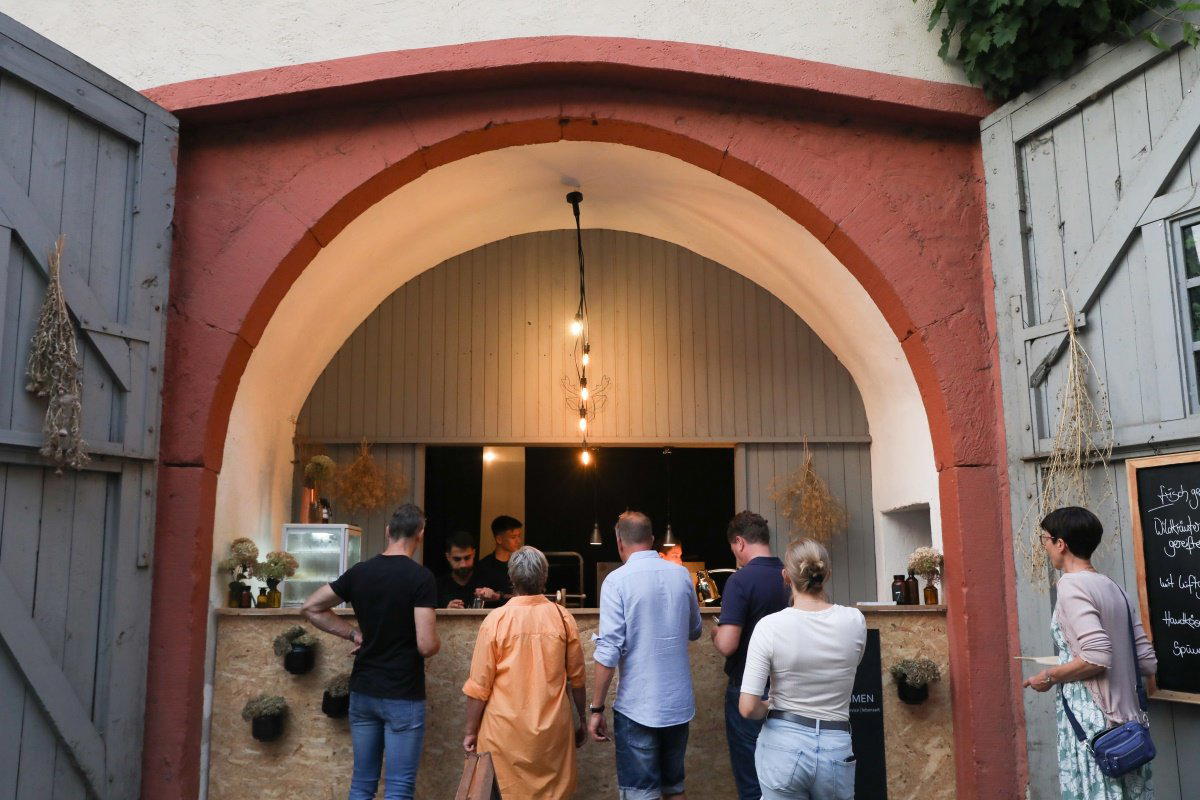
Cosy restaurant with terrace featuring warm, inviting lighting and a family-friendly atmosphere that blends traditional kosher dining with contemporary comfort.