Set inside a preserved 19th-century pharmacy building on Adelgade in central Randers, Restaurant det gamle apothek trades on its address as much as its kitchen. The former apothek format, with its architectural character intact, places it in a small category of Danish provincial dining rooms where the room itself does part of the editorial work. Visitors to Randers with an eye for setting should factor it into their planning.
Pearl is the En Primeur Club membership app — saves, bookings, and concierge access live there. Same editors, same standards.
- Address
- Adelgade 2, 8900 Randers C, Denmark
- Phone
- +4541101269
- Website
- restaurantdetgamleapothek.dk
- Directions
- Get directions
 Saves & bookings on Pearl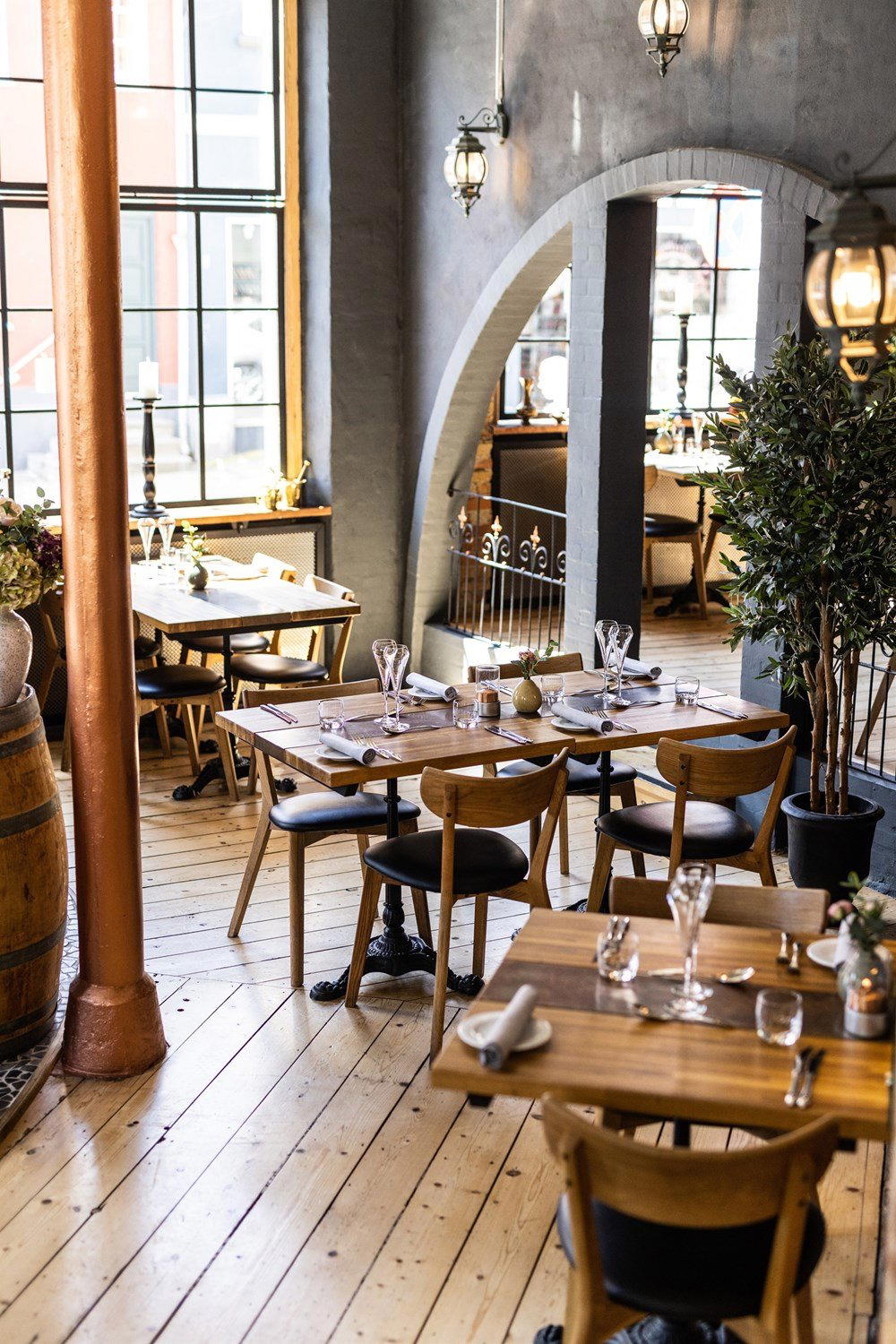
A Pharmacy Repurposed: What the Room Says Before the Food Arrives
In Danish provincial cities, the most interesting dining rooms are often found inside buildings that were never designed for the purpose. Randers has a handful of these conversions, and Adelgade 2 is among the more legible: a 19th-century pharmacy whose bones, presumed original cabinetry lines, high ceilings, and architectural detailing, have been put to use as a restaurant setting. The address, det gamle apothek, translates directly as "the old pharmacy," and the name functions less as branding than as a statement of fact. You are eating inside a piece of the city's commercial history.
This matters for a specific kind of traveller. Provincial Denmark has largely followed two paths in its restaurant stock: utilitarian dining rooms with no particular identity, and newer, design-led spaces built from scratch. A third, smaller category occupies genuinely historic interiors, and det gamle apothek fits there. The room arrives with meaning attached, and that changes what the experience asks of its kitchen.
Randers in the Danish Dining Picture
Randers sits on the Gudenå river in central Jutland, roughly equidistant between Aarhus to the south and the Himmerland region to the north. It is not a dining destination in the way that Copenhagen or Aarhus functions for visiting food travellers, but that framing understates what the city offers at the local and regional level. Denmark's serious fine dining is concentrated at places like Geranium in Copenhagen and Jordnær in Gentofte, with strong provincial representation from Frederikshøj in Aarhus, Henne Kirkeby Kro in Henne, and operations such as Alimentum in Aalborg, ARO in Odense, LYST in Vejle, Domæne in Herning, Dragsholm Slot Gourmet in Hørve, and Frederiksminde in Præstø. Randers does not compete in that award tier, but the city supports a dining scene that reflects the rhythms of a working Danish city: a mix of neighbourhood regulars, visiting business travellers, and locals marking occasions.
Within that local context, det gamle apothek occupies a distinct position. Its peers in the city include Bistroteket and Cafe Hugo on the more casual and bistro-oriented end, Bone's for grilled formats, and international options like Atami Sushi Restaurant and Banana Leaf. Among these, det gamle apothek's historic address gives it a different register, one that suits occasion dining more naturally than a weeknight casual visit.
The Sourcing Logic Behind Danish Provincial Cooking
The editorial angle that matters most for understanding a kitchen like this one is ingredient geography. Denmark's food culture over the past two decades has been shaped, at every level from Noma downward, by a growing emphasis on what grows, swims, and forages within reach. For provincial Jutland kitchens, this is not a trend adopted from Copenhagen; it is a practical condition. Central Jutland has direct access to freshwater fish from the Gudenå and its tributaries, game from the surrounding heathland and forests, root vegetables from some of Denmark's most productive agricultural land, and coastal seafood within a two-hour radius in most directions.
A kitchen operating on Adelgade, in a building with the name and provenance of det gamle apothek, is working inside that geography whether or not it explicitly markets around it. The question for any visitor is how deliberately the menu reflects those local supply lines. Danish kitchens that do this well, at any price point, tend to anchor their menus on what is available in a given season rather than building year-round consistency around imported product. The distinction matters particularly in autumn and early winter, when Jutland's game, root vegetables, and late-harvest produce converge.
For context on what sourcing discipline looks like at its most rigorous in Denmark, the gap between a place like Geranium and a provincial dining room is primarily one of investment in supplier relationships and kitchen technique, not of access to raw materials. Central Jutland producers supply serious Danish kitchens at multiple price points, and the ingredient quality available to regional restaurants is structurally strong. International reference points for sourcing-led cooking, such as Le Bernardin in New York City with its singular focus on seafood provenance, or Atomix with its documented producer relationships, show what ingredient intentionality looks like at the highest expression. Provincial Danish kitchens operate at a different scale, but the underlying logic, treating sourcing as the first creative decision, is increasingly shared across the tier.
What the Setting Signals About the Experience
Historic conversions in provincial Denmark tend to attract a specific kind of guest: someone for whom atmosphere and place matter as much as the food itself, and who is likely making a decision between a handful of options in the same city rather than travelling specifically for the meal. Det gamle apothek's Adelgade address places it in the pedestrianised commercial heart of Randers, close to the city's historic quarter. The building's identity as a former pharmacy does work that a purpose-built dining room cannot replicate: it arrives with age, with a specific civic history, and with an implicit argument that the city's past is worth inhabiting rather than erasing.
For visitors approaching the Randers dining scene for the first time, our full Randers restaurants guide maps the city's options by format and occasion. Det gamle apothek is leading understood as the city's occasion-dining address with the strongest architectural identity, not as a destination in the Nordic fine dining sense, but as a room that earns its place in any serious local itinerary.
Planning Your Visit
The restaurant sits at Adelgade 2 in central Randers, within walking distance of the city's main pedestrian zone and accessible by rail from Aarhus in under 45 minutes. Seasonal timing in Jutland tends to favour visits in the autumn months, when regional produce is at its broadest and the historic interior reads particularly well against the shorter days.
Continue exploring
More in Randers
Restaurants in Randers
Browse all →
Bars in Randers
Browse all →
Hotels in Randers
Browse all →
Wineries in Randers
Browse all →

At a Glance
- Classic
- Cozy
- Date Night
- Business Dinner
- Historic Building
Current opening hours
- Monday
- 5 PM–12 AM
- Tuesday
- 5 PM–12 AM
- Wednesday
- 5 PM–12 AM
- Thursday
- 5 PM–12 AM
- Friday
- 5 PM–12 AM
- Saturday
- 5 PM–12 AM
- Sunday
- Closed
Hours can change for holidays and private events. Last verified .
Beautiful historic surroundings with warm, welcoming atmosphere and attentive service.
Know Before You Go
- Getting there
- Adelgade 2, 8900 Randers C, Denmark