Red Paperclip


1 Michelin Star
Our verdict
A Christopher Street storefront operating under a single red paperclip as its only exterior sign, Red Paperclip has climbed the Opinionated About Dining North America rankings three consecutive years, reaching #261 in 2025. Chef Kevin Chen channels Taiwanese heritage and a Queens upbringing through a farm-sourced New American format, with dishes that shift by season and carry Blue Hill at Stone Barns precision into a West Village register.

Pearl is the En Primeur Club membership app, where members save venues, book tables and use the concierge.
Christopher Street and the Economics of the Set Menu
America's relationship with the prix fixe has always been ambivalent. The format arrived with French fine dining and spent decades signalling occasion, formality, and a specific kind of deference to the chef's judgment. Then à la carte democratised the dining room, and set menus retreated to a narrow tier occupied by places like The French Laundry in Napa, Alinea in Chicago, and Per Se in New York, where the ticket price made the commitment explicit. What has changed in the last decade is a third category: small, independent rooms with strong farm sourcing and seasonal constraints that make à la carte impractical and the prix fixe philosophically coherent rather than just prestigious.
Red Paperclip, which opened on Christopher Street in the West Village after Chef Kevin Chen built his reputation through a series of pop-ups, sits in that third category. The format is driven by what the kitchen can source and sustain across a service rather than by a desire to position the restaurant upmarket. That distinction matters when reading the room.
What the Rankings Say About the Tier
Opinionated About Dining, the crowd-sourced ranking platform with a reputation for surfacing technically serious restaurants outside the Michelin-and-50-Leading axis, listed Red Paperclip as Recommended in 2023, then ranked it #288 in North America in 2024, and moved it to #261 in 2025. That three-year upward trajectory on OAD is a meaningful signal. The list rewards consistency and repeat visits from knowledgeable diners rather than a single splashy opening moment, which means the kitchen has held its standard and kept the room interested.
It is not competing with Masa or Eleven Madison Park on ceremony or price; it is competing on the quality of sourcing decisions and the coherence of a cuisine that synthesises multiple influences into a consistent point of view.
The Cuisine and the Set Menu Argument
The New American category has always been a broad tent. At one end sit steakhouse-adjacent rooms where the label means little more than geographic origin. At the other end sit kitchens where the term implies serious engagement with American produce, regional traditions, and the chef's own biographical ingredients. Red Paperclip belongs to the latter group.
Chef Kevin Chen trained at Blue Hill at Stone Barns, the Pocantico Hills operation where farm integration is not decorative but structural. That training produced a kitchen that treats local farm relationships as the foundation of menu planning rather than as a marketing footnote. The Taiwanese heritage and Queens upbringing that inform Chen's cooking are not separate from that sourcing commitment; they determine how the produce is handled once it arrives. A parsnip puree with celtuce ribbons finished tableside with chilled cucumber broth and chive oil is a dish that could exist only at the intersection of those coordinates: Hudson Valley winter produce, East Asian textural instinct, and fine-dining technique.
The Hainanese chicken preparation is another documented example. Hainanese chicken rice is a dish with a precise set of requirements in its Southeast Asian context, and reinterpreting it alongside a pickled salad in a West Village dining room requires confidence in what you are adapting and why. These are not fusion gestures; they are considered translations, which is exactly the kind of editorial position that makes a set menu format honest rather than arbitrary.
Elsewhere in New York, the farm-to-table argument has been tested by restaurants that adopted the language without the supply chain rigour. ABC Kitchen built an early reputation on local sourcing at a mid-range price point. Craft made the ingredient-first approach central to its identity in a different era. What distinguishes the current generation of small, chef-driven rooms is that the sourcing is inseparable from the format: you cannot run a seasonal menu that rotates genuinely without committing to a structure that gives the kitchen control over what each diner eats. The prix fixe is not an affectation at Red Paperclip; it is the logical consequence of how the kitchen operates.
West Village Context
Christopher Street in the West Village is not a restaurant row in the conventional sense. The neighbourhood has a density of ambitious independent rooms, but they tend to operate without the foot-traffic theatrics of the Meatpacking District or the destination-dining gravity of the Upper East Side. The Four Horsemen in Williamsburg and Beauty and Essex represent different points on New York's independent dining spectrum; the West Village version tends toward quieter rooms with deliberate menus.
Red Paperclip's exterior reinforces that register. The only exterior sign is the large red paperclip mounted on a narrow storefront. There is no awning, no chalkboard, no glowing logo. That kind of minimal identification is increasingly a marker of a room that has decided its audience will find it and is not optimising for walk-in volume. It is the same logic that applies to natural wine bars in Paris's 11th arrondissement or to small omakase counters in Ginza: the format requires a committed diner, and the exterior design self-selects for that.
Comparison: Set Menu Format and Price Tier in New York
| Venue | Format | Cuisine | Price Tier | OAD / Award Signal |
|---|---|---|---|---|
| Red Paperclip | Prix fixe (implied by format) | New American / Taiwanese-influenced | Not published | OAD #261 North America (2025) |
| Atomix | Prix fixe | Modern Korean | $$$$ | Multiple 50 Best appearances |
| Le Bernardin | Prix fixe / à la carte hybrid | French seafood | $$$$ | Three Michelin stars |
| Clocktower | À la carte | British-American | $$$ | Recognised by named publications |
| Lazy Bear in San Francisco | Prix fixe, communal | New American | $$$$ | Michelin-starred |
The table illustrates a pattern visible across the American fine-dining circuit: prix fixe correlates with both the highest price tier and, increasingly, with chef-driven rooms at lower price points where seasonal integrity requires menu control. Red Paperclip sits closer to the latter model, alongside peers like Single Thread Farm in Healdsburg and Providence in Los Angeles in terms of sourcing philosophy, even if the format and scale differ. Nationally, the argument has been made by rooms ranging from Emeril's in New Orleans to The Inn at Little Washington and Bayona in New Orleans that the set menu, when grounded in genuine sourcing, is a form of editorial honesty rather than a revenue mechanism.
Planning Your Visit
Red Paperclip operates Tuesday through Thursday from 5:30 PM to 10 PM, with Friday and Saturday service extending to 11 PM. The restaurant is closed on Sunday and Monday. Booking method and price range are not published by the venue; the OAD recognition suggests the room operates at a level where advance reservations are advisable. For broader planning in the city, EP Club maintains guides to New York City restaurants, hotels, bars, wineries, and experiences.
Frequently asked questions
Is Red Paperclip good for families?
Is Red Paperclip better for a quiet night or a lively one?
What do regulars order at Red Paperclip?
Where the Accolades Land
A small set of peers for context, based on recorded venue fields.
| Venue | Cuisine | Price | Awards | Notes |
|---|---|---|---|---|
| Red PaperclipThis venue (the venue you are viewing) | Modern Taiwanese-American Fine Dining | $50–100 | 1 Michelin Star | Not listed |
| Le Bernardin | French Seafood Fine Dining | $300–500 | 3 Michelin Stars · World's 50 Best #13 | French, Seafood |
| Atomix | Modern Korean Tasting Menu | $300–500 | 2 Michelin Stars · World's 50 Best #7 | Modern Korean, Korean |
| Masa | Seasonal Hokkaido Tempura Omakase | $150–200 | Tabelog 100 #34 | Sushi, Japanese |
| Per Se | French Fine Dining Tasting Menu | $300–500 | 3 Michelin Stars · World's 50 Best #40 | French, Contemporary |
| Eleven Madison Park | Contemporary Plant-Based Fine Dining | $300–500 | 3 Michelin Stars · World's 50 Best #4 | French, Vegan |
Recognition history
Dated appearances from independent guides and award organizations, with the underlying list record or original source where available.
Michelin 1 Star
Michelin
Opinionated About Dining Top Restaurants in North America Recommended
Opinionated About Dining
Full recognition history (5 entries)
Opinionated About Dining Top Restaurants in North America Ranked #261
Opinionated About Dining
Opinionated About Dining Top Restaurants in North America Ranked #288
Opinionated About Dining
Opinionated About Dining Top Restaurants in North America Recommended
Opinionated About Dining
Continue exploring
More in New York City
Restaurants in New York City
All restaurants in New York City →
Bars in New York City
All bars in New York City →
Details
- Intimate
- Modern
- Minimalist
- Date Night
- Special Occasion
- Open Kitchen
- Local Sourcing
- Tasting Menu
- A La Carte
Current opening hours
- Monday
- Closed
- Tuesday
- 5:30–10 PM
- Wednesday
- 5:30–10 PM
- Thursday
- 5:30–10 PM
- Friday
- 5:30–11 PM
- Saturday
- 5:30–11 PM
- Sunday
- Closed
Hours can change for holidays and private events. Hours as of .
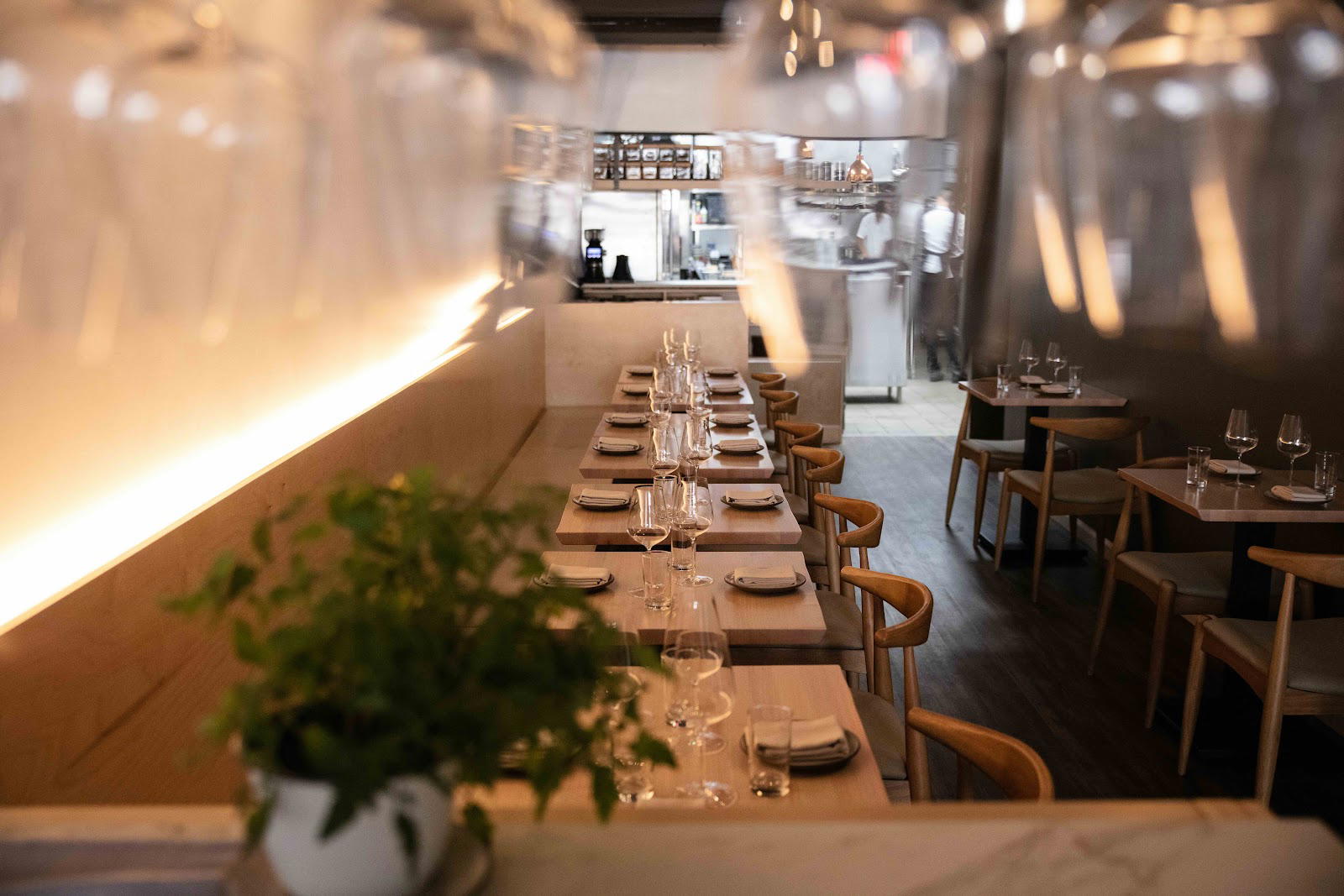
Simple, minimalistic decor focusing attention on the food, with a relaxed yet sophisticated atmosphere in a narrow, intimate space.