
Ramen Marusen places Musashi-Kosugi’s everyday ramen culture in a sharper frame: counter seating, ramen and dumplings, and recognition in Tabelog’s Ramen KANAGAWA 100 for 2024 and 2025. The draw is not luxury ceremony but disciplined sourcing logic, quick turnover, and the kind of compact Kawasaki format where broth, noodles, and side orders carry the argument.
Pearl is the En Primeur Club membership app — saves, bookings, and concierge access live there. Same editors, same standards.
- Address
- 神奈川県川崎市中原区小杉町3-66
- Phone
- +81447222827
- Website
- ramen-marusen.com
 Saves & bookings on Pearl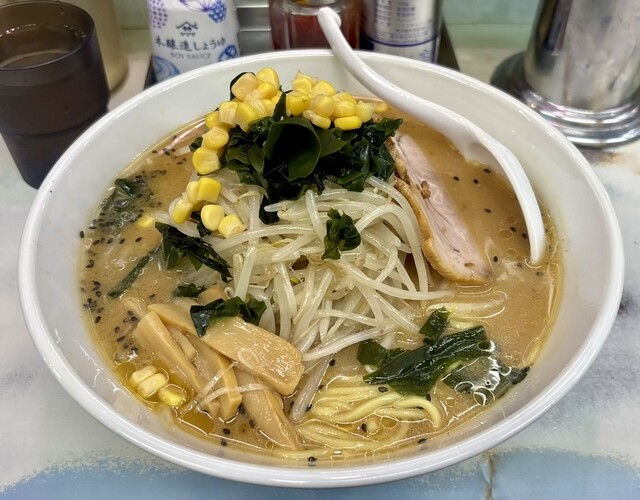
Musashi-Kosugi’s dining streets work at commuter rhythm: office workers, families, solo diners, and destination eaters moving between station exits and compact counters. In that setting, ramen is not a long-form restaurant performance. It is a test of compression: broth, noodle, tare, aroma oil, toppings, and timing all asked to make sense within minutes. Ramen Marusen belongs to that practical Kawasaki tradition, with a 13-seat counter-only room and a menu frame that keeps the focus on ramen and dumplings rather than spectacle.
Kanagawa ramen has a different centre of gravity from Tokyo’s headline counters. The prefecture has Yokohama’s iekei lineage, coastal and inland neighbourhood shops, and commuter-city bowls built for repeat use rather than tasting-menu theatre. Kawasaki sits inside that ecology: close enough to Tokyo for comparison, distinct enough to reward local loyalty. Recognition in Tabelog’s Ramen KANAGAWA 100 in both 2024 and 2025 places this shop in a curated prefectural group rather than a generic station-area category, which matters in a region where ramen strength is distributed across towns, not concentrated in a single dining district.
A counter format where sourcing has to show in the bowl
Ingredient sourcing in ramen is rarely announced with the same vocabulary used by kappo or sushi counters, but it is just as exposed. A ramen shop can hide little: soup base, seasoning, noodle texture, fat, and garnish all sit in plain view, and weak procurement shows quickly. The format rewards operators who keep the ingredient chain tight and the menu disciplined. Here, the available categories are ramen and dumpling, a narrow scope that suits a counter of this size. It suggests a kitchen built around repetition, heat management, and turnover rather than a broad izakaya-style spread.
That restraint is useful for travellers trying to understand Kawasaki eating. A city like this does not need another restaurant attempting to imitate Ginza formality. Its better casual rooms tend to perform a different job: feeding regulars at a high enough level that outside recognition follows. Ramen Marusen’s Tabelog score of 3.71 and inclusion on the 2025 Kanagawa ramen list give measurable support to that position, but the stronger point is structural. A small counter shop has to win on execution because the room offers few distractions.
Dumplings matter in this context. In ramen culture, gyoza is not a decorative extra; it is a signal of how a shop thinks about starch, fat, seasoning, and pace. A ramen-and-dumpling pairing turns a quick bowl into a fuller meal without shifting the restaurant into a multi-course format. For readers mapping the wider city, the contrast is instructive: Buta Boshi sits elsewhere in Kawasaki’s casual Japanese register, while Belmatine, C'EST UNE BONNE IDEE!, and Boulangerie Metier Pa-ku shiti musashi kosugi za ga-den show how Musashi-Kosugi’s food culture stretches from bread and Western-leaning formats to quick specialist counters.
Musashi-Kosugi rewards precision over ceremony
The neighbourhood context is important. Musashi-Kosugi has changed rapidly over the past two decades, with tower residential development, rail connectivity, and a growing all-day dining base. That kind of district can flatten into chain convenience, but ramen counters resist that flattening when they anchor themselves in local repeat business. A 13-seat counter-only setup suits solo dining and pairs naturally with the station-area rhythm: short meals, visible kitchen movement, and limited tolerance for drift.
Compared with Kawasaki peers in the same broad casual band, the pricing bracket sits in the accessible ramen zone rather than the special-occasion zone. Kayu Nabou reaches higher at dinner, while Menya Deko and Boulangerie Metier occupy lower or adjacent everyday ranges; L’atelier Hiro Wakisaka and Pan Jabi Daba share a similar casual spend bracket. Those comparisons are less about declaring a hierarchy than about reading the city correctly. Kawasaki’s appeal is range: ramen counters, bakeries, curry, Vietnamese cooking, and small Western-leaning kitchens all operate close to daily life. For a wider map, [Our full Kawasaki restaurants guide]() is the useful starting point, with neighbouring planning context in [Our full Kawasaki hotels guide](), [Our full Kawasaki bars guide](), [Our full Kawasaki wineries guide](), and Our full Kawasaki experiences guide.
There is also a broader Japanese travel lesson here. Premium dining coverage often overweights reservation-only counters and omakase rooms, but Japan’s ingredient intelligence is just as visible in low-friction formats. Ramen asks suppliers, noodle makers, and kitchens to work in tight coordination; the diner sees only the final bowl, but the category depends on decisions made well before service. That is why a recognized Kanagawa ramen counter can be more revealing than another polished dining room on an itinerary already crowded with formal meals.
How to place it in a Japan food itinerary
For travellers moving through the country, Ramen Marusen makes sense as a Kawasaki-specific stop rather than a detour framed around grandeur. Pairing it with other local addresses gives a clearer read on the city than treating the meal as a standalone trophy. Shoku Vietnam widens the picture beyond Japanese categories, while the bakery and casual restaurant links above show how Musashi-Kosugi’s dining base serves residents first. That local-first quality is the point.
For comparison across Japan, the useful question is not whether a ramen counter resembles a Kyoto tasting room or a Tokyo grill, but what kind of precision each format demands. -Grilled beef Sukiyaki- KAMAKURA TANUKIAN 鎌倉 たぬき庵 in Kamakura builds around beef and sukiyaki ritual;. 鮪と炭火焼き うお炭 秋葉原店 in Tokyo points toward tuna and charcoal;.cafe in Osaka.know in Kumamoto, [[Curry Senmon Ten] Maruyama Kyoju. in Sapporo](https://www.enprimeurclub.com/restaurants/curry-senmon-ten-maruyama-kyoju-1054392), and [[ki:] in Kyoto](https://www.enprimeurclub.com/restaurants/ki-26035998) each make a different argument about specialization. Even abroad, [Jōdo Saké Bar in Los Angeles]() and [Onigiri Time in Pasadena]() show how Japanese formats travel when the core product is tightly defined.
The editorial case is simple: this is a compact Kawasaki ramen counter with prefectural recognition, a tight food scope, and a format that leaves ingredient choices exposed. Build it into a Musashi-Kosugi day when the plan calls for local specificity rather than ceremony.
Side-by-Side Snapshot
Comparable venues by cuisine and price in the same metro.
| Venue | Cuisine | Price | Notes |
|---|---|---|---|
| Ramen MarusenThis venue — the venue you are viewing | Traditional Ramen Shop | $ | Not listed |
| Hikage | Ramen shop in Shin-Kawasaki | $ | Saiwai-ku |
| noodles kitchen GUNNERS | Ramen shop (clam-broth focus) | $ | Nakahara-ku (Musashi-Kosugi Area) |
| San San Nana | Tsukemen & ramen shop | $ | Kawasaki Station area |
| Teuchi Chuka Soba Sakata | Handmade Chuka Soba Ramen | $ | Kawasaki-ku |
| Ramen Jiro Ikuta ekimae ten | Jiro-style Ramen Shop | $ | Tama-ku |
Recognition history
Dated appearances from independent guides and award organizations, with the underlying list record or original source where available.
Tabelog 100 #27 · No. 27
Tabelog · Tabelog 100 - Ramen - KANAGAWA - 2025











At a Glance
- Classic
- Cozy
- Lively
- Well Known
- Solo
- After Work
- Casual Hangout
- Late Night
- Standalone
- Local Sourcing
- Street Scene
A nostalgic, old-school ramen shop with a bright yellow exterior sign and simple counter-style interior, creating a cozy yet lively atmosphere typical of traditional neighborhood ramen-ya.