
A Michelin one-star Beijing cuisine address on the East Third Ring Road, Poetry·Wine delivers braised fish head, chargrilled roast duck, and creamed yam at a price point that sits well below the capital's top-tier Beijing cuisine peers. Bamboo, jade ornaments, and ink paintings create an atmosphere that reads expensive without pricing that way — making it one of the more accessible starred entries in the city.
 Discover on Pearl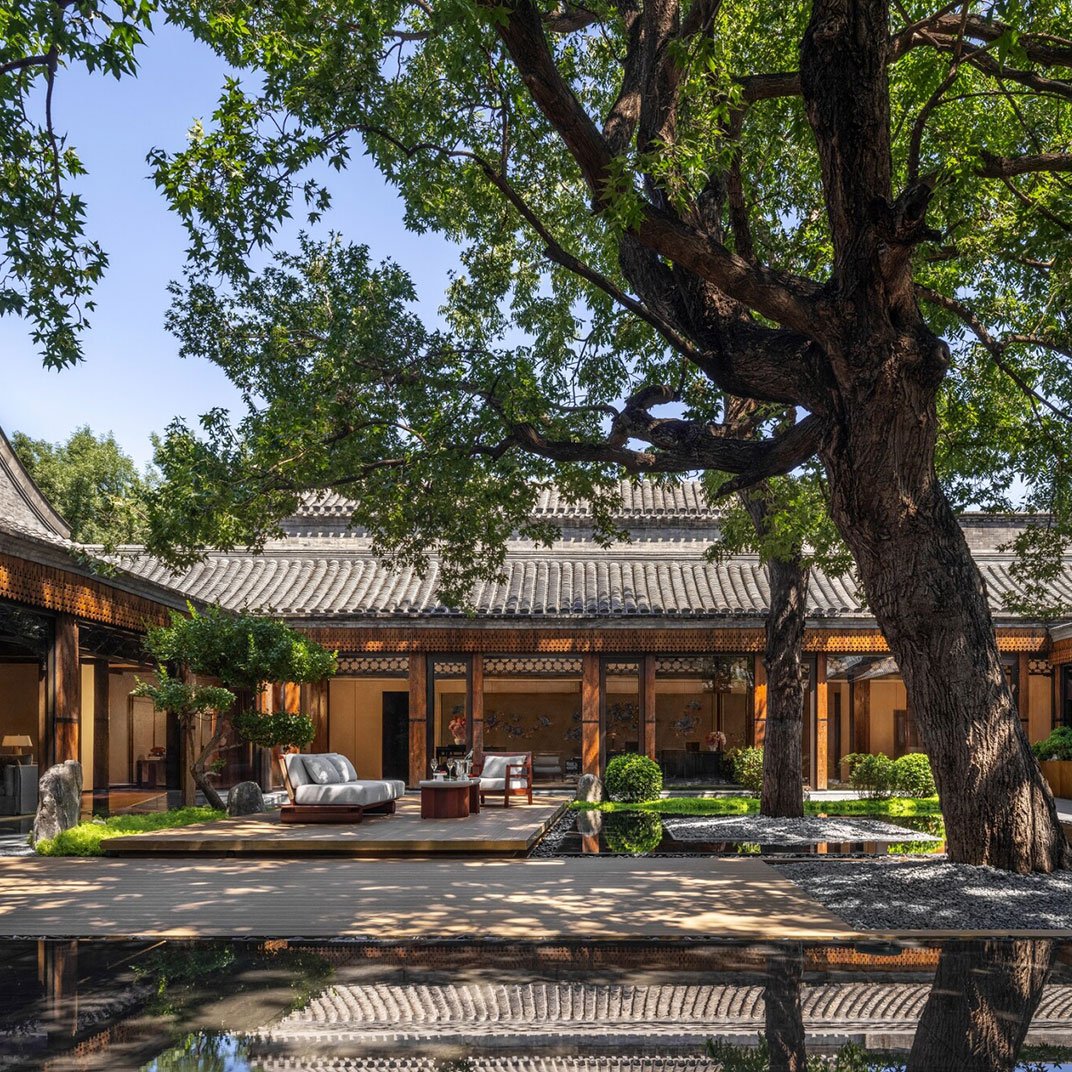
Atmosphere and First Impressions on the East Third Ring
The stretch of Dongsanhuan Middle Road in Chaoyang is not where most visitors expect a Michelin-starred dining room. The East Third Ring corridor is Beijing's commercial and diplomatic spine, dense with office towers, international hotels, and the kind of mid-range restaurant blocks that cater to after-work crowds. Poetry·Wine occupies a position on this strip that requires a moment of recalibration when you step inside. Bamboo installations, jade ornaments, ink paintings, and cut flowers signal a design language borrowed from classical Chinese literati aesthetics — the scholar's studio transposed into a restaurant interior. The effect is composed and deliberate, the kind of atmosphere that in most cities would accompany a check average two or three tiers higher.
That gap between visual register and price point is one of the more interesting things about the Beijing starred dining scene. At the ¥¥ tier, Poetry·Wine sits significantly below peers in the same cuisine category: Jingji, which occupies the ¥¥¥¥ band, represents what the market typically asks for Beijing cuisine at Michelin recognition level. The fact that a one-star kitchen operates at this price range says something meaningful about Poetry·Wine's positioning — and about the breadth of Beijing's starred dining tier, which is wider and more price-diverse than comparable scenes in Shanghai or Guangzhou.
The shortlist, unlocked.
Hard-to-book tables, cellar releases, and concierge-planned trips.
Get Exclusive Access →What Beijing Cuisine Actually Means Here
Beijing cuisine as a category covers a wider territory than the roast duck monoculture that tourism tends to reduce it to. The tradition draws on imperial court cooking, the Muslim Hui influence that shaped much of the city's lamb and braised preparations, and the northern Chinese preference for deep brown sauces built on fermented pastes, slow cooking, and aromatic complexity. Poetry·Wine's menu, as Michelin's inspectors describe it, reads as a clean articulation of this tradition rather than a reinvention of it.
The braised fish head arrives juicy and tender in an aromatic brown sauce , a preparation that is far more technically demanding than it looks. Keeping a braised fish head cohesive and deeply flavoured without the flesh turning dry or the sauce turning one-dimensional requires patience and precision in sauce-building. It is the kind of dish that separates kitchens that understand the braising canon from those that approximate it. For comparison, Sheng Yong Xing (Huangpu) in Shanghai represents how Beijing cuisine translates when it travels south, while Do It True (Xinyi) in Taipei shows the Taiwanese interpretation of the same tradition. Poetry·Wine's version is rooted in the source city.
The Duck, the Yam, and the Case for Ordering the Full Arc
Michelin's description of the roast duck specifies 40-day-old birds, chargrilled rather than the oven-roasted method that defines most Beijing duck houses. That distinction matters. The chargrilling process produces a different fat-render and skin texture than the hanging-oven approach associated with the most famous Beijing duck institutions. Whether one method is superior is a matter of taste, but the specificity of sourcing , birds at a defined age , indicates an approach to ingredient control that is consistent with how starred kitchens in this city think about their supply lines.
The creamed yam and osmanthus sweet soup completes what the kitchen seems to intend as a full tasting arc. Osmanthus is a flavouring with deep roots in Chinese dessert and beverage traditions, particularly in autumn, when the flower's honey-apricot fragrance peaks. Its pairing with yam in a sweet soup format is a deliberate soft landing after the density of the braised and roasted courses , and Michelin's inspectors single it out explicitly, which is the kind of detail that signals the kitchen treats dessert as part of the same conversation rather than an afterthought.
For a broader picture of how Beijing cuisine's starred restaurants handle the progression from savoury to sweet, Mansion Cuisine by Jingyan and Jing Hua Lou offer useful comparisons within the city. For classical northern noodle traditions at the other end of the price spectrum, Fortune Long Beijing Bean Sauce Noodles and Fu Man Yuan (Xinyuanli) show how deeply the capital's food culture extends across price tiers.
The Wine Question: What the Name Implies
The name Poetry·Wine is a direct reference to the classical Chinese literati pairing of poetry (shi) and wine (jiu) , two pleasures that Chinese scholar culture treated as inseparable. That framing raises expectations about the beverage program that the available data does not fully confirm. At the ¥¥ price range, a serious cellar with deep Chinese or international selection would be unusual, though not impossible for a Michelin-starred address. The more likely reality is a curated list calibrated to the price tier, probably weighted toward Chinese baijiu and rice wine alongside accessible imported options.
What the name does signal clearly is a deliberate positioning within a cultural register that takes beverage seriously as part of the dining experience. In the context of Beijing's starred scene, that matters. The capital's fine dining wine culture has matured considerably over the past decade, driven partly by a growing population of internationally trained sommeliers and partly by the same shift toward wine pairings with Chinese cuisine that has been documented at restaurants like 102 House in Shanghai, Ru Yuan in Hangzhou, and Xin Rong Ji in Chengdu. How aggressively Poetry·Wine pursues that pairing agenda at its price point is a question worth asking at the time of reservation.
For regional reference points where wine and Chinese cuisine are integrated at a higher investment level, Chef Tam's Seasons in Macau, Imperial Treasure Fine Chinese Cuisine in Guangzhou, and Dai Yuet Heen in Nanjing demonstrate how the pairing conversation plays out across the region's starred Chinese kitchens.
Where It Sits in Beijing's Dining Tier
Michelin's 2024 one-star designation places Poetry·Wine in a peer set that includes a wide range of cuisines and price points across the capital. Within the specific Beijing cuisine category, the one-star at ¥¥ is relatively rare. Most starred Beijing cuisine addresses operate at ¥¥¥ or above, reflecting the cost base of sourcing traditional ingredients, maintaining skilled kitchen teams for labour-intensive preparations, and occupying spaces designed to carry fine dining expectations. Poetry·Wine's ability to hold that recognition at a lower price band suggests an operational model that is lean without cutting into what ends up on the plate.
That cost discipline, combined with a design interior that reads several tiers above the price point, makes it an interesting case study in Beijing's mid-to-fine dining transition zone , a segment of the market where well-executed regional cuisine with Michelin credibility is gradually creating an alternative to the capital's expensive-by-default starred restaurants. Explore the full scope of what the city offers across our full Beijing restaurants guide, or broaden your trip planning through our full Beijing hotels guide, our full Beijing bars guide, our full Beijing wineries guide, and our full Beijing experiences guide.
Know Before You Go
- Address: 61 East 3rd Ring Middle Road, Chaoyang, Beijing (opposite Melody KTV)
- Cuisine: Beijing Cuisine
- Price range: ¥¥ (accessible for a Michelin-starred address)
- Recognition: Michelin 1 Star (2024)
- Dishes to order: Braised fish head in brown sauce; chargrilled roast duck (40-day-old birds); creamed yam with osmanthus sweet soup
- Getting there: The East Third Ring Road is well-served by Chaoyang-area metro lines; Jintaixizhao or Tuanjiehu stations are the nearest reference points
- Booking: Michelin recognition at this price tier generates demand disproportionate to what a ¥¥ address typically sees , confirm reservation in advance
Frequently Asked Questions
- What should I eat at Poetry·Wine (Dongsanhuan Middle Road)?
- The three dishes explicitly cited by Michelin inspectors are the braised fish head in aromatic brown sauce, the chargrilled roast duck from 40-day-old birds, and the creamed yam with osmanthus sweet soup. Order all three and treat them as a progression: the fish head is the technical centrepiece of the savoury courses, the duck is the showpiece, and the osmanthus sweet soup closes the meal in the classical Beijing tradition. The kitchen holds a 2024 Michelin one-star in Beijing cuisine, which gives these specific dishes particular authority as ordering anchors.
- Should I book Poetry·Wine (Dongsanhuan Middle Road) in advance?
- Yes. At the ¥¥ price range with a current Michelin star, Poetry·Wine attracts a volume of interest that exceeds what the walk-in model can absorb. Michelin recognition in Beijing reliably increases demand at any price tier, and the combination of accessible pricing and starred status creates a compressed booking window. If you are planning around a specific date, reserving several days in advance is the more reliable approach , particularly for weekend evenings.
- What is Poetry·Wine (Dongsanhuan Middle Road) leading at?
- The kitchen's case rests on its command of classical Beijing braising and roasting techniques: the braised fish head and chargrilled roast duck are the dishes that earned and sustain its Michelin one-star designation. What distinguishes it in context is that this level of execution is delivered at the ¥¥ price tier , a combination that is uncommon in Beijing's starred Chinese cuisine category, where most comparable kitchens operate at ¥¥¥ or ¥¥¥¥. The dessert program, represented by the osmanthus sweet soup, is treated with the same seriousness as the savoury courses.
Comparison Snapshot
A small set of peers for context, based on recorded venue fields.
| Venue | Cuisine | Price | Awards | Notes |
|---|---|---|---|---|
| Poetry‧Wine (Dongsanhuan Middle Road) | Beijing Cuisine | ¥¥ | Michelin 1 Star | This venue |
| Jing | French Contemporary | ¥¥¥ | Michelin 1 Star | French Contemporary, ¥¥¥ |
| Xin Rong Ji (Xinyuan South Road) | Taizhou | ¥¥¥¥ | Michelin 3 Star | Taizhou, ¥¥¥¥ |
| Chao Shang Chao (Chaoyang) | Chao Zhou | ¥¥¥¥ | Michelin 3 Star | Chao Zhou, ¥¥¥¥ |
| Lamdre | Vegetarian | ¥¥¥¥ | Michelin 1 Star | Vegetarian, ¥¥¥¥ |
| Jingji | Beijing Cuisine | ¥¥¥¥ | Michelin 2 Star | Beijing Cuisine, ¥¥¥¥ |
Need a table?
Our members enjoy priority alerts and concierge-led booking support for the world's most difficult tables.
Get Exclusive AccessThe shortlist, unlocked.
Hard-to-book tables, cellar releases, and concierge-planned trips.
Get Exclusive Access →