Patsy's Pizza
Our verdict
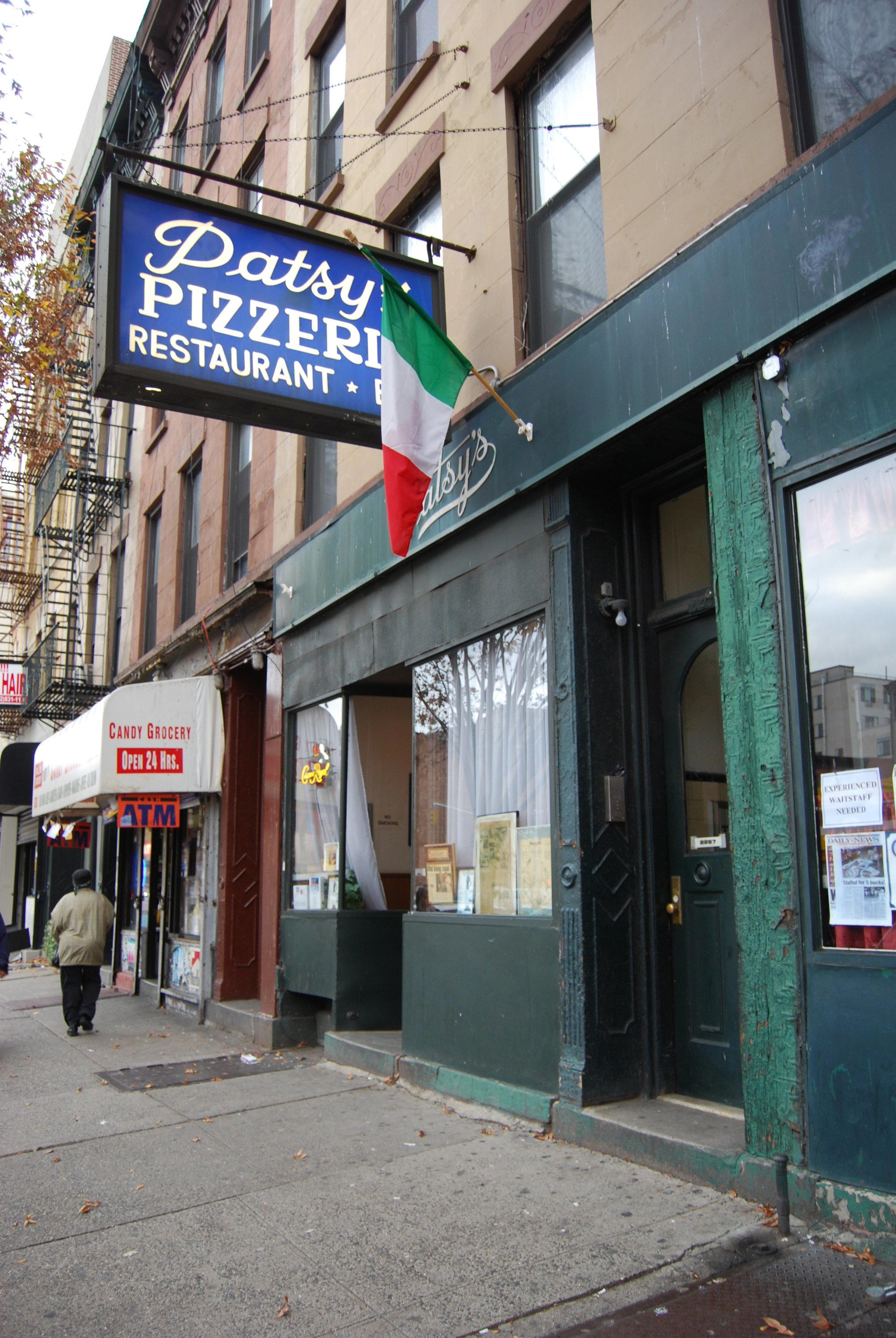
Patsy's Pizza on East Harlem's First Avenue has anchored New York's coal-fired pizza tradition since 1933, making it one of the oldest continuously operating pizzerias in the city. The thin-crust pies, blistered and charred at extreme heat, draw a loyal neighbourhood following that has sustained the place across generations. It sits in a different register from Manhattan's tasting-menu circuit, but occupies its own distinct tier of New York dining history.

Pearl is the En Primeur Club membership app, where members save venues, book tables and use the concierge.
The menu
What to order
- Classic New York Pizza
- Margherita
- White Cheese Pizza
- Old Fashioned Margherita Pizza
- Eggplant Parmigiana with Spaghetti
- Veal Chops Siciliano
East Harlem's Longest-Running Argument
New York's pizza debates tend to orbit a handful of fixed points, and Patsy's on First Avenue is one of them. Open since 1933, it predates the city's postwar pizza boom by two decades and the current artisan-pizza revival by the better part of a century. That longevity matters as context: the East Harlem original is not trading on nostalgia as a marketing device but on continuity as a demonstrable fact. The address at 2287 First Avenue has served coal-fired pies through the neighbourhood's various reinventions, and the regulars who fill the room on any given evening carry that history with them.
Coal-fired pizza occupies a specific position in the American pizza taxonomy. The oven temperatures reached by coal, routinely exceeding 800 degrees Fahrenheit, produce a crust that a gas oven cannot replicate: rapid charring on the underside, leopard-spotted blistering across the leading, a structural thinness that folds without collapsing. New York's original wave of Italian immigrant pizzerias in the early twentieth century was almost uniformly coal-fired, and the Patsy's on First Avenue represents one of the clearest surviving examples of that format in the borough of Manhattan.
What Keeps the Regulars Returning
The reliable tell of a neighbourhood institution is the gap between what's on the menu and what the regulars actually order. At a place operating for over ninety years, that gap has calcified into a kind of unwritten contract between kitchen and clientele. Patsy's regulars are not arriving to experiment with seasonal additions or to document the experience for an audience, they are arriving because the pie they want is the pie that has always been here.
That consistency is the core of the repeat-visit equation. In a city where restaurant openings generate cycles of hype and abandonment, a place that has held its position through nine decades of economic shocks, neighbourhood demographic shifts, and the full arc of American food culture is offering something that the new-opening circuit structurally cannot: a known quantity. The coal-fired margherita, the direct tomato application, the char-to-chew ratio on the crust, these are not variables for the regulars, they are the reason for the visit.
The East Harlem location also retains a neighbourhood character that distinguishes it from pizza operations that have expanded into multiple Manhattan outposts under the same name. The First Avenue address is the original, and regulars who have been coming for years tend to regard it as the reference point against which any other iteration should be measured.
Positioning in the New York Pizza Tier
It is worth establishing where a place like Patsy's sits relative to the broader New York dining circuit. The restaurants drawing international reservation traffic in Manhattan, Le Bernardin, Masa, Per Se, Atomix, Jungsik New York, operate in a tasting-menu, awards-circuit tier where the competitive set is global. Patsy's operates in a different tier entirely, one where the competitive set is historical rather than contemporary, and where longevity itself functions as the primary credential.
Across the United States, the venues that most reliably sustain multi-generational loyalty tend to be those that resist the pressure to modernise their core product. Blue Hill at Stone Barns near New York, The French Laundry in Napa, and Alinea in Chicago all sustain loyal followings through the opposite strategy, continuous reinvention. Patsy's demonstrates that the inverse can be equally effective when the founding product is strong enough to carry the weight of time.
The broader American fine-dining circuit, from Providence in Los Angeles to Addison in San Diego, Bacchanalia in Atlanta to The Inn at Little Washington, operates on tasting-menu rhythms and seasonal menu cycles. Patsy's is not in that conversation, but it is operating in a register that those restaurants cannot occupy. For our full guide to where Patsy's sits within New York's wider dining picture, see our full New York City restaurants guide.
Planning Your Visit
Patsy's East Harlem location on First Avenue is the original address, distinct from other establishments that use a similar name elsewhere in the city. Visitors should confirm they are heading to 2287 First Avenue in East Harlem, not to one of the separately operated pizzerias trading under a related name in Midtown or other neighbourhoods. The distinction matters both for historical authenticity and for the neighbourhood experience the original address provides.
East Harlem is accessible via the 6 train to 116th Street or 125th Street stations, placing the restaurant within a short walk. The neighbourhood itself has undergone significant change over the past two decades, but First Avenue in the low 100s retains a density of long-established businesses that gives it a different character from the more heavily gentrified corridors of Manhattan.
Quick Comparison: Coal-Fired Pizza Tier vs. Manhattan Tasting-Menu Tier
| Format | Price Signal | Booking Lead Time | Primary Draw |
|---|---|---|---|
| Patsy's Pizza (coal-fired, East Harlem original) | Casual / low | Walk-in friendly | Historical continuity, coal-fired crust |
| Le Bernardin / Per Se / Masa tier | $$$$ | Weeks to months ahead | Tasting menus, awards recognition |
| Mid-tier New York pizza (post-2010 artisan) | Moderate | Same-day to one week | Ingredient sourcing, format innovation |
Frequently asked questions
Where is Patsy's Pizza located?
Patsy's Pizza is located at 2287 1st Ave, New York, NY 10035, New York City.
How does the East Harlem Patsy's differ from other New York pizzerias using the Patsy's name?
The 2287 First Avenue address in East Harlem is the founding location, opened in 1933 by Pasquale 'Patsy' Lancieri, it is the original in any historically accurate sense. Other establishments operating under similar names in Midtown and elsewhere in New York City are distinct businesses with separate ownership and no direct operational continuity to that founding address. When New York pizza writers reference Patsy's in a historical context, they are referring to East Harlem.
What should I order at Patsy's Pizza?
The coal-fired margherita is the reference point at the 2287 First Avenue location, the thin crust and high-heat char from the original coal oven define what Patsy's has been doing since 1933. Regulars rarely deviate from it. Everything else on the menu is secondary to that baseline pie.
Do they take walk-ins at Patsy's Pizza?
The East Harlem original on First Avenue has historically operated as a walk-in-friendly neighbourhood pizzeria rather than a reservation-led destination. That walk-in format is part of what separates it from the tasting-menu tier that now dominates downtown Manhattan dining. Arriving early or off-peak hours is the practical approach.
What's the standout thing about Patsy's Pizza?
The founding date of 1933 at 2287 First Avenue is the concrete anchor, that places Patsy's among New York City's oldest continuously operating pizzerias, predating most of the debates the city now has about coal-fired technique. The coal oven itself is the technical constant that connects the current operation to Pasquale 'Patsy' Lancieri's original address.
Is Patsy's Pizza good for vegetarians?
Traditional New York coal-fired pizza menus centre on tomato-and-cheese pies with optional toppings, so the format at the First Avenue location is naturally compatible with vegetarian eating. The margherita is the house standard and contains no meat. Vegetarians are not making a compromise here, that pie is what the place is known for regardless.
Is a meal at Patsy's Pizza worth the investment?
Patsy's sits far below the tasting-menu tier that dominates Manhattan's awards circuit, this is a neighbourhood pizzeria, not a fine-dining destination, and the price point reflects that. What you are purchasing is access to a coal-fired tradition running continuously since 1933 in East Harlem, at an address that has outlasted most of the city's dining conversation. The value calculus is straightforward for anyone interested in New York pizza history.
City Peers
Comparable venues nearby, for context on price, style, and recognition.
| Venue | Cuisine | Price | Notes |
|---|---|---|---|
| Patsy's PizzaThis venue (the venue you are viewing) | Traditional New York Coal-Oven Pizza | $20–30 | Not listed |
| Serafina Long Island City | Italian Classics & Craft Cocktails | $30–50 | Queensbridge-Ravenswood-Dutch Kills |
| Becco | Regional Italian Trattoria | $50–100 | Hell's Kitchen |
| Juliana's | New York-Style Coal-Fired Pizza | $20–30 | Downtown Brooklyn-DUMBO-Boerum Hill |
| Adrienne's Pizzabar | Authentic New York Square Pizza | $20–30 | Financial District-Battery Park City |
| Novelli Cafe & Restaurant | Italian & Middle Eastern Fusion | Not listed | Crown Heights (South) |
Continue exploring
More in New York City
Restaurants in New York City
All restaurants in New York City →
Bars in New York City
All bars in New York City →
Details
- Well Known
- Classic
- Rustic
- Lively
- Casual Hangout
- Group Dining
- Family
- Late Night
- Historic Building
- Open Kitchen
- A La Carte
- Vegetarian Friendly
- Vegan Options
Current opening hours
- Monday
- 11 AM–10 PM
- Tuesday
- 11 AM–10 PM
- Wednesday
- 11 AM–10 PM
- Thursday
- 11 AM–11 PM
- Friday
- 11 AM–11 PM
- Saturday
- 11 AM–10 PM
- Sunday
- 12–10 PM
Hours can change for holidays and private events. Hours as of .