Becco
On Restaurant Row in Midtown Manhattan, Becco has anchored the pre-theatre dining circuit at 355 W 46th St since the 1990s, earning a loyal following for its Italian cooking and approachable wine program. The format suits those who want a proper sit-down Italian meal without the price pressure of Midtown's tasting-menu tier. A practical and dependable address in a neighbourhood better known for tourist traps.
Pearl is the En Primeur Club membership app — saves, bookings, and concierge access live there. Same editors, same standards.
- Address
- 355 W 46th St, New York, NY 10036
- Phone
- +12123977597
- Website
- becco-nyc.com
- Directions
- Get directions
 Saves & bookings on Pearl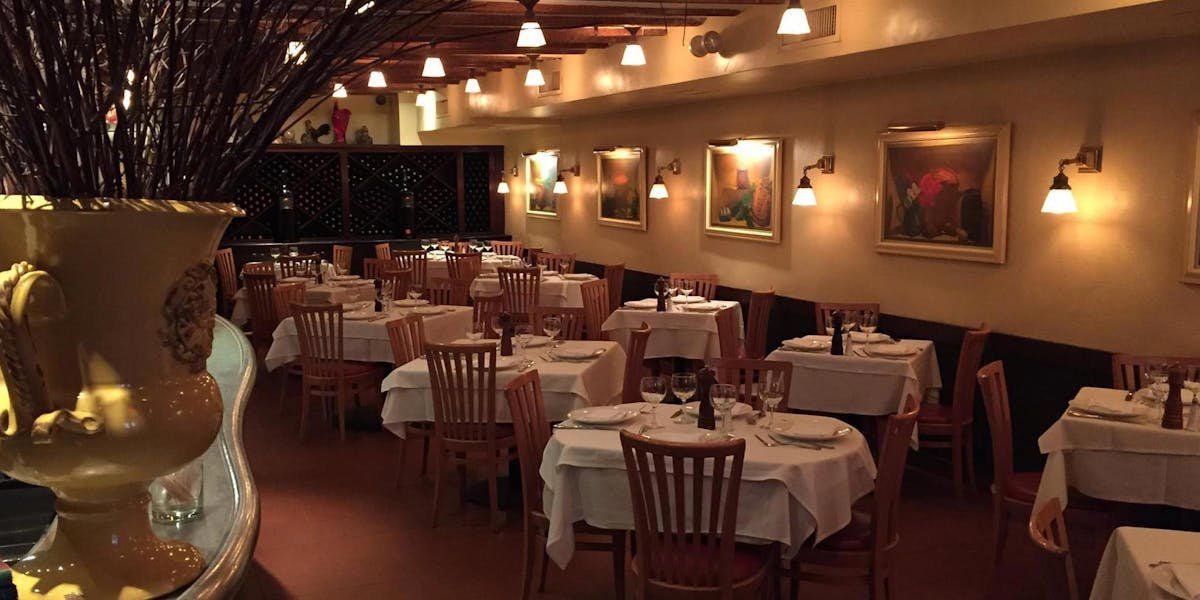
Restaurant Row's Italian Anchor
West 46th Street between Eighth and Ninth Avenues has carried the nickname Restaurant Row since the 1970s, a stretch that once defined accessible pre-theatre dining for New Yorkers heading to Broadway. The block has cycled through trends, closures, and changing ownership over the decades, but the principle remains: this is a street built around the practical contract between kitchen and curtain time. Becco, operating at 355 W 46th St, New York, NY 10036, belongs to that tradition, and its longevity on a block where turnover is high is itself evidence of the restaurant’s staying power.
Italian-American dining in New York splits broadly into two tiers: the white-tablecloth, multi-course format that competes in the same conversation as Le Bernardin or Per Se, and the neighbourhood-rooted trattoria model that prizes consistency and accessibility over ceremony. Becco operates in the latter category, and has done so with enough discipline to outlast most of its contemporaries on the Row. That consistency, across a dining room that fills and turns multiple times on a performance night, is harder to maintain than it looks.
The Format and How It Works
The Italian trattoria model that Becco follows has deep precedent both in New York and in Italy itself. In the Veneto and Emilia-Romagna, the salsiccia e primi format, where a kitchen rotates through a short list of pastas and secondi, priced to encourage volume and return visits, predates the tasting-menu era by centuries. New York adapted this into a fixed-price pasta model that became a signature move for mid-market Italian houses through the 1990s and 2000s. Becco's enduring pasta program fits squarely in that lineage.
For diners accustomed to the allocation-style booking required at Atomix or the months-ahead planning needed at Masa, the operational tempo at Becco is accessible, volume-capable, and structured around the neighborhood's pre-show rhythm.
The Team Dynamic: Kitchen, Floor, and the Wine List
In Italian dining rooms of Becco's generation, the relationship between kitchen output and front-of-house pacing is as important as any single dish. A pre-theatre room lives or dies on floor management: tables that turn at the right speed, servers who read the room's urgency correctly, and a wine program that can be navigated quickly without sacrificing quality. This coordination, across kitchen, sommelier, and service floor, is what separates a reliable neighbourhood Italian from a frustrating one.
Becco built its reputation in part on an unusually well-considered wine list for its price bracket, with a depth in Italian regional bottles that reflects genuine program investment. The Italian wine category rewards this kind of curatorial discipline: the country's regional complexity, from Friulian whites to Sicilian reds to the Nebbiolo-based bottles of Piedmont, gives a thoughtful list genuine range without requiring the budget of a four-star cellar. In the broader context of New York Italian dining, a wine program that takes Vermentino and Nerello Mascalese seriously alongside the Barolo and Brunello staples signals a kitchen-and-floor team that is speaking a shared language, rather than running parallel tracks.
This matters more on Restaurant Row than it might elsewhere. The pre-theatre diner is under time pressure; they need a sommelier or a floor manager who can make a confident recommendation in forty-five seconds. At the more contemplative end of New York dining, say, Eleven Madison Park or Blue Hill at Stone Barns, the sommelier's role is expansive and unhurried. At Becco, it is compressed and precise, and that compression is its own form of discipline.
Becco in the New York Italian Context
New York's Italian restaurant scene has expanded considerably since Becco opened, incorporating regional Calabrian, Sardinian, and Venetian cooking alongside the Roman and Neapolitan traditions that dominated earlier decades. The city now supports a range of Italian formats, from the counter-service pasta shop to the full-format Italian fine dining room. Becco sits in the mid-tier of that spectrum, in a position that is harder to occupy than it once was: the casual-but-serious Italian trattoria faces competition from fast-casual operators at the bottom and from more ambitious regional-Italian projects at the leading.
Those planning a comparative Italian dining trip might also look at Frasca Food and Wine in Boulder, which takes a different approach to Italian regional cooking in a US context, or Dal Pescatore in Runate for the source-country reference point. For the Italian Alpine tradition, Atelier Moessmer Norbert Niederkofler in Brunico represents a distinct contemporary direction that contrasts usefully with Becco's more conservative Italian-American register.
Among comparable US addresses in the mid-to-upper casual tier, Emeril's in New Orleans operates with a similar logic of accessible American regional cooking at scale, while Smyth in Chicago represents the more ambitious end of American regional cooking for context on where the category ceiling sits. Further up the ambition ladder on the West Coast, Lazy Bear in San Francisco, Providence in Los Angeles, Single Thread Farm in Healdsburg, and Addison in San Diego all occupy a different tier entirely. For the East Coast fine dining reference, The Inn at Little Washington and The French Laundry in Napa show what the ceiling of American formal dining looks like.
Same-City Peers
Comparable venues nearby, for context on price, style, and recognition.
| Venue | Cuisine | Price | Notes |
|---|---|---|---|
| BeccoThis venue — the venue you are viewing | Regional Italian Trattoria | $$ | Not listed |
| Water & Wheat Upper West | Fresh Pasta & Neapolitan Pizza | $$ | Upper West Side (Central) |
| Fiat Cafe | Authentic Italian Cafe | $$ | SoHo-Little Italy-Hudson Square |
| Altamirano's Italian Ristorante | Italian Trattoria | $$ | Upper East Side-Yorkville |
| Italianissimo Ristorante | Classic Italian Trattoria | $$ | Upper East Side-Yorkville |
| Paola's | Traditional Italian | $$ | Upper East Side-Carnegie Hill |
Continue exploring
More in New York City
Restaurants in New York City
Browse all →
Bars in New York City
Browse all →
Hotels in New York City
Browse all →





At a Glance
- Classic
- Elegant
- Well Known
- Sophisticated
- Date Night
- Business Dinner
- Group Dining
- Special Occasion
- After Work
- Standalone
- Historic Building
- Extensive Wine List
- Sommelier Led
Current opening hours
- Monday
- Closed
- Tuesday
- 4:30–10 PM
- Wednesday
- 11:30 AM–2:30 PM, 4:30–10 PM
- Thursday
- 4:30–10 PM
- Friday
- 4:30–11 PM
- Saturday
- 11:30 AM–2:30 PM, 4–11 PM
- Sunday
- 12–9 PM
Hours can change for holidays and private events. Last verified .
Warm, unhurried indulgence with rich, deep atmosphere; full around theater times with a neighborhood feel that balances sophistication with approachability.