Palace Saimin
Palace Saimin occupies a specific and durable place in Honolulu's dining culture: a counter-service institution on North King Street where the local noodle soup that helped define Hawaii's working-class food identity is served without ceremony or revision. Against Honolulu's growing roster of destination restaurants, it represents a deliberate counterpoint — a place where the dish, not the room, carries all the weight.
Pearl is the En Primeur Club membership app — saves, bookings, and concierge access live there. Same editors, same standards.
- Address
- 1256 N King St, Honolulu, HI 96817
- Phone
- (808) 841-9983
- Website
- palacesaimin.com
- Directions
- Get directions
 Saves & bookings on Pearl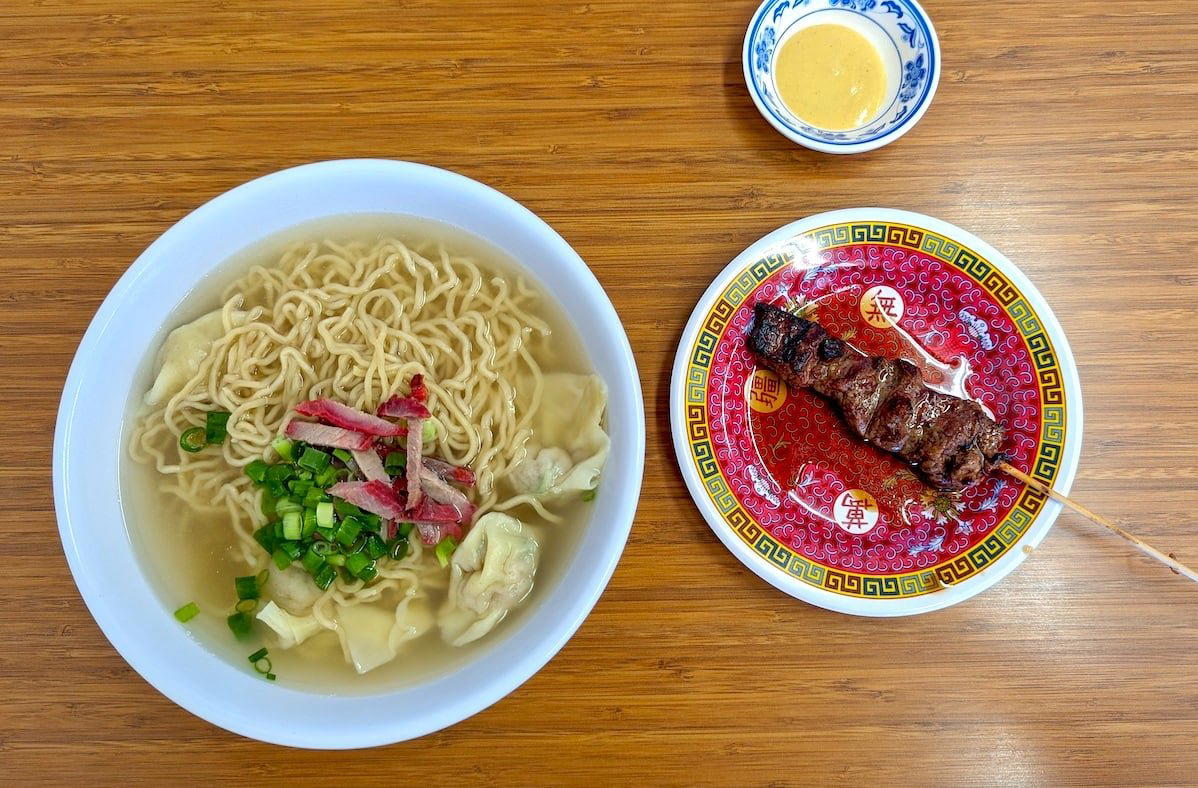
The Counter at the Centre of Something
North King Street runs through a stretch of Honolulu that doesn't attract much tourist traffic. The neighbourhood is functional, lived-in, and largely indifferent to the premium dining corridor that runs through Waikiki and the Kahala end of the island. It's precisely this context that makes Palace Saimin legible: a counter-service spot operating on a block where the clientele is local by default, not by aspiration. You're not here because a hotel concierge sent you. You're here because someone who grew up in Honolulu told you to go.
Saimin itself is worth understanding before the venue makes sense. It is, in the most direct terms, a noodle soup that emerged from Hawaii's plantation era, drawing from the food traditions of Japanese, Chinese, Filipino, and Korean immigrant communities who worked in close proximity and cooked from overlapping pantries. The broth is typically dashi-forward, the noodles wheat-based and slightly alkaline, and the garnishes often include char siu, fish cake, and green onion. It is not ramen, though mainland visitors sometimes reach for that comparison. It is a specifically Hawaiian form, shaped by a specific labour history, and it has been part of the state's food culture long enough that most residents have a strong opinion about whose version is correct.
Where Palace Saimin Sits in the City's Dining Spectrum
Honolulu's restaurant scene has developed considerable range in the past decade. Venues like Fête (New American) and 3660 On the Rise represent a local fine-dining tradition that draws on Pacific ingredients with serious technique. 53 By The Sea occupies the waterfront occasion-dining category. Further along the experiential spectrum, Ahaaina Luau and 855-ALOHA serve a different kind of appetite altogether. Palace Saimin does not compete with any of these formats. It occupies a category that has less to do with price tier or experience design and more to do with institutional longevity and community authority.
That positioning is not unusual in American cities with deep immigrant food histories. Spots that anchor a specific dish to a specific neighbourhood tend to develop a kind of cultural weight that is difficult for newer, more formally conceived restaurants to replicate. The equivalent logic applies in other food cities across the country: the long-running counter in the unglamorous part of town that has been making one thing for decades holds a different kind of credibility than the technically accomplished restaurant that references the same tradition. Honolulu has both types, and they serve different functions for the city's dining culture.
For readers familiar with the upper tier of American fine dining, places like The French Laundry in Napa, Le Bernardin in New York City, or Alinea in Chicago, the interest of a place like Palace Saimin is almost the inverse of what makes those restaurants compelling. Where venues like Single Thread Farm in Healdsburg, Blue Hill at Stone Barns in Tarrytown, or Providence in Los Angeles derive authority from credentials, technique, and critical apparatus, Palace Saimin derives authority from repetition, community endorsement, and the kind of institutional memory that only comes from operating in one place for a long time. The contrast is instructive. Neither model is superior; they are answering different questions about what a restaurant is for.
The Role of the Team in a Counter-Service Institution
The editorial angle of collaboration between kitchen, service, and front-of-house reads differently at a counter-service establishment than it does at, say, Atomix in New York City or Addison in San Diego, where the team dynamic is formalised, documented, and often cited in award citations. At a place like Palace Saimin, the equivalent dynamic is expressed in consistency rather than choreography. The discipline of producing the same bowl of noodle soup to the same standard, day after day, across a counter to a regular clientele that has developed exacting expectations, is its own form of team craft. The gap between a bowl that holds its character and one that doesn't is often a function of small decisions made across the kitchen at every service.
This is a pattern visible across long-running counter institutions in American cities with strong immigrant food traditions. The team dynamic in these environments tends to be less visible than in tasting-menu restaurants, but no less consequential. It shows up in timing, in portion calibration, and in the accumulated knowledge of what a regular expects without being asked. That kind of service intelligence is harder to build than it looks, and harder to maintain across staff changes and years of operation.
For context across other respected American dining institutions, Emeril's in New Orleans, Lazy Bear in San Francisco, The Inn at Little Washington in Washington, and 8½ Otto e Mezzo Bombana in Hong Kong all represent the formalised end of team-driven dining culture. Palace Saimin represents the informal end of the same impulse: a consistent product, delivered without ceremony, to an audience that would notice immediately if the standard slipped.
Why This Address Still Matters
The address at 1256 North King Street in Honolulu is not a destination in the way that a waterfront restaurant or a hotel dining room becomes one. It is destination-adjacent: a place you go to if you're already oriented toward what Honolulu actually eats rather than what Honolulu serves to visitors. The distinction matters more in Hawaii than in most American cities, because the gap between tourist-facing and local-facing food is more pronounced here. Saimin is almost entirely absent from the tourist circuit, which is part of what makes the category credible to local diners.
Anyone spending time in Honolulu who is interested in how the city's food culture was formed, rather than simply what its restaurants currently offer, would find Palace Saimin a more instructive hour than many of the more formally celebrated addresses. See our full Honolulu restaurants guide for the broader range of what the city offers across all price tiers and formats.
Know Before You Go
| Address | 1256 N King St, Honolulu, HI 96817 |
|---|---|
| Cuisine | Saimin (Hawaiian noodle soup) |
| Format | Counter service |
| Booking | Walk-ins standard for this format |
| Neighbourhood | North King Street corridor, away from the tourist-facing dining districts |
How Palace Saimin Honolulu compares with similar nearby venues.
| Venue | Cuisine |
|---|---|
| Helena Hawaiian Foods | Hawaiian |
| Liliha Bakery | Bakery |
At a Glance
- Classic
- Well Known
- Rustic
- Casual Hangout
- Solo
- Family
- Open Kitchen
- Standalone
- Historic Building
- Local Sourcing
Current opening hours
- Monday
- Closed
- Tuesday
- 10 AM–8 PM
- Wednesday
- 10 AM–8 PM
- Thursday
- 10 AM–8 PM
- Friday
- 10 AM–8 PM
- Saturday
- 10 AM–3 PM
- Sunday
- Closed
Hours can change for holidays and private events. Last verified .
Minimalist tan-painted cinder block interior with simple communal and individual tables, dim lighting, and an open kitchen window where food is served; nostalgic and unpretentious working-class atmosphere.
Know Before You Go
- Getting there
- 1256 N King St, Honolulu, HI 96817