Tabelog 100 #33
Our verdict
Ningyocho Imahan has anchored Tokyo's Nihonbashi neighbourhood for well over a century, serving sukiyaki and shabu-shabu built around Kuroge Wagyu beef with sourcing practices that predate the modern farm-to-table conversation. The restaurant occupies a distinct tier among Tokyo's traditional beef houses: deeply rooted in place, practised in restraint, and consistently referenced as a benchmark for the form.

Pearl is the En Primeur Club membership app, where members save venues, book tables and use the concierge.
Where Nihonbashi Keeps Its Oldest Habits
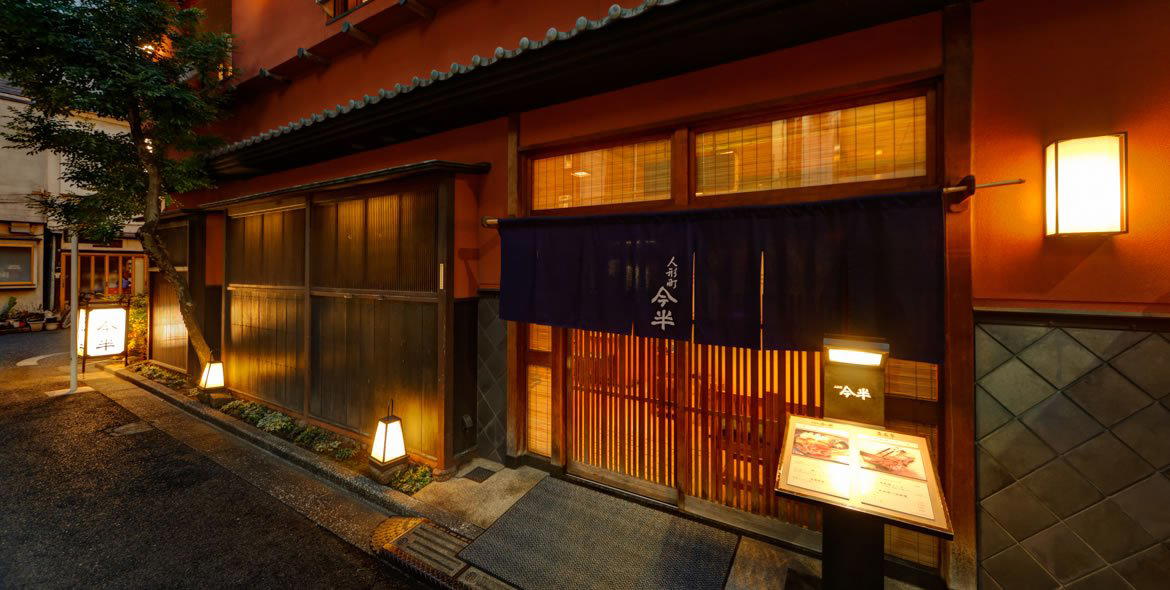
The streets around Ningyocho have a different rhythm from the rest of central Tokyo. The neighbourhood sits east of the Sumida River's influence and south of the Akihabara current, insulated by a grid of narrow commercial lanes that have traded in food, textiles, and craft since the Edo period. Walking toward Ningyocho Imahan, you pass lacquerware shops and tofu makers that have occupied the same storefronts for generations. The building itself reads as deliberate understatement: the kind of facade that communicates longevity without signage theatrics. This is the architectural register of old Shitamachi, the low city, where the statement is continuity, not spectacle.
That context matters for understanding what kind of restaurant this is. Tokyo's premium dining tier has fractured over the past two decades into a wide range of formats: kaiseki counters reaching into six-figure territory per head, French tasting menus competing on fermentation technique and sourcing transparency, and omakase sushi rooms where lineage and brevity define the price. Ningyocho Imahan operates in a different register entirely. It belongs to the category of long-established beef restaurants, yoshoku-adjacent but rooted firmly in Japanese preparation traditions, that have survived by doing one thing with accumulated precision rather than reinventing for each dining generation.
Sukiyaki, Shabu-Shabu, and the Ethics of Sourcing
The cooking format here is built around Kuroge Wagyu, the black-haired Japanese cattle breed that forms the basis of premium beef identity across the country. What distinguishes Ningyocho Imahan's position in that category is not merely ingredient quality, Wagyu availability has expanded considerably across Tokyo's mid-to-upper dining tier, but sourcing depth. The restaurant has maintained direct relationships with Wagyu producers over decades, a practice that pre-dates the language of ethical sourcing by a considerable margin. When the modern farm-to-table framework caught up with what Japanese traditional restaurants had been doing through necessity and relationship rather than ideology, places like this were already operating at that standard.
Sukiyaki, as a format, rewards this sourcing logic directly. The dish involves thin-sliced beef cooked tableside in a shallow iron pan with soy, sugar, and mirin, then dipped in raw egg, a method that places the quality of the beef at the front of every mouthful, with no sauce complexity to redistribute attention. There is nowhere to hide inferior product in that preparation. Shabu-shabu works similarly: barely-cooked slices passed through light dashi broth, then finished with ponzu or sesame. Both formats are as much tests of sourcing as they are cooking techniques, which is precisely why restaurants with deep producer relationships have a structural advantage in executing them. Sustainability, in this context, is less a branding position than an operational necessity, the restaurant's output is inseparable from the consistency of its supply chain.
For readers interested in how Tokyo's kaiseki and high-end Japanese cooking tradition handles similar questions of sourcing and seasonal restraint, RyuGin applies comparable rigour across a broader ingredient set. Gion Sasaki in Kyoto extends the argument into full kaiseki territory, where seasonal ethics shapes the entire menu architecture.
The Ningyocho Tradition in Tokyo's Beef Restaurant Tier
Tokyo has a defined tier of long-established beef restaurants, most of them concentrated in historic commercial districts rather than the newer dining corridors of Minami-Aoyama or Ebisu. These restaurants share a common operational logic: fixed preparation formats, tableside cooking, high sourcing standards, and a resistance to menu experimentation that would dilute the core proposition. Within that group, Ningyocho Imahan's address in Chuo City, specifically the Nihonbashiningyocho district, places it in one of Tokyo's oldest continuously commercial areas, which adds a layer of neighbourhood authority that newer beef restaurants in more fashionable postcodes cannot replicate by design.
That comparative context is useful for readers building a Tokyo itinerary across dining categories. The French-influenced end of Tokyo's premium market is well-documented: L'Effervescence operates with its own sourcing transparency credentials, and Sézanne has become a reference point for Franco-Japanese technique. Crony sits in the innovative French tier. Harutaka anchors the premium sushi counter format. Ningyocho Imahan occupies a separate lane from all of them, traditional Japanese beef preparation rather than either sushi or Western-influenced cuisine, and that specificity is the point.
Beyond Tokyo, visitors building a Japan-wide itinerary around high-craft traditional cooking will find useful reference points in HAJIME in Osaka and akordu in Nara, while Goh in Fukuoka handles Kyushu's version of ingredient-led cooking. Regional Japanese producers also appear through the work of restaurants like 一本杉 川嶋制 in Nanao and 夕佳亭山之 in Sapporo, each operating within distinct local ingredient frameworks.
What the Format Demands of the Diner
Tableside cooking formats require a different kind of attention from the diner than plated tasting menus. At a kaiseki counter, the kitchen controls pacing, temperature, and the sequence of flavours. At a sukiyaki table, the diner participates in the process, adjusting heat, managing the egg dip, sequencing vegetables and tofu alongside the beef. This is not a passive dining format, and the leading sukiyaki experiences reward diners who arrive understanding the preparation rather than waiting to be instructed through it. First-time visitors to this style of restaurant are better served by a short briefing before arriving than by reading the menu cold.
The neighbourhood itself justifies arriving early. Ningyocho has a density of traditional food retailers that extends the visit beyond the meal itself: regional confectionery shops, tamago-yaki specialists, and produce retailers that supply some of the same ingredients appearing on the restaurant's tables. The district functions as an integrated food environment in the way that Tokyo's newer dining corridors, built around restaurant concentration alone, do not.
For a broader reading of where Ningyocho Imahan fits within Tokyo's full dining spectrum, our full Tokyo restaurants guide maps the city's categories and neighbourhoods in detail. Restaurants with distinct regional sourcing approaches, such as 湖隣庵 in Takashima and 庄羽屋 in Nishikawa Machi, offer additional context for understanding how Japanese restaurants outside the major cities maintain producer relationships.
Planning Your Visit
| Detail | Ningyocho Imahan | RyuGin | Harutaka |
|---|---|---|---|
| Cuisine Format | Sukiyaki / Shabu-shabu | Kaiseki | Omakase Sushi |
| Price Tier | Not confirmed | ¥¥¥¥ | ¥¥¥¥ |
| Booking | Advance reservation required | Advance reservation required | |
| Neighbourhood | Nihonbashi, Chuo City | Roppongi | Ginza |
| Address | 2 Chome-9-12 Nihonbashiningyocho, Tokyo 103-0013 | Roppongi Hills area | Ginza district |
Visitors pairing Tokyo with a New York dining leg will find that Le Bernardin and Atomix anchor the highest tier of that city's tasting menu scene, though neither maps directly to the tableside tradition represented here. Birdland in Sakai and Bistro Ange in Toyohashi round out the regional Japanese picture for travellers moving beyond the main city hubs.
Frequently asked questions
How do I find Ningyocho Imahan (人形町今半)?
Ningyocho Imahan (人形町今半) is located at 2 Chome-9-12 Nihonbashiningyocho, Chuo City, Tokyo 103-0013, Japan, Tokyo.
How does Ningyocho Imahan compare to other long-established wagyu restaurants in Tokyo?
Tokyo's historic beef restaurant tier is concentrated in older commercial districts like Nihonbashi and Asakusa rather than in newer areas such as Roppongi or Shinjuku. Imahan, based at its Ningyocho address in Chuo City, belongs to this older cohort alongside a small number of Kuroge Wagyu specialists that predate the post-war dining expansion. What distinguishes Ningyocho specifically is the neighbourhood's preserved commercial character, which shapes the dining atmosphere in ways that newer districts do not replicate.
What should I order at Ningyocho Imahan (人形町今半)?
The menu centres on two tableside formats: sukiyaki and shabu-shabu, both built around Kuroge Wagyu, the black-haired Japanese cattle breed that defines premium beef in Japan. Sukiyaki is the more traditional choice in this neighbourhood and the format Imahan has long been associated with in Nihonbashiningyocho. First-time visitors typically begin there before exploring the shabu-shabu courses on subsequent visits.
Can I walk in to Ningyocho Imahan (人形町今半)?
Walk-in availability at Imahan depends heavily on the time of day and day of the week, the restaurant's location in Chuo City's historic Ningyocho district draws both local regulars and visitors, and peak lunch and dinner sittings fill early. Reservations made in advance are the more reliable approach, particularly for weekend visits or larger groups. Arriving at opening time on a weekday offers the best walk-in prospects.
What is Ningyocho Imahan (人形町今半) known for?
Imahan is known as one of Tokyo's long-established Kuroge Wagyu restaurants operating in the historic Nihonbashiningyocho district of Chuo City. The restaurant represents a tier of Tokyo beef dining that pre-dates the modern restaurant boom, concentrated in older commercial neighbourhoods rather than newer entertainment districts. Its cooking formats, sukiyaki and shabu-shabu, are executed tableside, placing the ritual of preparation at the centre of the meal.
Can Ningyocho Imahan (人形町今半) handle vegetarian requests?
Imahan's identity is built entirely around Kuroge Wagyu beef, and the sukiyaki and shabu-shabu formats are not structured to accommodate vegetarian dining in any meaningful way. The broths, dipping sauces, and course compositions are designed around the beef as the primary ingredient. Vegetarian diners would find the menu largely inaccessible, and this is not a restaurant to visit with that expectation.
Cuisine Lens
Comparable venues nearby, for context on price, style, and recognition.
| Venue | Cuisine | Price | Awards | Notes |
|---|---|---|---|---|
| Ningyocho Imahan (人形町今半)This venue (the venue you are viewing) | Traditional Japanese Sukiyaki | $100–150 | Tabelog 100 #33 | Not listed |
| Sushi Sho | Traditional Edomae Sushi Omakase | $300–500 | Not listed | Nishiazabu |
| Inoue (井上) | Modern Yakiniku | $150–200 | Not listed | Ginza |
| Takagaki's Sushi | Traditional Edomae Omakase | $200–300 | Tabelog 100 #52 | Chūō |
| てんぷら 小野 | Seasonal Tempura Omakase | $200–300 | Not listed | Chūō |
| Ichiyanagi | Edomae Sushi Omakase | $150–200 | Tabelog 100 #1 | Chūō |
Recognition history
Dated appearances from independent guides and award organizations, with the underlying list record or original source where available.
Tabelog 100 #33 · No. 33
Tabelog · Tabelog 100 - Hot Pot - 2024