
Asakusa’s soba culture rewards restraint: buckwheat noodles, dipping broth, sake, and a room that moves at lunch-counter pace rather than tasting-menu tempo. Namiki Yabu Soba belongs to that older Tokyo category, with Tabelog 100 Soba EAST 2025 recognition and a format that suits travelers who want classic Tokyo noodle craft without ceremony.
Pearl is the En Primeur Club membership app — saves, bookings, and concierge access live there. Same editors, same standards.
- Address
- 2 Chome-11-9 Kaminarimon, Taito City, Tokyo 111-0034, Japan
- Phone
- +81 3-3841-1340
- Website
- yabusoba.co.jp
 Saves & bookings on Pearl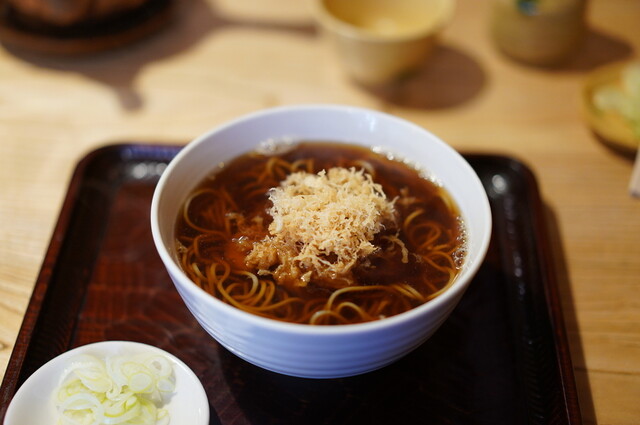
Approaching the Kaminarimon side of Asakusa, the city changes texture before speed: tourist traffic gathers around temple routes, rickshaws cut through side streets, and small dining rooms continue the quiet work that made the district worth eating in before souvenir snacks became the default. Soba fits because it asks for attention without ceremony: buckwheat, broth, heat, cold, sake, and timing. Namiki Yabu Soba sits inside that grammar rather than above it.
Tokyo’s high-end dining conversation often favours sushi counters, kappo rooms, and French-Japanese tasting menus, but soba has its own hierarchy. Serious shops are judged less by spectacle than proportion: noodle texture against dipping sauce, room rhythm, and whether the meal feels complete without a long menu. Selection for Tabelog 100 Soba EAST 2025 places this address in a recognised regional group for buckwheat noodles; the stronger point is category discipline. This is not a luxury restaurant disguised as a noodle shop, but a classic soba stop in a city where modest formats carry serious culinary weight.
Asakusa soba culture, with sake in the supporting role
The beverage angle is not a Western fine-dining wine list. In a soba house, drinking is shorter, sharper, and tied to the meal’s sequence. Sake, listed as the house drink category, fits because Tokyo soba shops have long doubled as places for restrained early drinking: a small pour, a snack if offered, then noodles to close. That structure separates this style from izakaya sprawl and omakase formality, keeping the meal compact and adult.
For travelers used to pairing menus and cellar pages, the lesson is useful: Japanese noodle rooms often treat alcohol as punctuation, not performance. The drink need not announce range to work. It slows the opening and keeps focus on buckwheat and broth: curation by fit rather than depth.
Within Asakusa, this restraint reads against neighbouring formats. 浅草むぎとろ本店 points to the district’s long-running Japanese dining traditions, Bona Festa to its older Western-influenced restaurant layer, Hatsuogawa anchors the eel conversation, Kameju sits in the sweets-and-gifts flow, and FEBRUARY CAFE belongs to the contemporary café circuit. Soba offers the clearest bridge between local routine and destination eating: quick enough for a temple-area day, specific enough to plan around.
What the room tells you about the meal
The format is compact and traditional rather than staged. The seating count is 36, with table seating and a raised tatami area, signalling the pace to expect. This is neither counter-theatre nor a private-room occasion. It belongs to a Tokyo genre where efficiency is part of the appeal: orders move, turnover matters, and pleasure comes from precision inside a short meal.
That matters when reading the awards. A Tabelog 100 selection in soba does not promise the same experience as a starred tasting counter or hotel dining room. It signals seriousness within a specialised noodle category, where small differences in broth concentration, noodle handling, and service rhythm carry weight. Namiki Yabu Soba also has repeated Tabelog 100 Soba selections in 2017, 2018, 2019, 2021, and 2024, giving the recognition continuity beyond a single year.
The price tier reinforces the point. Tokyo can make soba humble or rarefied, but this address remains accessible for both lunch and dinner. Recognised category status without fine-dining pricing explains why the experience is best understood as heritage everyday dining rather than a splurge. Treat it as a focused soba meal, not a long lunch stretched with expectations borrowed from kaiseki or sushi.
How to place it in a Tokyo itinerary
Asakusa rewards precision. The district is easy to overfill with temple visits, street snacks, cafés, and riverfront detours, so soba works as a clean anchor rather than an add-on. The nearest rail access is Asakusa Station, and the restaurant’s position near Kaminarimon puts it in the dense visitor zone, making timing matter more than distance. Midweek closures also affect planning, especially for short Tokyo stays built around older neighbourhoods.
Reservations are unavailable, changing the calculus. This is a walk-in soba house with recognised standing, not a concierge-managed table. Build flexibility into the day and avoid treating it like a fixed tasting-menu appointment. Payment options include major credit cards and several electronic money systems; QR code payments are not accepted. Parking is unavailable, standard enough in central Tokyo but relevant for anyone moving between outer districts by car.
For a broader Tokyo eating map, pair this meal with a split itinerary rather than a single-theme crawl. Akihabara and eastern Tokyo connect through casual seafood at . 鮪と炭火焼き うお炭 秋葉原店, while Shinjuku’s denser late-day orbit includes 12/10 Shinjuku ten. For grilled skewers in another old-meets-new pocket, 124. KAGURAZAKA (Yakitori) gives a different reading of Tokyo craft. Lighter or more casual stops such as 2D Cafe and 3 Chome no Curry Ya San show the range of the city’s low-to-mid price dining.
Travelers on a wider Japan route can use soba as a reference for regional contrast. Compare Tokyo’s noodle restraint with beef sukiyaki at -Grilled beef Sukiyaki- KAMAKURA TANUKIAN 鎌倉 たぬき庵 in Kamakura, café culture at.cafe in Osaka, contemporary dining at.know in Kumamoto, Vietnamese cooking at (Shoku) Vietnam in Kawasaki, curry specialization at [Curry Senmon Ten] Maruyama Kyoju. in Sapporo, and Kyoto’s quieter register at [ki:] in Kyoto. For Japanese food culture abroad, Jōdo Saké Bar in Los Angeles and Onigiri Time in Pasadena show how specific formats travel and change.
Use Our full Tokyo restaurants guide for the dining route around this stop, then widen the trip through Our full Tokyo hotels guide, Our full Tokyo bars guide, Our full Tokyo wineries guide, and Our full Tokyo experiences guide. Namiki Yabu Soba’s value is not that it summarizes Tokyo dining. It shows one durable part of it: a recognised soba house where the meal is short, specific, and confident enough to leave luxury signals outside the door.
The Short List
Comparable venues by cuisine and category.
| Venue | Cuisine | Price | Notes |
|---|---|---|---|
| Namiki Yabu SobaThis venue — the venue you are viewing | Taitō, Traditional Japanese Soba | $$ | Not listed |
| Tengoku | Asakusa, Retro Japanese Cafe | $$ | Not listed |
| HIKINIKU TO COME (挽肉と米) | Not listed | $$ | Shibuya, Japanese Hamburger Steak with Rice |
| Mendokoro Honda | Akihabara, Shoyu Ramen Specialist | $$ | Not listed |
| Yamada Ya | Not listed | $$ | Arakawa, Tokyo Yakiniku (Japanese BBQ) |
| Senju Takeyabu | Adachi, Traditional Soba Noodle Shop | $$ | Not listed |
Recognition history
Dated appearances from independent guides and award organizations, with the underlying list record or original source where available.
Tabelog 100 #6 · No. 6
Tabelog · Tabelog 100 - Soba - EAST - 2025









At a Glance
- Classic
- Cozy
- Quiet
- Well Known
- Solo
- Casual Hangout
- Group Dining
- Historic Building
- Standalone
- Sake Program
- Street Scene
Current opening hours
- Monday
- 11 AM–7 PM
- Tuesday
- 11 AM–7 PM
- Wednesday
- Closed
- Thursday
- Closed
- Friday
- 11 AM–7 PM
- Saturday
- 11 AM–7 PM
- Sunday
- 11 AM–7 PM
Hours can change for holidays and private events. Last verified .
Traditional and understated, with a long-standing neighborhood restaurant feel and a historic, no-frills atmosphere.