Nagahama Mangetsu

Michelin Bib Gourmand
Our verdict
Nagahama Mangetsu holds consecutive Michelin Bib Gourmand recognition for 2024 and 2025, placing it among Busan's most consistent value-tier Japanese kitchens. Located in Haeundae-gu, the ramen specialist draws a loyal local crowd alongside visitors crossing the city specifically for the bowl.

Pearl is the En Primeur Club membership app, where members save venues, book tables and use the concierge.
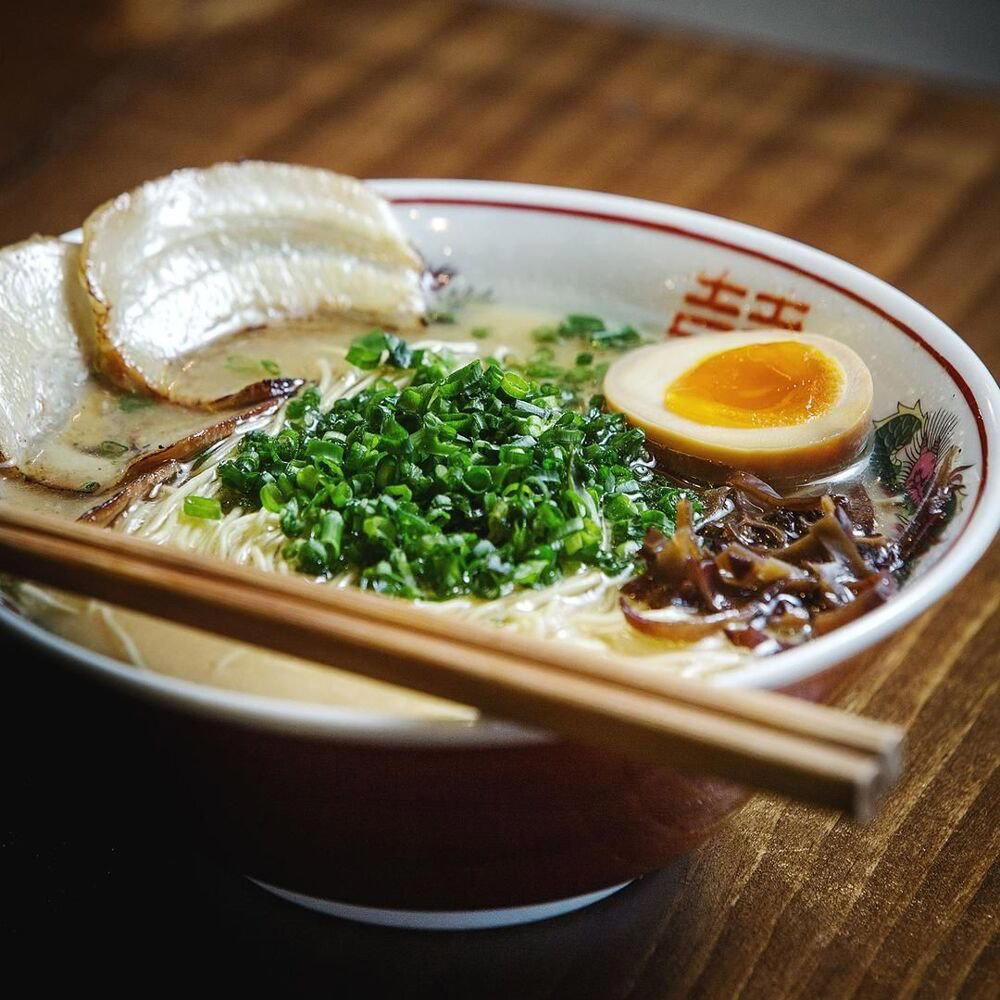
Where Ramen Becomes a Ritual in Haeundae
The stretch of Haeundae-gu that runs inland from the beach hotels toward residential Udong carries a different energy to the seafront. Fewer tourists, more regulars. Restaurants here earn their following through repetition rather than spectacle, and the queue outside Nagahama Mangetsu most evenings reflects exactly that dynamic: people who have come back, and people who have come specifically to see what the return visitors know. This is the social logic of ramen culture at its most direct, a single-bowl format that collapses the usual calculus of ordering, sharing, and decision fatigue into one concentrated act of eating.
Ramen in Japan developed partly through izakaya culture, where communal spaces, late hours, and affordable bowls served as the infrastructure for drinking-and-eating sessions that stretched into the night. The Nagahama style, which traces its lineage to the Hakata district of Fukuoka, carries that spirit in its bones: rich tonkotsu broth, thin straight noodles, a counter or close-packed seating, and a pace that suits both quick stops and deliberate lingering. That format has traveled across the Korea Strait with considerable fidelity, and Busan, a port city with longstanding Japanese cultural proximity, has proved a receptive home for it.
Consecutive Michelin Recognition and What It Signals
Nagahama Mangetsu received the Michelin Bib Gourmand in both 2024 and 2025. The Bib Gourmand category is worth clarifying in context: it identifies restaurants where inspectors found quality cooking at a price point they considered favorable, specifically outside the starred tier. For a ramen counter operating at the ₩ price level, consecutive recognition is a meaningful signal. It means the kitchen held its standard across two separate inspection cycles, which is a more demanding achievement than a single-year appearance.
Within Busan's wider Michelin-recognized dining set, the ₩ tier is occupied by a small group of specialists. Anmok, recognized for dwaeji-gukbap, and 100.1. Pyeongnaeng, which focuses on naengmyeon, sit in the same value bracket and represent the same broader argument: that Busan's most interesting eating is not concentrated at the leading price tier. The mid-range Palate (₩₩) and upper-bracket Mori (₩₩₩) or Born and Bred (₩₩₩₩) occupy different competitive positions entirely.
A high volume of consistent scores, particularly for a restaurant operating at low prices, tends to indicate a loyal local base rather than a tourism spike. The gap between a 4.3 mean across over a thousand reviews and a high-volume tourist venue with a shorter tail of ratings is significant: the former implies sustained satisfaction from people who return and from those who came on specific recommendation.
The Nagahama Ramen Tradition and Its Busan Expression
Nagahama ramen is a substyle within the broader Hakata/Fukuoka tonkotsu tradition. The defining characteristics are a particularly pale, milky pork-bone broth cooked to a high-collagen concentration, extremely thin noodles served firm, and a customization culture, hardness of noodle, richness of broth, amount of fat, that lets regulars calibrate their bowl to precise preference. The social dimension of this is not incidental: the ability to specify your bowl, to have the counter staff recognize your order pattern, is part of what turns a ramen shop into something closer to a local. That relationship between regular and kitchen is the izakaya impulse applied to a bowl format.
Ramen as a category has built a serious international footprint over the past decade. Afuri in Tokyo has extended its yuzu shio format to international markets including Portland, while Akahoshi Ramen in Chicago has brought miso-forward ramen to a North American audience with significant critical attention. The Nagahama style, rooted in Fukuoka, has its own loyal constituency and represents a different technical approach: the broth work favors depth through collagen extraction over the cleaner, lighter profiles of shio or shoyu styles. Chef Yap Hock Kee's stewardship of this tradition in Haeundae positions the restaurant as a serious practitioner of a defined regional style rather than a ramen generalist.
Haeundae-gu in Context
Haeundae is Busan's most internationally recognized district, anchored by the beach and surrounded by the hotel infrastructure that serves it. But the dining map extends well beyond the seafront. Udong 1-ro, where Nagahama Mangetsu sits, is part of the residential hinterland where the day-to-day eating culture of the neighborhood plays out. Restaurants here compete on quality and price to a local audience first. That competitive pressure, without the tourist floor-propping that inflates prices near the water, is part of what keeps the value proposition sharp.
For visitors building a broader picture of Busan's dining, our full Busan restaurants guide covers the range across all price tiers and cuisines. Those extending beyond food will find further context in our Busan hotels guide, our Busan bars guide, and our Busan experiences guide. For those tracking Korea's wider dining scene, the contrast with Seoul's fine-dining tier, represented by venues like Mingles, Gaon, or Kwon Sook Soo in Gangnam-gu, underlines how different the value-specialist tier in Busan operates: lower prices, tighter formats, singular focus. Outside the peninsula, Baegyangsa Temple in Jangseong-gun and The Flying Hog in Seogwipo represent other poles of Korean regional eating. Our Busan wineries guide rounds out the city picture for those interested in the broader drinks scene.
Planning a Visit
Nagahama Mangetsu is located at 57 Udong 1-ro, Haeundae-gu, Busan. At the ₩ price tier, the restaurant operates without a reservation infrastructure typical of higher-end venues, which means walk-in timing matters more than advance booking. Arriving outside peak meal windows, particularly for dinner, when the Michelin recognition draws additional demand, is the most reliable way to minimize a wait. Come with time to spare, or early in a service period.
Frequently Asked Questions
- What do people recommend at Nagahama Mangetsu?
- The kitchen operates within the Nagahama ramen tradition, which is built around tonkotsu-style pork-bone broth and thin straight noodles, the format associated with the Hakata district of Fukuoka.
Frequently asked questions
What awards or recognition does Nagahama Mangetsu have?
Nagahama Mangetsu has received recognition including: Michelin Bib Gourmand (2025); Michelin Bib Gourmand (2024).
Where is Nagahama Mangetsu in Busan?
Nagahama Mangetsu is located at 57 Udong 1-ro, Haeundae-gu, Busan, South Korea, Busan.
What do people recommend at Nagahama Mangetsu?
The kitchen is built around nagahama-style ramen, a pale, milky tonkotsu substyle from the Fukuoka tradition known for a lighter colour and cleaner finish than standard Hakata bowls. Given the ₩ price tier and back-to-back Michelin Bib Gourmand recognition in 2024 and 2025, the ramen itself is the reason to visit. Ordering the house tonkotsu and customising noodle firmness is standard practice at counters running this tradition.
What cuisine category does Nagahama Mangetsu fall under?
What price level is Nagahama Mangetsu?
Pricing at Nagahama Mangetsu is listed as ₩.
Budget Reality Check
Comparable options at a glance, pulled from our tracked venues.
| Venue | Cuisine | Price | Awards | Notes |
|---|---|---|---|---|
| Nagahama MangetsuThis venue (the venue you are viewing) | Authentic Nagahama Tonkotsu Ramen | $10–20 | Michelin Bib Gourmand | Not listed |
| Palate | Contemporary French with Korean Fusion | $150–200 | 1 Michelin Star · La Liste Top Restaurants | Contemporary |
| Mori | Japanese Kaiseki | $200–300 | 1 Michelin Star | Japanese |
| Born and Bred | Modern Hanwoo Beef Omakase Steakhouse | $100–150 | Michelin Plate · World's 50 Best #51 | Steakhouse |
| 100.1. Pyeongnaeng | Pyongyang-style Naengmyeon | $10–20 | Michelin Bib Gourmand | Naengmyeon |
| Anmok | Modern Korean Dwaeji-Gukbap | $10–20 | Michelin Bib Gourmand | Dwaeji-gukbap |
Recognition history
Dated appearances from independent guides and award organizations, with the underlying list record or original source where available.
Michelin Bib Gourmand
Michelin
Full recognition history (3 entries)
Michelin Bib Gourmand
Michelin
Michelin Bib Gourmand
Michelin