Meskerem
Meskerem serves authentic Ethiopian dishes such as Vegetarian Combo, Tibs Wat, and Kitfo in a historic building, with conversational pacing for lunch or dinner.
Pearl is the En Primeur Club membership app — saves, bookings, and concierge access live there. Same editors, same standards.
- Address
- 124 MacDougal St #1247, New York, NY 10012
- Phone
- +12127778111
- Website
- ethiopianmeskeremnyc.com
- Directions
- Get directions
 Saves & bookings on Pearl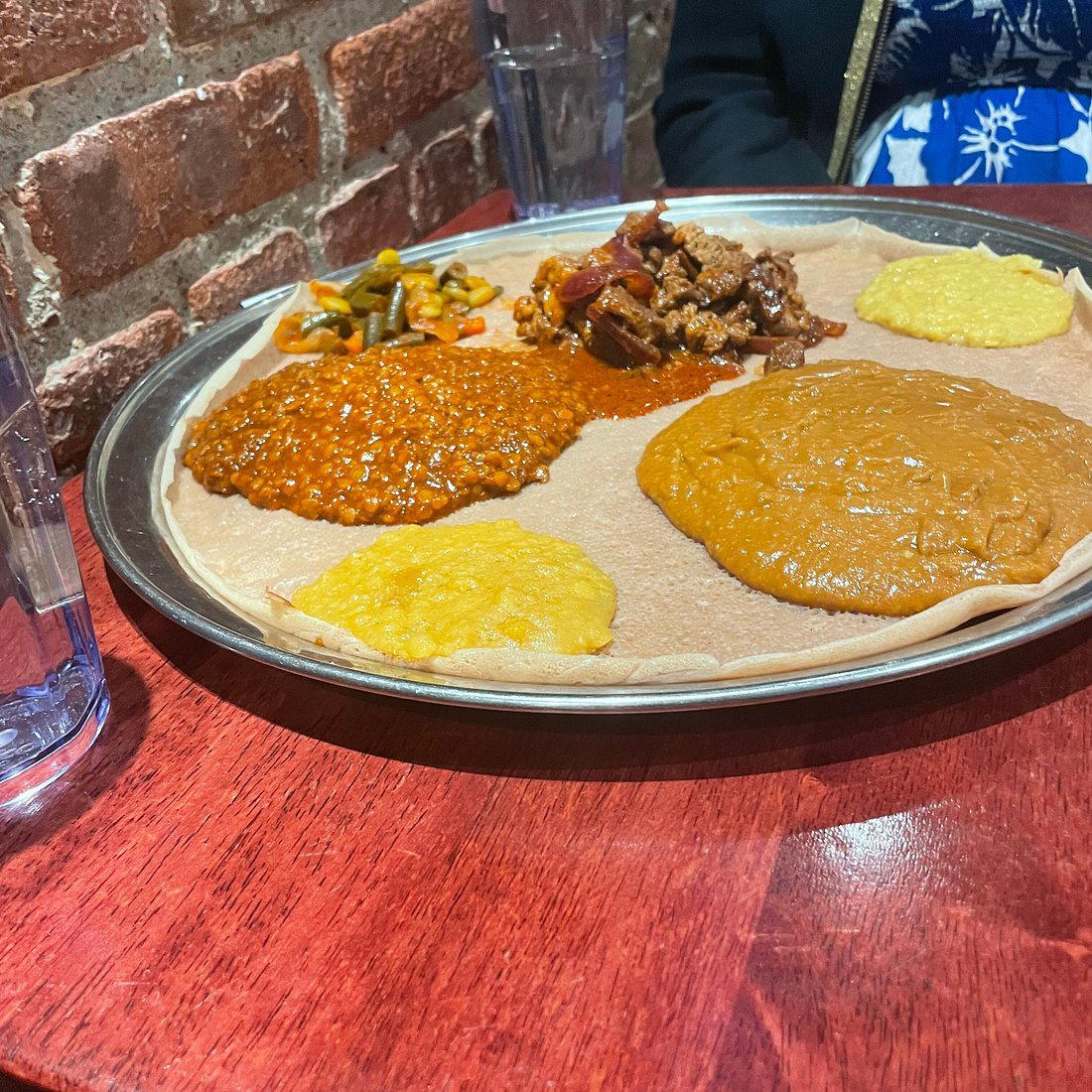
Greenwich Village's Ethiopian Anchor
MacDougal Street has housed generations of Village institutions, from folk clubs to coffeehouses to the kind of neighborhood restaurants that outlast trends by simply being correct about what they do. Meskerem, at 124 MacDougal Street, belongs to that longer continuum. Ethiopian restaurants began appearing in American cities in meaningful numbers during the late 1970s and early 1980s, as the diaspora established footholds in Washington D.C. Los Angeles, and New York. Greenwich Village, with its historically internationalist dining culture, became one of the early New York neighborhoods where Ethiopian cuisine found a stable audience, and Meskerem has been part of that address for decades.
The broader context matters here. Ethiopian food occupies a specific position in New York's dining ecology: it is one of the few traditions where communal eating is structurally built into the format rather than offered as a novelty option. The injera, a spongy sourdough flatbread fermented from teff, functions simultaneously as plate and utensil. It has its own internal logic of flavor sequencing, textural contrast, and table-level assembly. Understanding that system is the entry point for reading a meal at Meskerem correctly.
The Architecture of an Ethiopian Meal
The progression of an Ethiopian spread does not follow the Western appetizer-entree-dessert arc. It operates more like a lateral unfolding: a large injera arrives as the base, and the wots (stewed dishes), tibs (sauteed meats), and vegetarian preparations are arranged on leading or alongside. The sequence in which you move across the platter is largely self-directed, which makes the opening positioning of each preparation significant. Dishes with more assertive spice profiles, typically those built on berbere, the foundational Ethiopian spice blend of chili, fenugreek, coriander, and korarima, tend to anchor one end; milder legume preparations and the cooling of plain injera provide counterbalance.
At Meskerem, this format places the kitchen's competence on immediate display. There is nowhere to hide when every element of the meal arrives simultaneously and the quality of the injera itself sets the tone. Teff-based injera requires precise fermentation timing to achieve the right degree of sourness without becoming harsh, and the texture needs enough porosity to absorb sauce without disintegrating. This is an ingredient that takes days to prepare correctly, which is why the quality of the bread is the first reliable signal of a kitchen's seriousness.
The vegetarian preparations in Ethiopian cuisine are worth particular attention at Meskerem. The tradition of fasting days in Ethiopian Orthodox Christianity produced a centuries-old culture of complex, satisfying plant-based cooking long before plant-forward dining became a Western restaurant trend. Dishes like misir (red lentils cooked in berbere), gomen (collard greens with ginger and garlic), and tikil gomen (cabbage and carrots spiced with turmeric) are not substitutes for meat dishes; they are the tradition. A well-composed vegetarian combination at a serious Ethiopian restaurant is often the clearest demonstration of the kitchen's range.
MacDougal Street and the Downtown Dining Pattern
Greenwich Village functions differently from Midtown's destination-restaurant corridor, where tables at places like Le Bernardin, Per Se, or Masa are planned weeks or months in advance. The Village operates on neighborhood logic: restaurants earn loyalty through repetition and reliability rather than through event-dining status. Korean tasting-menu destinations like Atomix or Jungsik New York represent a different tier entirely, where advance booking is the product. Meskerem exists in a different relationship with its diners: it is a place people return to, not a place they save for an occasion.
That distinction shapes the experience. The room on MacDougal is not designed to signal occasion; it is designed to facilitate the kind of table-sharing that Ethiopian food demands. Groups of four to six tend to get full value from the format, since the communal platter scales well and the variety of preparations increases proportionally with the number of diners. Couples eating together from a shared spread are doing the same thing, just with fewer dishes to navigate.
The location puts Meskerem within easy walking distance of Washington Square Park and the broader NYU corridor, which means the dining room draws a genuinely mixed crowd: neighborhood regulars, students, and visitors who have specifically sought out the address. MacDougal Street sits near the southern boundary of the Village before it transitions into SoHo. Practical planning is direct: reservations are recommended, and weekends during peak dinner hours will tighten availability.
Ethiopian Food in the American City
New York's Ethiopian dining scene has remained smaller than Washington D.C.'s, where the largest Ethiopian diaspora community in the United States established a critical mass of restaurants in the U Street corridor. In New York, the tradition has been represented by a more dispersed set of addresses, making the Village's established options more significant as reference points. Nationally, premium tasting-format restaurants like Alinea in Chicago, Lazy Bear in San Francisco, or The French Laundry in Napa represent one definition of serious dining in America. Ethiopian restaurants like Meskerem represent another: traditions that require genuine craft and deep ingredient knowledge, operating without the infrastructure of formal fine dining recognition, and sustained by communities who understand what they are eating.
The comparison is not about prestige equivalence. It is about recognizing that the multi-course logic of a well-assembled Ethiopian spread at places like Meskerem draws on centuries of culinary development, with its own internal standards, that sit entirely outside the Michelin-inflected frameworks applied to restaurants like Blue Hill at Stone Barns, Providence, Single Thread Farm, Addison, The Inn at Little Washington, Bacchanalia, Emeril's in New Orleans, 8 1/2 Otto e Mezzo Bombana in Hong Kong, or Alain Ducasse at Louis XV in Monte Carlo. Different standards, different traditions, different relationship between diner and kitchen.
Planning Your Visit
Meskerem is located at 124 MacDougal Street in Greenwich Village, reached via the West 4th Street station on the A/C/E or B/D/F/M lines. Reservations are recommended, and weekend evenings represent the highest-demand window. Groups planning to share a full combination platter should plan on arriving early in the dinner service to secure adequate table space for the spread format. The meal is structured to be unhurried; the communal platter encourages conversation and is poorly suited to a rushed sitting.
Quick Comparison
Comparable venues nearby, for context on price, style, and recognition.
| Venue | Cuisine | Price | Notes |
|---|---|---|---|
| MeskeremThis venue — the venue you are viewing | Authentic Ethiopian | $$ | Not listed |
| Chez Jacob | Authentic Senegalese | $$ | Harlem (North) |
| Africa Kine | Senegalese | $$ | Harlem (North) |
| Awash | Authentic Ethiopian | $$ | Upper West Side-Manhattan Valley |
| Ewe's Delicious Treats | Authentic Nigerian | $ | East New York-New Lots |
| Azara Kitchen | West African Fusion | $$ | Harlem (North) |
Continue exploring
More in New York City
Restaurants in New York City
Browse all →
Bars in New York City
Browse all →
Hotels in New York City
Browse all →






At a Glance
- Cozy
- Lively
- Casual Hangout
- Group Dining
- Historic Building
- Beer Program
Current opening hours
- Monday
- 12–10 PM
- Tuesday
- 12–10 PM
- Wednesday
- 12–10 PM
- Thursday
- 12–10 PM
- Friday
- 12–10 PM
- Saturday
- 12–10 PM
- Sunday
- 12–10 PM
Hours can change for holidays and private events. Last verified .
Cozy and casual atmosphere with friendly service, featuring Ethiopian music in a basement setting.