Tabelog 100 #79
Our verdict
Men Chubo Kaen belongs to Osaka’s serious ramen conversation rather than its tourist shorthand: a Takatsuki shop known for ramen, tantan-men, and brothless tantan-men, with selection in Tabelog Ramen OSAKA “Tabelog 100” for 2023, 2024, and 2025. The appeal is category depth: a suburban noodle counter where spice, texture, and Chinese-Japanese ramen lineage matter more than spectacle.

Pearl is the En Primeur Club membership app, where members save venues, book tables and use the concierge.
The menu
What to order
- Tantanmen (spicy noodle soup)
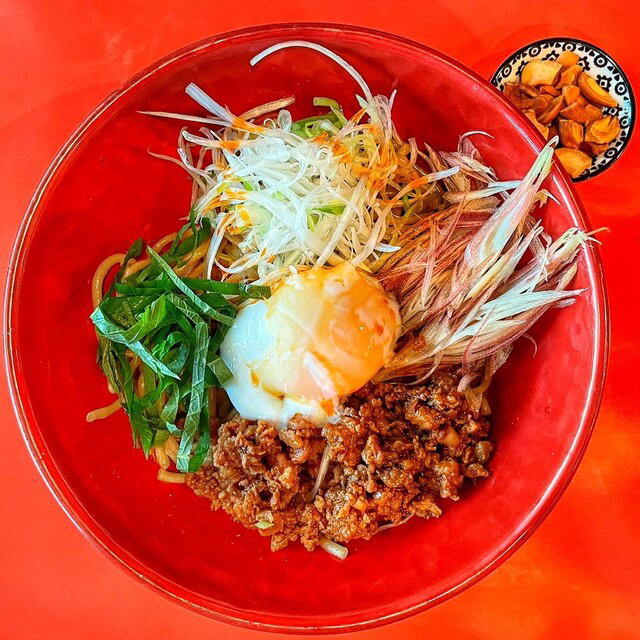
- Brothless tantanmen
- Cold dandan noodles
- Spicy tantanmen with sweetbread
Osaka changes dining’s rhythm as soon as the focus moves beyond the most obvious visitor corridors. The central ramen areas announce themselves with station-front queues, bright signage, and narrow counters built for speed; elsewhere in the city, the pace loosens, and serious noodle shops can feel more like local institutions than urban set pieces. Men Chubo Kaen belongs to that second Osaka: practical, local, and grounded in ramen culture where repeat selection and category focus matter more than design theatre.
Osaka ramen is often framed through familiar bowl styles, but its noodle map is broader. Tantan-men occupies a distinct lane within that map, and brothless tantan-men sharpens the test: seasoning, spice, fat, and noodle texture face scrutiny without soup to soften the edges. Read this shop not as a generic ramen stop, but as part of Osaka’s smaller, more exacting tantan-men conversation.
Tantan-men gives Osaka ramen a sharper grammar
The category matters because preparation is judged differently. In a lighter ramen bowl, the conversation may turn to stock clarity or tare restraint; in tantan-men, the essentials are balance, seasoning, aromatic lift, and how noodles hold sauce or broth. The question is not simply where the food comes from, but how each element behaves under intensity and fat. A weaker bowl becomes heavy; a stronger one keeps the palate moving.
Men Chubo Kaen’s listed categories, ramen, tantan-men, and brothless tantan-men, place it in a defined noodle lane rather than a broad catch-all format. That distinction matters in Osaka, where everyday eating is often more compelling than formal dining for visitors who understand what they are seeing. Recognition in Tabelog’s Hyakumeiten for 2025 gives the case hard backing. Tabelog’s Hyakumeiten lists are not luxury awards; they are useful genre signals, especially in ramen, where the gap between merely popular and serious is often visible in consistency and focus.
The comparison set clarifies the lane. Menya Ikkei and Nakamura Shoten Takatsuki honten sit in a similar Osaka conversation, while Raa Menya Harinezumi, JouEt BoIte, and Shio Ramen Asuryu show how much city dining discussion still happens at everyday prices. Here, the interest is not extravagance. It is the concentration of a spice-led noodle format in a city better known abroad for takoyaki, okonomiyaki, and counter drinking than for tantan-men’s finer distinctions.
A neighbourhood room, not a destination-stage performance
The room reinforces that reading without needing a theatrical frame. Men Chubo Kaen is best understood as a practical Osaka ramen shop rather than a dining room built around occasion or spectacle. That flexibility is a quiet Osaka signal. Many high-attention ramen shops operate with one tight rhythm; here, the format reads less as destination drama and more as part of how local restaurants fold into weekly routines.
That does not make the food casual in ambition. Ramen excellence in Japan is measured by repetition: the same bowl, produced under pressure, within a narrow service window, with little room for correction once noodles hit water. The focus remains on the bowl rather than the occasion. For travellers treating ramen as an afterthought, this is the corrective: in Osaka, persuasive noodle eating can happen away from the most obvious visitor routes, where seriousness comes through category precision rather than ceremony.
It also fits an Osaka itinerary that rewards range. Use Our full Osaka restaurants guide for the city’s dining spread, then see casual excellence in different forms across other Osaka dining rooms and everyday specialist formats. The point is not ranking those meals; it is understanding Osaka as a city where low-formality formats can carry serious craft.
How to place it in a wider Japan food itinerary
For travellers building a Japan trip around specificity rather than trophy collecting, Men Chubo Kaen makes sense when Osaka is treated as a working food city, not a checklist. The practical appeal is narrower than an obvious central address, but the editorial reward is clearer: ramen reputations can form away from visitor shorthand, supported by category recognition and a defined noodle identity.
The same logic applies beyond Osaka. Regional and genre-specific eating rewards precision, whether the subject is a specialist noodle counter, a casual set-meal room, a curry shop, a grill, or a compact contemporary restaurant. Even outside Japan, Japanese food categories travel best when treated with discipline rather than as loose branding. Men Chubo Kaen fits that wider lesson because it asks diners to pay attention to a specific format rather than to a generic idea of ramen.
For the wider trip architecture, food is only one layer. Osaka hotels, bars, and experiences can decide the shape of the day around lunch or dinner, while the restaurant itinerary supplies the city’s sharper details. The editorial verdict is simple: this is a ramen address for diners who care about Osaka’s ingredient-and-format detail, especially how tantan-men turns seasoning, intensity, and noodle texture into a more demanding test than a casual bowl suggests.
Frequently asked questions
What kind of setting is Men Chubo Kaen?
Men Chubo Kaen is a ramen shop in Osaka whose profile is tied to ramen, tantan-men, and tantan-men without the broth.
What does dinner at Men Chubo Kaen typically cost?
Pricing at Men Chubo Kaen is listed as JPY 1,000 - JPY 1,999.
What are the opening hours for Men Chubo Kaen?
Opening hours are not specified in the provided venue details.
Where is Men Chubo Kaen in Osaka?
Osaka.
What has Men Chubo Kaen built its reputation on?
Its profile is anchored by Tabelog Hyakumeiten recognition in 2025. The menu focus is ramen, tantan-men, and tantan-men without the broth, with pricing in the JPY 1,000 to JPY 1,999 range.
Cost and Credentials
Comparable venues at the same tier.
| Venue | Cuisine | Price | Awards | Notes |
|---|---|---|---|---|
| Men Chubo KaenThis venue (the venue you are viewing) | Tantanmen-focused Ramen Shop | $10–20 | Tabelog 100 #79 | Not listed |
| Marusho Gyoza | Japanese Gyoza Specialist | $10–20 | Not listed | Daito City, Traditional Japanese Gyoza Specialist |
| Menya Jikon Daitou honten | Ramen & Tsukemen | $10–20 | Tabelog 100 #5 | Daito, Ramen & Tsukemen |
| Washington Shokudo | Standing Japanese bar (tachinomi izakaya) | $10–20 | Tabelog 100 #6 | Miyakojima, Standing Japanese bar (tachinomi izakaya) |
| Ichifuji Shokudo | Osaka shokudo with udon and oyakodon | $1–10 | Tabelog 100 #56 | Kita, Osaka shokudo with udon and oyakodon |
| Curry & Nice Katool | Japanese spice curry stand | $1–10 | Tabelog 100 #34 | Chūō, Japanese spice curry stand |
Recognition history
Dated appearances from independent guides and award organizations, with the underlying list record or original source where available.
Tabelog 100 #79 · No. 79
Tabelog · Tabelog 100 - Ramen - OSAKA - 2025