Tabelog 100 #6
Our verdict
Washington Shokudo brings Osaka’s tachinomi culture into sharp focus: compact, social, quick-moving, and grounded in the city’s appetite for value without ceremony. Its selection for Tabelog 100 - Tachinomi - 2025 places it among Japan’s closely watched stand-up drinking rooms, with Kyobashi giving the format the right commuter-district pressure.

Pearl is the En Primeur Club membership app, where members save venues, book tables and use the concierge.
The menu
What to order
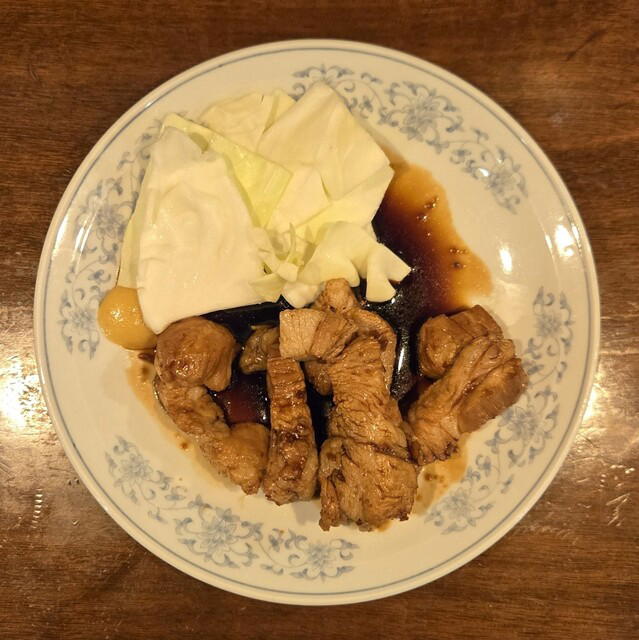
- Ton ton ton pork skewers
- Daily small plates (obanzai-style snacks)
Osaka rewards places that work at street speed. Around the city, dining is less about long reservations than movement: office workers ending the day, small groups sliding into narrow counters, a drink ordered before evening fully settles. Here, tachinomi is not novelty but practical Osaka language: low-friction, social, and built on the idea that standing can make a meal feel sharper rather than smaller.
Washington Shokudo belongs to that language. The category matters more than any single plate. Osaka stand-up bars compress dinner into small decisions: what to drink first, which dish keeps pace, when to add one more order, when to move on. The format changes the critical lens. Comfort is flow, not upholstery. Hospitality is tempo, not tableside theatre. The room asks diners to read the counter, order with intent, and accept the pleasure of little over-explanation.
Osaka tachinomi, read as a meal in chapters
The rhythm here is closer to a tasting progression than a conventional izakaya sprawl, even without a set menu. Tachinomi often starts with the drink as anchor, then moves through quick-arriving orders and a final choice selected as much for closure as appetite. That sequence suits Osaka, a city that has long treated everyday eating as serious craft, from takeout counters to compact drinking rooms.
The Tabelog 100 - Tachinomi - 2025 selection gives the room a clear trust signal in a category where casualness can disguise real competition. Tachinomi venues are judged in a crowded field, and recognition suggests consistency within a narrow format: speed, drink compatibility, crowd management, and value all have to align. This is a different competitive set from other Osaka names such as Yakiniku Horumon Odoru or Kyoshoran Honten, where the rhythm and expectations are not the same as a stand-up bar. It is also distinct from Izakaya Toyo, another Osaka reference point for casual energy. Osaka’s stand-up counter culture is more clipped: arrive, read the room, commit.
That economy of choice is the appeal. Osaka dining is often discussed through famous snacks and market theatrics, but everyday drinking rooms reveal a more useful truth: price discipline does not mean thin experience. A strong tachinomi counter can deliver a complete night through sequencing alone. The first round loosens the room, middle orders define the kitchen’s range, and the last drink decides whether the stop was a prelude or the evening’s point.
Why the stand-up format changes the critic's criteria
Seated restaurants invite diners to linger over polish. Tachinomi asks different questions. Is the room legible from the entrance? Does ordering feel efficient rather than rushed? Are portions calibrated for drinking rather than built like full dinner plates? Does the crowd create momentum without tipping into disorder? These are not secondary details; they are the architecture of the genre.
Washington Shokudo’s 2025 Tabelog 100 placement is notable within the stand-up bar category. Venues in established Osaka drinking circuits must prove they understand inherited habits before bending them. The city is not a blank canvas for concept dining; it has an established after-work rhythm and diners who compare instinctively. A stand-up bar here competes not only with other tachinomi counters but with quick meals, convenience, fatigue, and the next plan.
For visitors building an Osaka itinerary, this corrects a schedule overloaded with destination meals. The city is better understood when high-control dining and casual counter culture sit side by side. A night starting with tachinomi in Osaka tells a different story from one shaped around more formal dining rooms, specialist counters, or famous casual institutions elsewhere in the city. The point is not hierarchy. It is range.
That range extends beyond dinner. Osaka’s food map can move from daytime stops into a standing bar as the city shifts into evening mode. Readers planning around neighborhoods rather than isolated bookings should start with Our full Osaka restaurants guide, then match the night with Our full Osaka bars guide and, for the stay, Our full Osaka hotels guide. Broader planning can also pull in Our full Osaka experiences guide and Our full Osaka wineries guide.
How it fits into a Japan eating itinerary
Japan’s casual dining formats are often misunderstood by travelers looking only for reservations, tasting counters, and chef-led rooms. Smarter itineraries leave space for small, specialized stops where the format does the teaching. Tachinomi in Osaka and other compact, single-purpose dining rooms show how a narrow premise can carry an evening when execution and context align.
Within Japan, the same principle applies across categories. A traveler might compare the clarity of a standing bar with other focused rooms in major cities, quieter counters, casual specialists, or regional restaurants built around a clear format. Even more assertive dining styles are easier to understand when the diner tracks structure: what the room wants you to do, how quickly the meal should move, and where value is concentrated.
The editorial verdict is simple: this is an Osaka-format meal, not a trophy reservation. Its interest lies in how much the city can compress into a standing-room evening: pace, thrift, crowd energy, and a sequence of orders that feels complete without ceremony. For travelers who only chase formal counters, this is the kind of stop that recalibrates Osaka.
Frequently asked questions
What's the overall feel of Washington Shokudo?
Washington Shokudo reads as an Osaka tachinomi, with the stand-up format shaping the whole experience. It was selected for Tabelog 100 Tachinomi 2025, and its listed spending range keeps the room focused on pace rather than linger-over-luxury dining.
What should I budget for a meal at Washington Shokudo?
Pricing at Washington Shokudo is listed as - JPY 999 JPY 1,000 - JPY 1,999 View spending breakdown.
Where do I go for Washington Shokudo?
Osaka.
What is Washington Shokudo known for?
Washington Shokudo is primarily known as a stand-up bar in Osaka, with recognition in the Tabelog 100 - Tachinomi - 2025 selection.
Cost and Credentials
Comparable venues for orientation by cuisine and category.
| Venue | Cuisine | Price | Awards | Notes |
|---|---|---|---|---|
| Washington ShokudoThis venue (the venue you are viewing) | Standing Japanese bar (tachinomi izakaya) | $10–20 | Tabelog 100 #6 | Not listed |
| Human beings everybody noodles (人類みな麺類) | Traditional Shoyu Ramen | $1–10 | Tabelog 100 #65 | Nishinakajima, Yodogawa-ku, Traditional Shoyu Ramen |
| Curry Rice | Japanese Curry House | $1–10 | Tabelog 100 #35 | Chūō, Japanese Curry House |
| Kikujudo Yoshinobu | Traditional Japanese wagashi & tea cafe | Not listed | Tabelog 100 #4 | Chūō, Traditional Japanese wagashi & tea cafe |
| Buttah | Japanese Curry | Not listed | Tabelog 100 #55 | Chūō, Japanese Curry |
| Angetsu | Traditional Japanese Wagashi (Confectionery) | $10–20 | Tabelog 100 #56 | Chūō, Traditional Japanese Wagashi (Confectionery) |
Recognition history
Dated appearances from independent guides and award organizations, with the underlying list record or original source where available.
Tabelog 100 #6 · No. 6
Tabelog · Tabelog 100 - Tachinomi - 2025