Our verdict
Me Wah Restaurant on Invermay Road in Launceston has been a reference point for Chinese dining in northern Tasmania for decades, operating in a suburb better known for industrial yards than restaurant rows. The room and the kitchen sit within a broader conversation about how Chinese-Australian cuisine has evolved outside the mainland capitals, where sourcing from Tasmania's agricultural and maritime supply chain carries particular weight.

Pearl is the En Primeur Club membership app — saves, bookings, and concierge access live there. Same editors, same standards.
- Address
- 39-41 Invermay Rd, Launceston TAS 7250, Australia
- Phone
- +61 3 6331 1308
- Hours
- Mon ClosedTue–Wed 5–9:30 PMThu–Fri 11:30 AM–2:30 PM, 5–9:30 PMSat 11:30 AM–2:30 PM, 5–10:30 PMSun 11:30 AM–2:30 PM, 5–9:30 PM
- Website
- mewah.com.au
- Directions
- Get directions
Chinese Dining in Northern Tasmania: Where Invermay Road Fits
Launceston's dining scene has always operated at a remove from the capital-city restaurant press cycle. While Hobart attracts the bulk of interstate food coverage — see Aloft in Hobart for a sense of how the southern city's fine-dining tier has developed — the north has built its own reference points through longevity rather than awards campaigns. Me Wah Restaurant on Invermay Road sits in that category: a Chinese dining address in a suburb defined by light industrial use and residential streets, not the kind of precinct that generates editorial attention on its own terms. That geographic remove has, in some ways, insulated the kitchen from the trend cycles that reset menus in Melbourne and Sydney every eighteen months.
Chinese-Australian restaurants outside the major capitals occupy a specific position in the country's food culture. They absorb less of the fine-dining infrastructure, the chef pipeline, the PR apparatus, the Michelin-adjacent benchmarking, and often rely instead on community continuity and consistent sourcing relationships. In this respect, what happens in a room like Me Wah's tells you something broader about how Chinese cuisine has taken root in regional Australia: not through chef-driven reinvention in the manner of Attica in Melbourne or Rockpool in Sydney, but through a quieter accumulation of regulars, relationships, and a kitchen that knows its supply chain.
The Ingredient Argument: Tasmania as a Source
The ingredient case for Tasmania is well established at this point, though it is worth separating the genuine supply-chain advantage from the promotional shorthand. The island's cool-climate growing conditions, clean water systems, and comparatively low-intensity agricultural footprint produce seafood, vegetables, and protein that benchmark well against mainland equivalents. For a Chinese kitchen, one that depends on the precise texture of freshly killed protein, the salinity of shellfish, and the sweetness of cold-water fish, the proximity to Tasmanian supply is not a marketing point but a practical one.
This is the context in which Me Wah's address in Invermay becomes relevant. The restaurant sits close enough to northern Tasmania's agricultural and aquaculture supply lines to source with less intermediation than a comparable Chinese kitchen in Sydney or Brisbane. Across Australia's premium restaurant tier, from Brae in Birregurra to Hentley Farm in Seppeltsfield to Pipit in Pottsville, the sourcing story has become a primary editorial frame, and regional Chinese restaurants in Tasmania operate within that same ingredient context even when the public-facing narrative doesn't emphasise it.
It is worth noting how this compares to the approach taken at Chinese-Australian restaurants in larger cities. Cantonese kitchens in Melbourne's CBD, for instance, often source from dedicated Asian produce networks that prioritise variety and volume over regional specificity. A regional Tasmanian kitchen has a different set of trade-offs: narrower variety, but tighter provenance on the proteins and vegetables that do appear.
The Room and the Setting
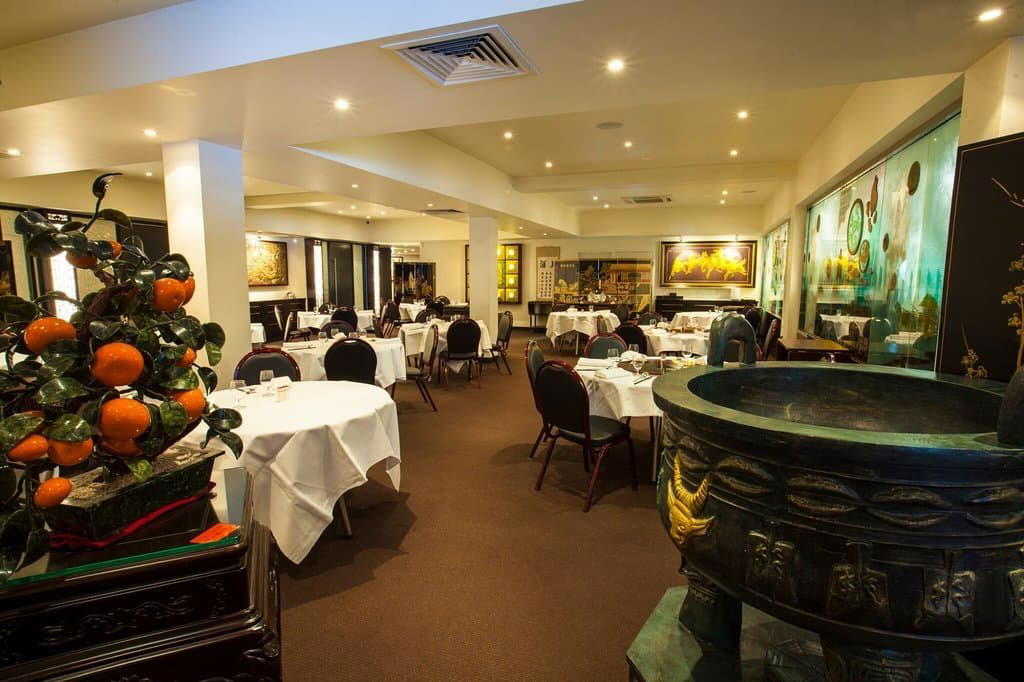
Invermay Road is not a dining strip. The surrounding blocks mix residential housing with warehousing and service businesses, and Me Wah occupies a low-rise address at numbers 39-41 that reads as practical rather than atmospheric. This is not unusual for Chinese restaurants in Australian regional cities, which have historically prioritised capacity and accessibility over design-led environments. The contrast with, say, destination restaurants built around landscape and architecture, Wills Domain in Yallingup or Laura at Pt Leo Estate in Merricks, is pronounced. Me Wah belongs to a different tradition: the working Chinese restaurant that earns its standing through the plate rather than the room.
For the Australian regional Chinese restaurant format, this is actually the norm rather than the exception. The Cantonese dining tradition that shaped much of Australian Chinese cuisine prioritises round-table service, shared dishes, and a room that can function for a family banquet and a business lunch without major reconfiguration. Invermay's dining options are covered in more detail in our full Invermay restaurants guide, which maps the suburb's limited but functional food scene.
Where Me Wah Sits in the Regional Chinese Dining Picture
Regional Chinese restaurants across Australia occupy a wide quality spectrum. At the recognised end of the tier, Melbourne's Flower Drum has set a Cantonese benchmark for decades. Further afield, ingredient-led approaches at places like fermentAsian in Barossa Valley show how Chinese-influenced cooking has found a place within the Australian fine-dining conversation. Me Wah in Invermay operates without that awards scaffolding in the available record, which places it in the community-anchor category: the kind of restaurant that sustains a city's Chinese dining culture between the capital-city flagships.
For context, Tasmania's Chinese-Australian restaurant history traces back to the gold rush era and subsequent migration waves. Northern Tasmanian cities like Launceston developed Chinese communities and, eventually, Chinese restaurants well before the modern fine-dining industry took shape. What survives in addresses like Me Wah's is the institutional memory of that trajectory, a restaurant in a suburb, serving a city, without the need to perform for a national audience. This is a pattern visible across Australia's regional centres, from Salt Water Restaurant in Cairns to Provenance in Beechworth, where the local audience is the primary constituency.
Internationally, the reference points for Chinese restaurants embedded in non-metropolitan settings include some of the most technically precise kitchens in the world. Le Bernardin in New York City and Lazy Bear in San Francisco represent the American equivalent of the chef-driven destination model that Chinese regional restaurants largely sidestep. The comparison is useful precisely because it shows how differently the community-anchor model functions: without the tasting-menu format, the reservation scarcity, or the awards apparatus, what remains is the kitchen's relationship with its regular clientele and its suppliers.
Planning Your Visit
Me Wah Restaurant is located at 39-41 Invermay Road, Launceston, Tasmania. Invermay sits immediately north of Launceston's CBD, accessible by car in under ten minutes from the city centre. The suburb has limited foot traffic in the evenings, so driving or rideshare is the practical approach. For a broader picture of what northern Tasmania's food scene offers alongside Me Wah, Ormeggio at The Spit in Mosman and Blackwood Pantry in Cronulla offer points of comparison for regional Australian dining of a similar character. For Tasmanian visitors with time to move between the island's dining options, the contrast between Launceston's community-anchored restaurants and Hobart's more design-conscious offerings is worth experiencing across a longer trip. Lizard Island Resort sits at the other end of the Australian destination-dining spectrum and is useful context for understanding where a place like Me Wah positions itself: close to its city, close to its regulars, and without the resort infrastructure.
Frequently asked questions
Can I bring kids to Me Wah Restaurant?
Me Wah Restaurant on Invermay Road, Launceston occupies a low-key commercial setting that is not oriented around fine-dining formality, which generally makes it a more relaxed environment for families. Chinese restaurant formats — with shared dishes ordered to the table — tend to suit groups that include children. For specific seating arrangements or high chair availability, contacting the restaurant directly before your visit is advisable.
What should I expect atmosphere-wise at Me Wah Restaurant?
Invermay Road is a mixed residential and commercial strip north of Launceston's CBD, and Me Wah sits within that workaday context rather than on a polished dining precinct. The setting is neighbourhood-scale and unpretentious. That remove from the city-centre restaurant cluster tends to attract a local repeat clientele rather than the tourist-driven foot traffic that shapes venues closer to the mall or waterfront.
Is Me Wah Restaurant one of the longer-established Chinese dining venues in Launceston?
Me Wah Restaurant has operated from its Invermay Road address in Launceston long enough to hold a recognised presence in northern Tasmania's dining scene, a region where the Chinese restaurant tier is smaller and less documented than in Hobart or the mainland capitals. In a city where the broader restaurant press cycle tends to focus on new openings, longevity on a non-tourist strip like Invermay Road reflects a consistent local following. For verified trading history or awards, the restaurant itself is the authoritative source.
What do people recommend at Me Wah Restaurant?
Specific dish recommendations are best sourced from recent diner reviews, as menus at long-running Chinese restaurants in regional Australia typically shift with seasonal availability and kitchen focus. Me Wah's address at 39-41 Invermay Road, Launceston places it within reach of Tasmania's well-documented local produce supply chains, which regional Chinese restaurants have increasingly drawn on.
Where is Me Wah Restaurant in Invermay?
Me Wah Restaurant is located at 39-41 Invermay Rd, Launceston TAS 7250, Australia, Invermay.
Comparable Spots, Quickly
Comparable venues nearby, for context on price, style, and recognition.
| Venue | Cuisine | Price | Notes |
|---|---|---|---|
| Me Wah RestaurantThis venue — the venue you are viewing | Cantonese-Australian Fusion | $50–100 | Not listed |
| Wonton House | Traditional Chinese Noodle House | $10–20 | Box Hill |
| Wunderbar | French Brasserie with Tasmanian Ingredients | Not listed | North Hobart |
| Analiese Gregory’s anti-restaurant | Intimate seasonal fusion by Analiese Gregory | Not listed | Hobart |
| Centonove | Contemporary Italian | $100–150 | Kew |
| Icebergs Bar and Kitchen | Coastal Italian Fine Dining | $100–150 | Sydney Airport T3 Domestic Terminal |
Continue exploring
More in Invermay
Restaurants in Invermay
Browse all →
Bars in Invermay
Browse all →
Hotels in Invermay
Browse all →

Details
- Classic
- Special Occasion
- Local Sourcing
- A La Carte
- Vegetarian Friendly
- Vegan Options
- Gluten Free Options
Current opening hours
- Monday
- Closed
- Tuesday
- 5–9:30 PM
- Wednesday
- 5–9:30 PM
- Thursday
- 11:30 AM–2:30 PM, 5–9:30 PM
- Friday
- 11:30 AM–2:30 PM, 5–9:30 PM
- Saturday
- 11:30 AM–2:30 PM, 5–10:30 PM
- Sunday
- 11:30 AM–2:30 PM, 5–9:30 PM
Hours can change for holidays and private events. Last verified .
Old-school ambience with polished service.