Mandalay
Mandalay serves Burmese food in a historic building, with beer alongside lunch and dinner; tea leaf salad and nan gyi dok anchor the menu.
Pearl is the En Primeur Club membership app — saves, bookings, and concierge access live there. Same editors, same standards.
- Address
- 4348 California St, San Francisco, CA 94118
- Phone
- +14153863895
- Website
- mandalaysf.com
- Directions
- Get directions
 Saves & bookings on Pearl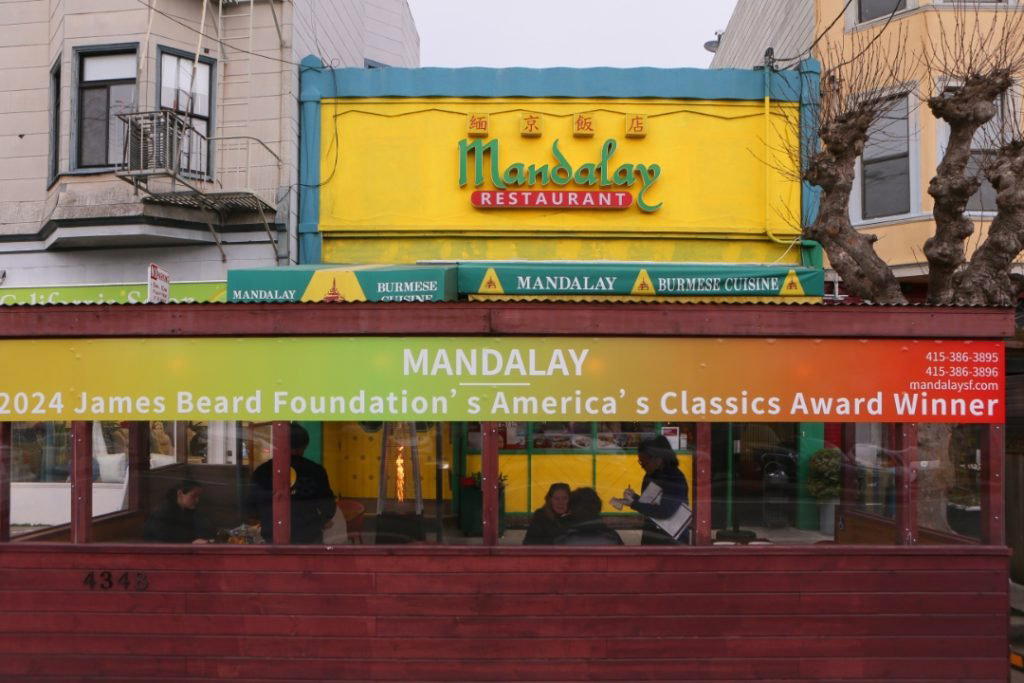
California Street and the Richmond's Burmese Anchor
The Inner Richmond has long operated as San Francisco's most quietly serious dining neighborhood. While SoMa and the Financial District absorb the press cycles around tasting-menu dining, the avenues between Arguello and Park Presidio sustain a denser, older tradition: family-run restaurants drawing on Southeast and East Asian culinary lineages that predate most of the city's celebrated fine-dining openings. Mandalay, at 4348 California Street, sits within that tradition. The address places it in the heart of the Richmond's mid-block commercial corridor, where Burmese cooking has found a steady American foothold.
Burmese cuisine occupies a distinctive position in American cities: it absorbs Indian spicing, Chinese technique, and Southeast Asian fermentation logic into a register that feels familiar from multiple angles yet collapses into none of them. Dishes built on fermented tea leaves, shrimp paste, and dried shrimp operate on the same sourcing philosophy that drives much of the high-end farm-to-table programming now standard at San Francisco's upper-tier restaurants. The difference is that these ingredients arrive not from local purveyors but from a supply chain rooted in Burmese culinary culture, and the flavor depth they produce requires no intervention from modernist technique.
Ingredient Logic in Burmese Cooking
The sourcing framework behind Burmese cooking is worth understanding because it explains why the cuisine resists easy adaptation. Laphet thoke, the fermented tea leaf salad that functions as a national reference dish, depends on tea leaves that have been buried and fermented for months before reaching the table. The crunch components, typically fried garlic, sesame seeds, dried shrimp, and peanuts, are assembled at service so each textural layer remains distinct. This is sourcing-driven cooking in a literal sense: the ingredient's pre-table life determines the dish's character more than any kitchen intervention does.
The same logic applies to mohinga, the fish-based rice noodle soup that functions as an everyday reference point across Burmese cooking. The broth's depth comes from dried fish and lemongrass cooked down over time, not from high-heat reduction or finishing-fat enrichment. These are flavor-building approaches grounded in preservation and fermentation traditions that developed in a climate and food system entirely different from California's. Restaurants working in this tradition are essentially translating a sourcing philosophy that traveled with the cuisine, not one assembled from local supply chains.
This distinction matters in San Francisco's current dining context. The city's most celebrated rooms, including Saison, Lazy Bear, and Atelier Crenn, operate on a sourcing-first premise where the story of an ingredient's origin is built into the menu narrative. Burmese restaurants working with fermented and dried pantry ingredients carry an equivalent depth, but without the accompanying PR architecture. The sourcing is simply assumed, embedded in recipes that have been stable across generations.
Richmond District Context
The Inner Richmond's restaurant density reflects San Francisco's broader immigrant community geography. The neighborhood's Burmese and Chinese restaurant concentration developed over decades, with California Street serving as one of the primary commercial spines. This is not a recent dining trend. The Burmese presence in the Richmond predates the current wave of interest in Southeast Asian cuisines by a significant margin, which means restaurants like Mandalay have been serving a regular, return-visit-driven clientele rather than building on novelty cycles.
That dynamic distinguishes the Richmond from the neighborhoods that draw most of San Francisco's food press. Restaurants at the caliber of Benu, Quince, and Atelier Crenn occupy a formal, reservation-dependent tier where the visitor is often a first-time diner treating the meal as a destination event. A neighborhood Burmese restaurant operates on different terms: the regulars set the social rhythm, the menu is stable enough that ordering habits deepen over multiple visits, and the value proposition is repeatability rather than occasion.
Nationally, the Burmese restaurant category remains smaller than many other Southeast Asian cuisines, and cities with significant Burmese communities, San Francisco, Los Angeles, and New York among them, each have a handful of serious Burmese rooms. Atomix in New York exemplifies the Korean fine-dining tier; Burmese cooking has no direct equivalent in that formal register. The Richmond's Burmese restaurants operate in the space between neighborhood staple and serious-cooking destination, and that positioning is increasingly where particularly consistent cooking in American cities actually lives.
Placing Mandalay in Broader American Dining
The conversation around where serious cooking happens in the United States has shifted. Restaurants at the caliber of The French Laundry in Napa, Le Bernardin in New York, and Alinea in Chicago anchor formal recognition, but editorial attention has also turned to the community-anchored restaurants that sustain daily cooking traditions without seeking that kind of validation. Blue Hill at Stone Barns made sourcing philosophy legible to a fine-dining audience; Burmese cooking has been applying comparable logic for far longer, without the same institutional framing.
Other regionally specific American rooms that operate on a similar philosophy of technique-in-service-of-tradition include Bacchanalia in Atlanta and Single Thread Farm in Healdsburg, both of which treat sourcing decisions as the primary editorial statement of a meal. The difference is format and price point. Addison in San Diego, Providence in Los Angeles, and The Inn at Little Washington all operate with the full apparatus of formal dining recognition behind them. The Richmond's Burmese rooms work without that apparatus, and the cooking is no less considered for it.
Know Before You Go
- tea leaf salad
- samusa soup
- nan gyi dok
- Mandalay special noodles
- balata
- rainbow salad
Cost Snapshot
Comparable venues nearby, for context on price, style, and recognition.
| Venue | Cuisine | Price | Notes |
|---|---|---|---|
| MandalayThis venue — the venue you are viewing | Inner Richmond, Burmese | $$ | Not listed |
| Pica Pica Arepa Kitchen | Mission, Venezuelan Arepas | $$ | Not listed |
| Paulie's Pickling | Not listed | $$ | Bernal Heights, Cali-Jewish Deli & Pickles |
| Polly Ann Ice Cream | Not listed | $ | Sunset/Parkside, Artisanal Ice Cream |
| Paprika | Mission, Czech-Hungarian Comfort Food | $$ | Not listed |
| Burma Superstar | Inner Richmond, Authentic Burmese | $$ | Not listed |
Continue exploring
More in San Francisco
Restaurants in San Francisco
Browse all →
Bars in San Francisco
Browse all →
Hotels in San Francisco
Browse all →
At a Glance
- Well Known
- Cozy
- Lively
- Family
- Group Dining
- Casual Hangout
- Celebration
- Standalone
- Historic Building
- Beer Program
Current opening hours
- Monday
- 4:30–8:30 PM
- Tuesday
- 4:30–8:30 PM
- Wednesday
- 4:30–8:30 PM
- Thursday
- 4:30–8:30 PM
- Friday
- 11:30 AM–3 PM, 4:30–8:30 PM
- Saturday
- 11:30 AM–3 PM, 4:30–8:30 PM
- Sunday
- 11:30 AM–3 PM, 4:30–8:30 PM
Hours can change for holidays and private events. Last verified .
Warm and welcoming with beautiful decorative pujas in every corner; spacious interior with close-quarters seating typical of San Francisco cafes; feels like a guest at someone's home.