Maltby Street Market
Our verdict
Maltby Street Market occupies a run of railway arches in Bermondsey, operating at the less-polished, more serious end of London's street food scene. Where Borough Market draws the tourist footfall, Maltby Street pulls the producers: small-batch traders, natural wine importers, and weekend stalls that prioritise provenance over presentation. It is a working market with an editorial sensibility, best visited on a Saturday morning with no fixed agenda.

Pearl is the En Primeur Club membership app — saves, bookings, and concierge access live there. Same editors, same standards.
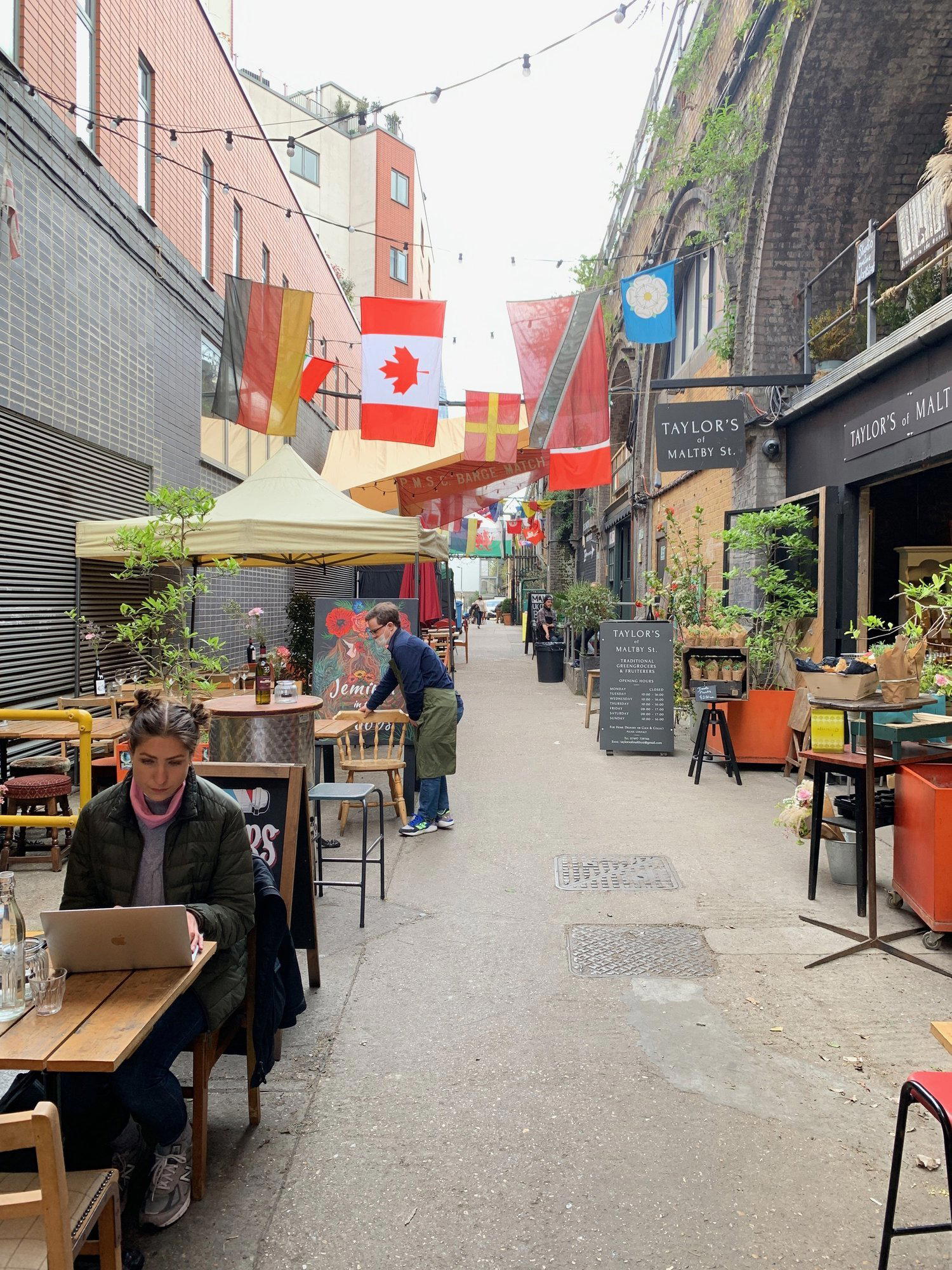
Under the Arches: What Bermondsey's Market Quarter Actually Looks Like
Approach Maltby Street from Bermondsey Street and the shift is immediate. The railway arches running along Ropewalk carry a particular kind of urban weight: Victorian brickwork blackened by decades of traffic, low ceilings that force conversation inward, the sound of freight still moving overhead on some mornings. This is not a designed market environment in the way that many of London's food destinations have become. There are no heritage-font wayfinding signs, no sponsor banners, no unified aesthetic. What you get instead is a corridor of traders who have chosen this location for practical reasons: affordable arch space, proximity to Bermondsey's growing density of food and drink professionals, and a crowd that shows up specifically because the product is the point.
The Saturday market is the primary draw, when the full stretch of stalls between the arches activates. Weekday trading exists in a quieter form, primarily through the permanent arch tenants rather than the outdoor pitch holders. Timing matters: arrive before midday on a Saturday and you are moving through a working market at full pace; arrive after 2pm and some stalls will have sold through their leading stock.
Where Maltby Street Sits in London's Market Hierarchy
London's food market scene has fragmented considerably over the past decade. Borough Market, a ten-minute walk west, operates at a different scale entirely: 100-plus traders, year-round operation, global visitor numbers, and a product mix that now includes as much prepared food consumption as raw ingredient retail. Brixton Village moved toward a permanent restaurant corridor model. Maltby Street has remained in a smaller, more specialised tier, where individual stall holders tend to be producers or importers with direct supply relationships rather than resellers aggregating from wholesale sources.
That positioning matters for what you actually find here. Natural and low-intervention wine importers have had a consistent presence, which places Maltby Street in conversation with the broader Bermondsey wine corridor that has developed along Bermondsey Street and its surrounding blocks. Cheesemakers, small-batch preservers, bread bakers with named grain sourcing, and meat traders working with specific farms all appear in the stall mix. The market functions as a distribution point for producers who either cannot or choose not to operate full retail premises.
For visitors mapping London's drink-led venues, the market's relationship to the surrounding Bermondsey bar and restaurant scene is worth noting. The arch format that defines Maltby Street is the same format that has housed a generation of London's more serious independent bars and bottle shops. Venues like 69 Colebrooke Row in Islington represent the precise, technique-driven end of London cocktail culture; Maltby Street represents the ingredient-first, provenance-driven end of the same broader shift in how London eats and drinks. A Bar with Shapes For a Name and Academy sit within the same London ecosystem of venues where the sourcing conversation is as important as the finished product. Amaro similarly reflects how London's independent bar culture has developed a vocabulary around Italian digestif traditions.
The Drinks Dimension: Natural Wine and Small-Batch Producers
The editorial angle on Maltby Street as a drinks destination rests primarily on its wine and small-producer spirits presence. The market has consistently attracted importers working in the natural and low-intervention wine space, which during the period of that category's rapid London growth made it an early public-access point for bottles that were otherwise sold through restaurant lists or specialist retail only. The pattern repeats across several categories: producers use the market format to reach a direct retail customer before or alongside their wholesale accounts.
This is meaningfully different from the approach taken by London's cocktail bar scene. Where venues like Bramble in Edinburgh or Schofield's in Manchester curate drinking experiences through a bartender's technical vision, Maltby Street places the sourcing decision with the visitor. There is no bartender mediation, no cocktail programme, no house style. The drink-led experience here is about buying directly from people who made or imported what they are selling, then consuming it in the immediate surroundings of the market. Several arch tenants and permanent operators run on-site consumption alongside retail, which means you can drink a glass of something while learning where it came from in a single transaction.
For visitors building a broader London drinks itinerary, the market pairs well with Bermondsey's permanent bottle shops and bar operators who work with similar supplier networks. The same logic applies if you are mapping regional British bar culture: Mojo Leeds, Bar Kismet in Halifax, and Dear Friend Bar in Dartmouth each represent how independent drink culture has embedded itself in different UK cities; Maltby Street represents the London end of that movement at the retail and market level rather than the bar-format level. Internationally, Bar Leather Apron in Honolulu and Lab 22 in Cardiff show how the sourcing-first sensibility has spread well beyond London's immediate orbit.
The Food Stall Picture
The prepared food offer at Maltby Street has evolved alongside the broader London street food maturation. Early market years saw a rougher rotation of pop-up concepts; the current Saturday mix tends toward stalls with defined identities and repeat presence, which allows regulars to track specific operators across weeks and seasons. The cuisine range is not organised by category in the way a food hall might be: you are as likely to find a hyper-specific regional dish from a single-origin trader as you are a broader European-influenced preparation. The informality is deliberate and the physical layout enforces it. There is limited seating, minimal shelter, and no particular logic to the progression of stalls. You eat standing up, or perched on whatever surface is available, usually in conversation range of the person who prepared what you are holding.
For a broader map of where to eat and drink across the capital, see our full London restaurants guide.
Know Before You Go
- Location: Arch 46, Ropewalk, Maltby St, London SE1 3PA
- Primary trading day: Saturday; reduced activity on other days through permanent arch tenants
- Nearest transport: Bermondsey (Jubilee line) is the closest Underground station; London Bridge is a slightly longer walk but offers more transport options
- What to bring: Cash is accepted at most stalls; card acceptance varies by trader
- Timing: Saturday mornings before midday for the fullest stall activation and leading stock availability
- Booking: No reservation required or possible for the market itself; individual arch tenants with restaurant or bar formats may operate their own booking arrangements
Frequently asked questions
Where can I find Maltby Street Market?
Maltby Street Market is located at Arch 46, Ropewalk, Maltby St, London SE1 3PA, United Kingdom, London.
How does Maltby Street Market differ from Borough Market?
Borough Market, roughly ten minutes west of Ropewalk SE1, operates at a substantially larger scale with year-round opening and a significant tourist footfall. Maltby Street runs on a tighter weekend schedule and leans heavily toward natural wine and small-batch producers rather than the broader retail and prepared-food mix Borough offers. The Bermondsey arches format also means the physical layout is linear and more intimate, with individual operators occupying distinct arch units rather than a consolidated market hall.
What's the must-try cocktail at Maltby Street Market?
Maltby Street Market does not operate a cocktail programme. The drinks offer is built around individual stallholders and arch tenants, with natural wine and small-batch spirits making up the primary proposition. If you are specifically after cocktails, this is not the right destination — the market's strength lies in producer-direct wine and fermented or craft drinks rather than mixed drinks.
What is Maltby Street Market known for?
Maltby Street Market, at Arch 46 on Ropewalk in Bermondsey SE1, has built its reputation around a producer-led model that prioritises natural wine and small-batch food and drink over the tourist-facing scale of markets like Borough Market. It operates as a more localised circuit where stallholders tend to be makers rather than resellers. The market has consistently attracted natural wine importers and independent food producers who use the arches as a direct sales and tasting point.
Do I need a reservation for Maltby Street Market?
The market itself requires no reservation — entry is open and movement between stalls is self-directed. Some permanent arch tenants with seating may take bookings independently, so if you are planning around a specific operator rather than the broader market, it is worth checking with them directly before visiting Ropewalk, SE1.
Who is Maltby Street Market best for?
The market is most useful for visitors who want direct access to London's small-producer food and drink community: natural wine drinkers, people sourcing artisan provisions, and those who prefer a less commercialised format than Borough Market, a ten-minute walk west. It is less suited to visitors expecting a wide prepared-food hall or a predictable, year-round menu-driven experience.
Just the Basics
A compact comparison to help you place this venue among nearby peers.
| Venue | Cuisine | Price | Awards |
|---|---|---|---|
| Maltby Street MarketThis venue — the venue you are viewing | Not listed | $20–30 | Not listed |
| Quo Vadis | Seasonal British | $50–100 | World's 50 Best #42 · The Good Food Guide GFG Good |
Continue exploring
More in London
Restaurants in London
All restaurants in London →
Bars in London
All bars in London →





Details
- Trendy
- Lively
- Rustic
- Industrial
- Casual Hangout
- After Work
- Beer Garden
Current opening hours
- Monday
- Closed
- Tuesday
- Closed
- Wednesday
- Closed
- Thursday
- Closed
- Friday
- Closed
- Saturday
- 10 AM–5 PM
- Sunday
- 11 AM–4 PM
Hours can change for holidays and private events. Last verified .
Lively and lively market atmosphere with a relaxed, hipster feel under brick arches, busy with foodies on weekends.