Michelin Plate · Tabelog 100 #42
Our verdict
In Setagaya's Futako-Tamagawa neighbourhood, Maeshiba Ryoriten operates as one of Tokyo's most focused French restaurants, built around a single discipline: charcoal-grilled beef and classical sauce work. Named producers, meticulous flame technique, and a 2025 Michelin Plate recognition place it firmly within Tokyo's quieter tier of serious French cooking, away from the Michelin-starred circuit in central districts.

Pearl is the En Primeur Club membership app, where members save venues, book tables and use the concierge.
French Cooking at the Edge of the City
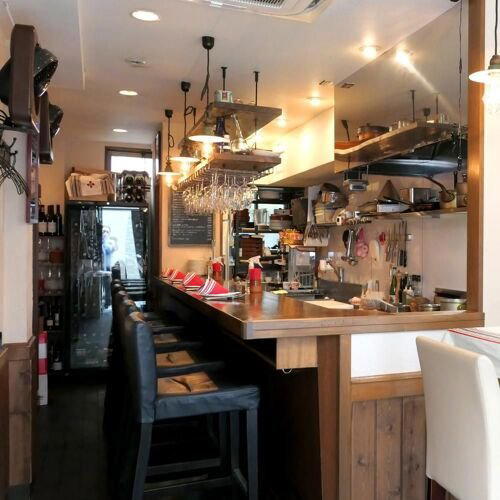
Tokyo's French restaurant scene concentrates most of its institutional weight in Minami-Aoyama, Ginza, and Azabu-Juban, where three-Michelin-star addresses like Château Restaurant Joël Robuchon and multi-awarded rooms like L'Effervescence, Sézanne, and ESqUISSE form a recognisable prestige cluster. Further out, in residential Setagaya, a different kind of French kitchen has taken hold. Maeshiba Ryoriten occupies basement space in Futako-Tamagawa, a neighbourhood better known for its riverbank walks and department stores than for fine dining, and it operates on a logic that the central circuit rarely follows: radical reduction of scope, not expansion of it.
The restaurant holds a 2025 Michelin Plate, a designation that signals consistent cooking quality without the theatre of a star. In Tokyo's French dining tier, that places it alongside restaurants where the kitchen's discipline is evident but the room's ambition is local rather than international. It is a meaningful distinction. The Plate, in practice, often identifies the city's most reliable neighbourhood destinations rather than its trophy tables.
One Speciality, Executed at Depth
The premise at Maeshiba Ryoriten is narrow enough to be instructive about a broader trend in Japanese French cooking. Where many of Tokyo's mid-tier French rooms attempt range, offering seafood courses, vegetable compositions, and meat in sequence, Maeshiba Ryoriten has reduced its focus to two things: charcoal-grilled beef and classical sauces. Every element of the menu is organised around that axis.
Ingredients are sourced with named-producer specificity, a practice that is now standard at starred Tokyo addresses like Florilège but rarer at the Plate tier. Here, the sourcing is not a marketing point appended to the menu; it is the operating premise. The fire technique is described as finely disciplined, which in charcoal cookery means sustained, attentive management of temperature zones, distance, and timing. Classical French sauce work, which requires long reduction and precision calibration, sits alongside that flame discipline as the kitchen's second technical foundation.
This kind of singular focus has precedent in French cooking elsewhere. Hotel de Ville Crissier in Switzerland built its reputation on classical rigour rather than conceptual range. Les Amis in Singapore demonstrates how French technique applied with depth of commitment holds up in a non-European context. In Tokyo, that depth-over-breadth model has produced some of the city's most disciplined cooking rooms.
The Lunch and Dinner Question
The editorial angle on Maeshiba Ryoriten that matters most to a prospective visitor is not whether to go, but when. The restaurant's format, built around charcoal grilling and sauce work on a menu where beef is the central discipline, shapes service differently across lunch and dinner in ways that are worth thinking through before booking.
In Japanese French restaurants at this tier, lunch typically offers abbreviated menus at lower price points, drawing a neighbourhood clientele of local professionals and regulars who want a serious meal without a full evening's commitment. The ¥¥¥ price tier at Maeshiba Ryoriten, positioned below the ¥¥¥¥ level that defines most of its starred peers in central Tokyo, suggests that the value proposition across both services is already more accessible than the competition. But a lunchtime visit, if service runs that way, is likely to concentrate the kitchen's attention on a tighter menu format, which in a restaurant defined by singular focus may be precisely the right context to experience the core discipline without distraction.
Evening service in a room like this tends to allow the sauce component more time to express itself. Classical French sauces are made in advance, rested, and served at a pace that longer evening formats support. If the kitchen runs a more complete menu at dinner, that is the service in which the full argument for named-producer beef with traditional sauce construction is most legible.
Futako-Tamagawa as Context
Setagaya is one of Tokyo's most populous wards, predominantly residential, and Futako-Tamagawa in particular functions as a weekend destination for families from across the southwestern edge of the city. The dining scene there reflects that demographic: neighbourhood izakayas, casual ramen, a few well-regarded sushi rooms. A French restaurant operating at this level of technical specificity in that context is not competing with the Aoyama cluster. It is serving a different need entirely, providing access to serious French cooking for Setagaya residents and for visitors willing to make the journey on the Den-en-toshi or Ōimachi lines.
For visitors approaching from central Tokyo, Futako-Tamagawa Station is the practical endpoint, reached directly from Shibuya. The address in Luminous Futako-Tamagawa building places the restaurant in a basement retail and restaurant block adjacent to the station, which makes the logistics direct for an area that first-time visitors might otherwise approach with uncertainty.
Where Maeshiba Sits in the Tokyo French Picture
Tokyo's French restaurant ecosystem is broader than its starred tier. Beyond the institutions, a second layer of technically serious kitchens operates at the Michelin Plate level or outside the guide entirely, often in residential neighbourhoods, often with focused rather than comprehensive menus. Maeshiba Ryoriten is part of that layer, and it is a layer worth understanding on its own terms rather than as a step below something else.
The comparison set is not Sézanne or L'Effervescence. It is the category of specialist neighbourhood French rooms that have carved their identity through constraint rather than ambition for scale. Japan more broadly produces this category with unusual reliability: HAJIME in Osaka, Gion Sasaki in Kyoto, akordu in Nara, Goh in Fukuoka, 1000 in Yokohama, and 6 in Okinawa all demonstrate how Japanese chefs at various price points are producing serious Western-rooted cooking outside the obvious prestige addresses. Maeshiba belongs in that reading of the country's dining geography.
For visitors building a longer Tokyo itinerary across categories, the full picture is available through our full Tokyo restaurants guide, alongside resources for hotels, bars, wineries, and experiences across the city.
Planning a Visit
The restaurant is located in the basement level of the Luminous Futako-Tamagawa building at 4 Chome-7-5 Tamagawa, Setagaya City, accessible from Futako-Tamagawa Station. The ¥¥¥ price tier positions a meal here at a meaningful step below Tokyo's starred French rooms, which typically run to ¥¥¥¥.
What Dish Is Maeshiba Ryoriten Famous For?
Maeshiba Ryoriten is defined by charcoal-grilled beef paired with classical French sauces. The kitchen does not present this as one element within a broader tasting menu structure: it is the entire premise. Beef sourced from named producers, grilled over charcoal using closely managed technique, and served with traditional sauces executed with precision is both the signature and the totality of the menu's identity. The 2025 Michelin Plate recognises a kitchen where the fare, as the guide's own language notes, is simple and the work meticulous, which is precisely the combination that makes the speciality legible to a visitor deciding whether to make the journey out to Setagaya.
Frequently asked questions
What style of cooking does Maeshiba Ryoriten do?
What kind of recognition has Maeshiba Ryoriten received?
Maeshiba Ryoriten has received recognition including: The speciality is charcoal-grilled beef and sauce only. On this, the French cuisine of Taira Maeshiba is focused. Ingredients whose producers are listed by name, finely disciplined flame-tending techniques, and traditional yet distinctive s….
What dish is Maeshiba Ryoriten famous for?
Charcoal-grilled beef with classical French sauces is the kitchen's singular focus, not one course among many but the entire premise of Chef Taira Maeshiba's menu. Ingredients are sourced from named producers, and the flame technique is described by Michelin's 2025 evaluators as finely disciplined. The sauces are traditional in method but distinctively composed, and the kitchen does not expand the menu concept beyond this core.
What's the price range at Maeshiba Ryoriten?
Pricing at Maeshiba Ryoriten is listed as ¥¥¥.
What part of town is Maeshiba Ryoriten in?
Maeshiba Ryoriten is located at Japan, 〒158-0094 Tokyo, Setagaya City, Tamagawa, 4 Chome−7−5 ルミナス二子玉川 B1, Tokyo.
Where the Accolades Land
| Venue | Cuisine | Price | Awards | Notes |
|---|---|---|---|---|
| Maeshiba RyoritenThis venue (the venue you are viewing) | French Charcoal-Grilled Beef | $150–200 | Michelin Plate · Tabelog 100 #42 | Not listed |
| Harutaka | Edo-Style Omakase Sushi | $200–300 | 3 Michelin Stars · World's 50 Best #76 | Sushi |
| RyuGin | Modern Kaiseki | $500+ | 3 Michelin Stars · World's 50 Best #41 | Kaiseki, Japanese |
| L'Effervescence | Modern French with Japanese Influences | $200–300 | 3 Michelin Stars · World's 50 Best #69 | French |
| HOMMAGE | Modern French with Japanese Influences | $150–200 | 2 Michelin Stars · World's 50 Best #78 | Innovtive French, French |
| MAZ | Innovative Peruvian-Japanese Fusion | $150–200 | 2 Michelin Stars · World's 50 Best #28 | Innovative |
Recognition history
Dated appearances from independent guides and award organizations, with the underlying list record or original source where available.
Michelin Plate
Michelin
Tabelog 100 #42 · No. 42
Tabelog · Tabelog 100 - French - TOKYO - 2025
Full recognition history (4 entries)
Michelin Plate
Michelin
Michelin Plate
Michelin