Lim Lao Ngow Fishball
Our verdict
Lim Lao Ngow Fishball is a Chiang Mai institution built around one of the most technically demanding preparations in Thai street food: hand-made fishballs. It occupies the low-cost, high-craft tier of the city's noodle scene, where ingredient sourcing and daily production discipline matter more than dining-room ambition. For visitors mapping the full range of northern Thai street eating, it belongs on the itinerary.

Pearl is the En Primeur Club membership app, where members save venues, book tables and use the concierge.
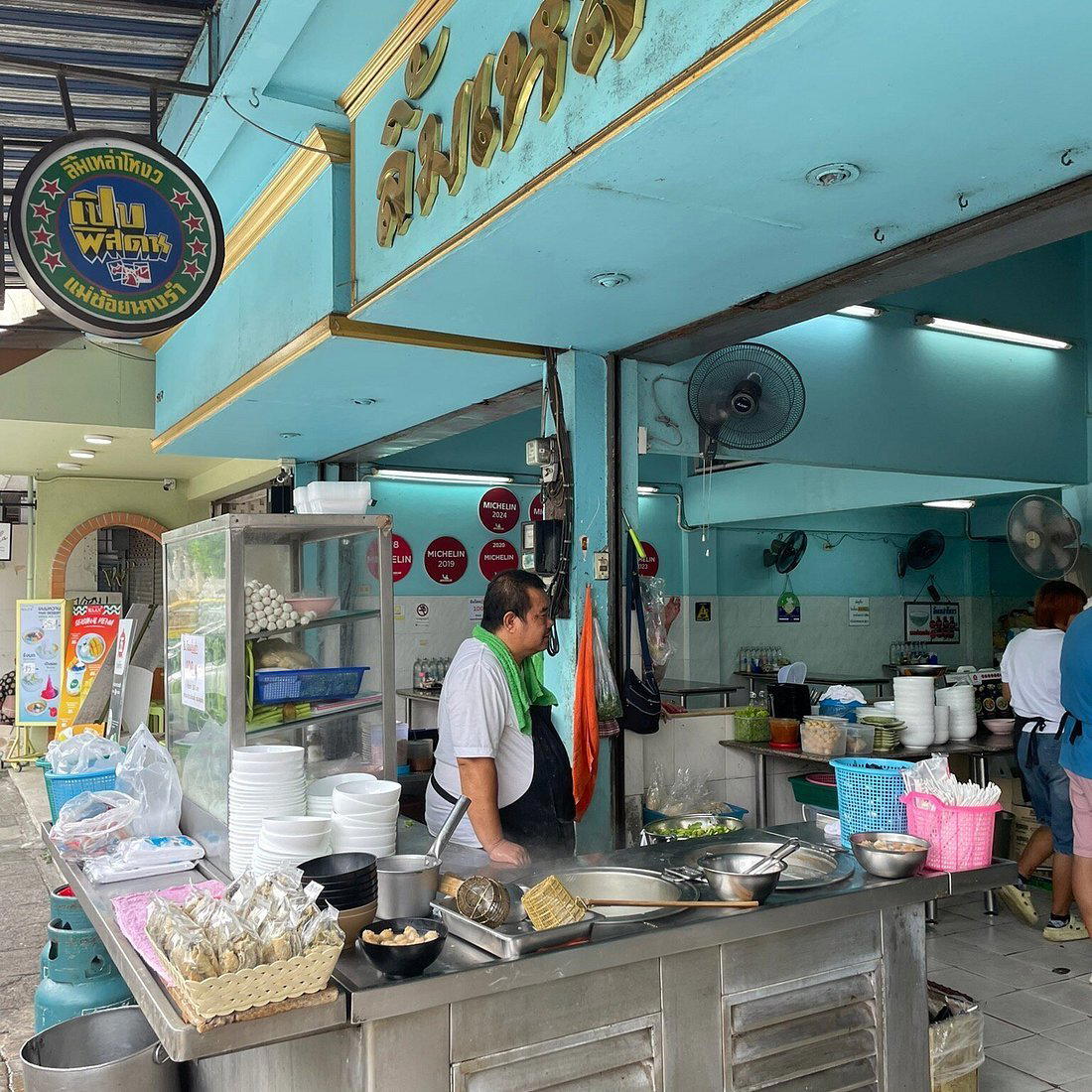
The menu
What to order
- Fishball Noodle Soup
- Tom Yum Noodle
- Special Egg Noodles
Where Chiang Mai's Street Food Gets Specific
Chiang Mai's street food reputation tends to get flattened into a few headline dishes: khao soi, sai ua, mango sticky rice. What gets less attention is the city's quieter, more workaday noodle culture, the kind built around shops that open early, run until the stock is gone, and repeat the same process the next morning. Lim Lao Ngow Fishball belongs to that category. It is a fishball noodle shop operating in a tradition that prizes daily production and product consistency over variety or spectacle.
In Thailand's broader street food hierarchy, fishball noodle shops sit at an interesting intersection. They are inexpensive and accessible, but the craft involved in producing fishballs from scratch, where the texture depends entirely on the quality of the fish and the handling of the paste, places the better operators in a different conversation from generic noodle stalls. Shops with multi-generational continuity, as the name here implies with its reference to a founding figure, tend to carry sourcing practices and technique passed through repeated daily production rather than formal training. That kind of accumulated process knowledge is harder to replicate than a recipe.
The Ingredient Logic Behind the Bowl
Fishballs are a product that exposes sourcing immediately. A fishball made from fresh, appropriate-grade fish, worked to the right elasticity and poached at the right moment, has a clean, springy bite and a flavour that reads as distinctly marine without being strong. A fishball made from lower-grade or older fish, or from pre-made commercial product, is detectable within the first chew: softer, blander, often with a slightly chalky finish.
The entire claim to quality in a fishball shop rests on that daily production cycle. Northern Thailand's inland geography means that fresh saltwater fish, traditionally the basis for fishballs in coastal Chinese-Thai communities, requires reliable supply chains or substitution with freshwater species that carry their own textural properties. Shops that maintain consistent product quality in Chiang Mai are therefore navigating a more complex sourcing challenge than their counterparts in coastal cities like Phuket, where venues such as PRU operate with direct access to coastal produce. That inland constraint is part of what makes a well-run fishball shop in Chiang Mai worth paying attention to.
The surrounding bowl construction, typically a clear or slightly cloudy broth, thin or flat rice noodles, and a handful of garnishes, is designed to let the fishball carry the weight. Broth clarity and depth in a fishball shop come from long-simmered fish or pork bones rather than from complex spice blends. It is a restrained format by design, and its quality is readable without any culinary background required.
Where This Fits in Chiang Mai's Eating Map
Chiang Mai's dining options now span an unusually wide range for a city of its size, from northern Thai heritage cooking at places like Huan Soontaree to vegetable-forward modern menus at Aeeen, Italian at Aquila, and traditional Thai home cooking at Aunt Aoy Kitchen. Within that spread, the fishball noodle shop occupies a specific and non-substitutable role: it is a single-product specialist, priced at the entry level of the market, where the only variable worth tracking is product quality.
Comparison venues in Chiang Mai like Loet Rot or the city's khao soi specialists represent the noodle tradition's more celebrated northern-specific expressions, but the fishball tradition carries a distinct Chinese-Thai lineage, common across Chiang Mai's historically significant Chinese merchant community. That community's culinary influence on the city is visible in the number of long-running shophouse kitchens that still operate on founding-family recipes, and Lim Lao Ngow Fishball is one of the more recognized names in that category.
For context on how fishball culture sits within Thai street food more broadly, Hoy Tord Chao Lay in Bangkok represents another shophouse-format specialist with deep Chinese-Thai roots, while AKKEE in Pak Kret shows how ingredient-focused, family-run formats can develop sustained followings without formal recognition. At the opposite end of the Thai fine dining register, Sorn in Bangkok has built a Michelin-starred case for Thai ingredient provenance, but the sourcing logic that underpins a two-star tasting menu and the logic that underlies a daily fishball production cycle are not as different in principle as price point suggests.
Planning Your Visit
Fishball shops in Chiang Mai typically run on morning and midday hours, with stock dictating closing time rather than a fixed schedule. Arriving early in the service window is the practical move for any high-turnover street food operation, particularly one where the product is made fresh each day and volume is finite. No reservation infrastructure applies at this price tier and format; the process is walk-in, order at the counter or from a server passing through, and seat yourself. Pricing sits at the lower end of Chiang Mai's street food range, in line with single-dish noodle shops throughout the city. For broader orientation on where Lim Lao Ngow Fishball fits within the city's full eating range, the EP Club Chiang Mai guide maps the scene across all price tiers and formats. Visitors building a longer Chiang Mai itinerary might also consider Baan Landai or its Phra Pok Klao Road location for northern Thai dining that sits in a different register entirely.
Frequently asked questions
How does Lim Lao Ngow Fishball fit into Chiang Mai's wider noodle scene?
Chiang Mai's noodle identity is dominated by khao soi and kuay jab, leaving fishball-specialist shops as a quieter category that draws a local rather than tourist crowd. Lim Lao Ngow occupies that specific niche in Chiang Mai, a city whose dining range now spans heritage northern Thai restaurants through to international formats. That positioning means the shop runs largely on repeat customers who prioritize the product over atmosphere or location convenience.
What do people recommend at Lim Lao Ngow Fishball?
The fishball noodle bowl is the focus here, that is the dish this shop is built around. Regulars tend to order with broth rather than dry-style, though both formats are common at Chiang Mai fishball shops. Arriving before midday gives you the widest choice before stock runs low.
Do I need a reservation for Lim Lao Ngow Fishball?
No reservation system applies at a street-format fishball shop like this one. Seats turn over quickly, and the operating model runs on walk-in traffic. Early arrival is the practical strategy, since closing time follows stock depletion rather than a fixed hour.
What's Lim Lao Ngow Fishball best at?
The shop is built around a single product category, fishballs, which makes consistency the measure of quality rather than menu range. In Chiang Mai's street food circuit, that kind of specialization signals a kitchen that has refined one thing rather than spread across many. The fishball itself, its texture and freshness, is the signal to watch.
Can Lim Lao Ngow Fishball adjust for dietary needs?
Fishball noodle shops operate on a tight, ingredient-specific menu with limited substitution flexibility. The core product is fish-based, which rules out the dish for those avoiding seafood or following vegetarian or vegan diets. For specific allergen questions, visiting in person during operating hours is the practical approach.
Is Lim Lao Ngow Fishball worth it?
For anyone tracking Chiang Mai's street food beyond the khao soi circuit, a focused fishball shop represents a different kind of precision, one ingredient, judged on sourcing and technique. Street-format pricing in this category is typically low, making the cost-to-quality ratio a reasonable proposition. The shop's longevity within Chiang Mai's eating culture is itself a form of endorsement.
Should I go to Lim Lao Ngow Fishball on a weekday or weekend?
Weekday mornings tend to run on local rhythm, working crowd, faster turnover, stock at its freshest. Weekends can bring more foot traffic in Chiang Mai's street food areas, which means earlier depletion of daily stock. If flexibility allows, a weekday visit before 10am is the practical choice at shops like this one.
At-a-Glance Comparison
Comparable venues nearby, for context on price, style, and recognition.
| Venue | Cuisine | Price | Notes |
|---|---|---|---|
| Lim Lao Ngow FishballThis venue (the venue you are viewing) | Traditional Thai Fishball Noodles | $10–20 | Not listed |
| Kao Man Kai Nantaram (ข้าวมันไก่นันทาราม) | Thai Chicken Rice (Khao Man Gai) | $1–10 | Haiya |
| Kaw Kha Moo Chang Phuek | Thai Braised Pork Leg Rice | $1–10 | Chang Phueak |
| Laap Kao Cham Chaa | Northern Thai Street Laap | Not listed | Mueang Chiang Mai |
| Sirichai Khao Man Gai | Northern Thai Khao Soi & Khao Man Gai | $1–10 | Chiang Mai Old Town |
| ศิริชัย ข้าวมันไก่ตอน | Northern Thai Khao Soi & Khao Man Gai | $1–10 | near Suan Dok Gate Monument |
Continue exploring
More in Chiang Mai
Restaurants in Chiang Mai
All restaurants in Chiang Mai →
Bars in Chiang Mai
All bars in Chiang Mai →
Details
- Cozy
- Rustic
- Casual Hangout
- Solo
- Family
- Standalone
- A La Carte
- Vegetarian Friendly
- Gluten Free Options
Current opening hours
- Monday
- 9 AM–2:30 PM
- Tuesday
- 9 AM–2:30 PM
- Wednesday
- 9 AM–2:30 PM
- Thursday
- 9 AM–2:30 PM
- Friday
- 9 AM–2:30 PM
- Saturday
- 9 AM–2:30 PM
- Sunday
- 9 AM–2:30 PM
Hours can change for holidays and private events. Hours as of .
Cozy local atmosphere with traditional Thai seating, warm and not too noisy.