
Tabelog 100 #53
Our verdict
Osaka’s creative dining tier has moved beyond easy fusion, and LIBRO VERDE sits in the small counter-led camp where Japanese, French, and broader creative cooking share the same frame. Its 2025 Tabelog 100 selection for Innovative / Creative cuisine gives the room a clear quality signal in a city better known internationally for casual appetite than composed tasting formats.

Pearl is the En Primeur Club membership app, where members save venues, book tables and use the concierge.
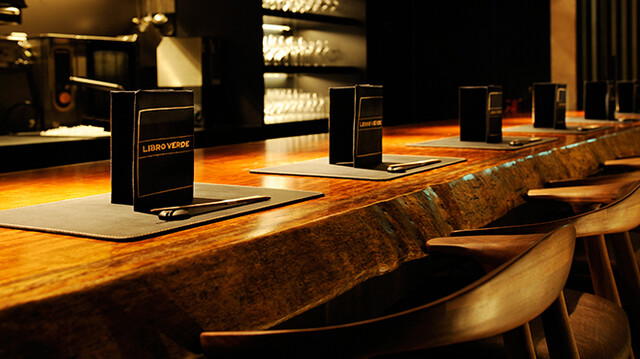
Osaka changes character after dark: office towers give way to discreet entrances, quiet signs, and rooms designed for diners who already know where they are going. In that context, focused dining has a different meaning from the quick, democratic meals found across Osaka. It becomes a matter of pacing, proximity, and control, especially in the city’s newer creative restaurants, where Japanese technique can sit beside French structure without turning dinner into a lecture.
LIBRO VERDE belongs to that contemporary Osaka category: positioned around creative cooking rather than a single inherited genre. The useful way to read it is not simply as a French restaurant with Japanese accents, or a washoku room borrowing Western plating, but as part of a local shift toward menus that use genre as material. Osaka has always been less precious than Kyoto and less status-coded than Tokyo; the creative dining rooms that work here tend to be judged by rhythm and coherence, not ceremony alone.
Creative Osaka cooking, seen through a focused restaurant lens
The format matters because it narrows the distance between cooking and judgment. In Osaka, that intimacy has deep roots, from kappo traditions to other small-format dining rooms, but the newer creative idiom changes the grammar. Instead of codified progression, diners encounter a looser conversation among Japanese ingredients, French technique, and seasonal composition. LIBRO VERDE’s classification across Creative, Japanese Cuisine, and French places it squarely inside that hybrid space.
That category can be messy when handled as decoration: a sauce here, a garnish there, a borrowed word on the menu. The stronger Osaka examples make the logic visible. Heat, timing, finishing, and sequence become part of the argument. The room’s selection for Tabelog Hyakumeiten in 2025 is a meaningful signal because the list is category-specific; this is recognition within a defined creative field, not a generic popularity badge.
Osaka is a fitting base for this style. The city supports serious dining, late-evening drinking, and small rooms that rely on regulars as much as visitors. That economy rewards precision. It also means the audience is used to paying for concentration rather than spectacle. Nearby comparison points show the spread of Osaka dining: Bobino, Kitashinchi Tentomi, WINE Shokudo Ono, Oban, and Ono each help frame the local map in different ways. LIBRO VERDE operates at a dinner budget listed as JPY 20,000 - JPY 29,999, where the expectation shifts from comfort to authorship.
Why the cultural mix makes sense in Osaka
Osaka’s food identity is often flattened into street snacks, noodles, and neon appetite, but the city’s serious dining culture has always been more technical than the shorthand suggests. Kappo cooking, built around close chef-diner exchange, is one of Kansai’s great contributions to Japanese restaurant culture. Creative restaurants in Osaka can borrow that social architecture while loosening the cuisine boundaries.
French technique has a long presence in Japanese fine dining, but in Osaka it often feels less formal than in more ceremonial settings elsewhere. The attraction is practical: stocks, reductions, controlled heat, and plated sequence give shape to ingredients that might otherwise be read through a strictly Japanese lens. When a room like LIBRO VERDE is categorized across Japanese and French cooking, the point is less East-meets-West than a working vocabulary for a city comfortable with appetite and craft in the same sentence.
The distinction matters for travelers building an Osaka dining itinerary. A day can move from bakeries and snack counters to formal creative rooms without contradiction. For the wider map, other Osaka dining rooms show how broad the city’s appetite has become. The contrast is useful: Osaka’s restaurant culture is not a ladder from casual to serious, but a set of parallel formats, each with its own codes.
How to place it in a wider dining plan
This is a room for diners who want Osaka’s creative side without abandoning the directness that makes Kansai dining so engaging. It is not the choice for a spontaneous snack crawl; it belongs to the planned evening, the kind built around one focused reservation and a short list of nearby drinks afterward. The appeal is part of the equation: the experience is organized around pacing, attention, and the close reading of the kitchen’s choices.
Travelers comparing cities should also separate this from Kyoto’s more tradition-bound dining and Tokyo’s status-heavy tasting menu circuit. Osaka’s appeal is its refusal to let refinement become stiff. The better creative rooms here keep the tempo alive, and LIBRO VERDE’s 2025 Tabelog Hyakumeiten recognition places it among the venues pushing that argument.
For broader planning, use Our full Osaka restaurants guide alongside Our full Osaka hotels guide, Our full Osaka bars guide, Our full Osaka wineries guide, and Our full Osaka experiences guide. Readers extending a Japan itinerary can compare regional dining codes through other dining rooms in Japan. For a cross-Pacific view of Japanese drinking and casual formats, unnamed Japanese-inspired drinking and casual formats abroad make the diaspora comparison clearer.
The Minimal Set
Comparable venues at a glance for context.
| Venue | Cuisine | Price | Awards | Notes |
|---|---|---|---|---|
| LIBRO VERDEThis venue (the venue you are viewing) | Innovative Chef’s Counter with Japanese, French & Creative Cuisine | $150–200 | Tabelog 100 #53 | Not listed |
| Bobino | Not listed | Not listed | Tabelog 100 #10 | JPY 15,000 - JPY 19,999 JPY 1,000 - JPY 1,999 View spending breakdown |
| Kitashinchi Tentomi | Seasonal Tempura Omakase | $100–150 | Tabelog 100 #72 | JPY 15,000 - JPY 19,999 JPY 2,000 - JPY 2,999 |
| Ono | Awaji Island Kaiseki | $200–300 | 1 Michelin Star · Tabelog Bronze #337 | Japanese |
| WINE Shokudo Ono | Modern Italian Wine Bistro with Awaji Island Ingredients | $150–200 | Tabelog 100 #1 | JPY 20,000 - JPY 29,999 |
| Oban | Traditional Yakiniku Counter | $30–50 | Tabelog 100 #72 | JPY 4,000 - JPY 4,999 |
Recognition history
Dated appearances from independent guides and award organizations, with the underlying list record or original source where available.
Tabelog 100 #53 · No. 53
Tabelog · Tabelog 100 - Innovative / Creative cuisine - 2025
Continue exploring
More in Osaka
Restaurants in Osaka
All restaurants in Osaka →


Bars in Osaka
All bars in Osaka →



Hotels in Osaka
All hotels in Osaka →



Wineries in Osaka
Browse all →
Details
- Elegant
- Cozy
- Intimate
- Modern
- Sophisticated
- Date Night
- Special Occasion
- Celebration
- Business Dinner
- Solo
- Chefs Counter
- Open Kitchen
- Standalone
- Design Destination
- Local Sourcing
- Tasting Menu
- Counter Dining
- Set Menu
An intimate eight-seat counter in a stylish, relaxed space overlooking the open kitchen, creating an elegant yet cozy atmosphere that feels like a hidden chef’s table experience in Kitashinchi.