La Masseria

La Masseria occupies a stretch of West 48th Street where Midtown's theater-district foot traffic meets a room designed to slow you down. The kitchen draws from southern Italian tradition, with a menu that rewards guests who work through multiple courses rather than arriving with a single dish in mind. For New York's Italian dining tier, it sits comfortably in the mid-to-upper bracket where hospitality formality and regional specificity share equal weight.
Pearl is the En Primeur Club membership app — saves, bookings, and concierge access live there. Same editors, same standards.
- Address
- 235 W 48th St, New York, NY 10036
- Phone
- +12125822111
- Website
- lamasserianyc.com
- Directions
- Get directions
 Saves & bookings on Pearl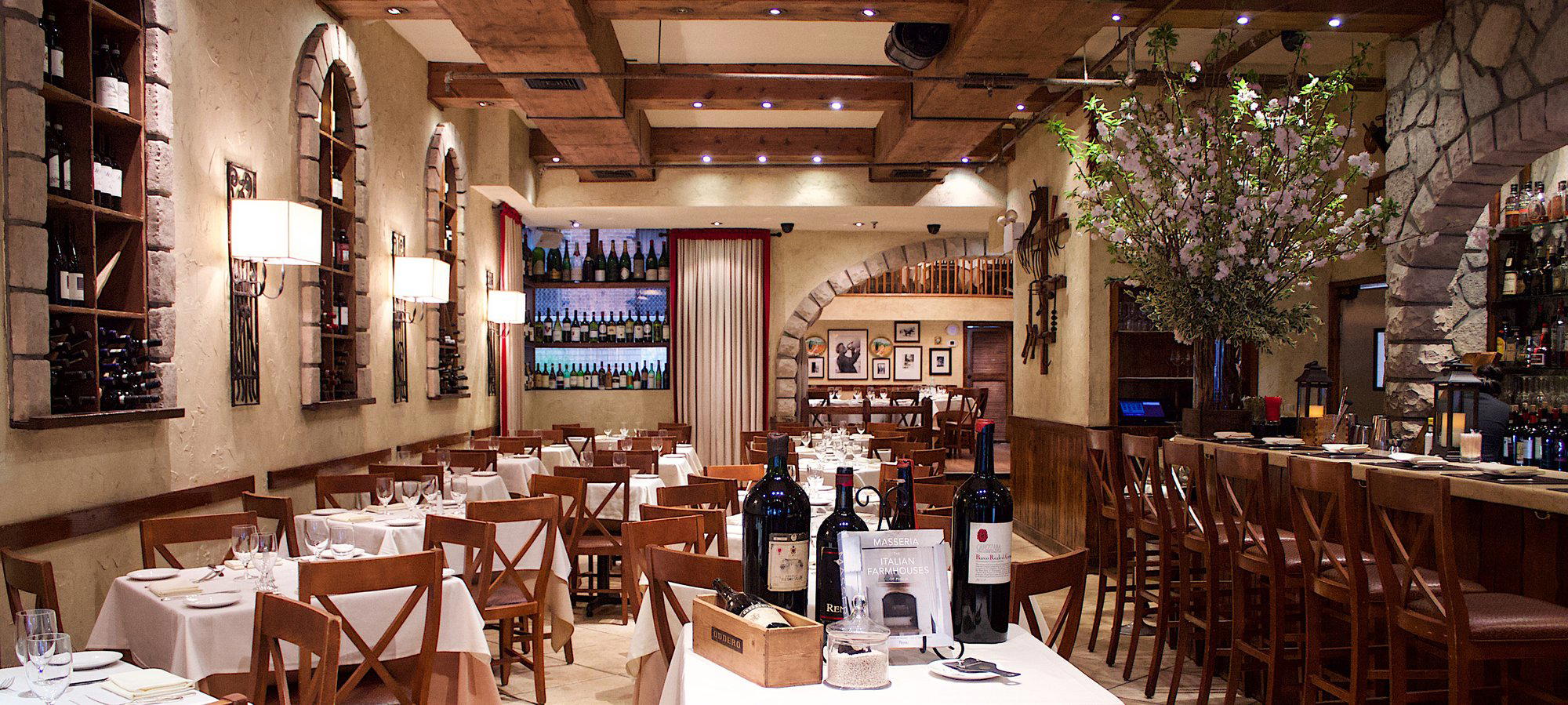
Where Midtown Pauses for the South
West 48th Street between Broadway and Eighth Avenue is a block shaped by theater schedules and quick arrivals. The theater district moves on its own schedule: pre-curtain rushes, post-show dispersals, tourists triangulating between Times Square and Restaurant Row. Against that cadence, La Masseria operates on a different register. The room is designed to suggest the courtyard architecture of a southern Italian farmhouse, all warm stone tones and deliberate enclosure, a spatial proposition that the neighborhood's louder addresses don't attempt. Arriving here, particularly before an evening performance nearby, feels like a deliberate gear change.
That spatial identity matters because it sets the terms for what follows. Southern Italian cooking at this level is not about velocity. It is about sequence, patience, and the gradual accumulation of a meal. A masseria, in the agricultural tradition of Puglia and Calabria, was a working estate where meals were communal and unhurried. The name is a positioning statement, not just a label.
The Architecture of the Meal
In a city where Italian dining ranges from corner red-sauce institutions to modernist tasting menus at the price point of Le Bernardin or Per Se, La Masseria operates in a middle register that values the integrity of the tradition over reinvention. One productive way to approach the kitchen here is through progression: antipasti that establish region and season, a pasta course that carries the structural weight of the meal, secondi that reward those who have paced themselves, and a close that earns its length.
That sequencing discipline separates the serious Italian rooms in New York from those that treat the cuisine as a delivery mechanism for volume. The tasting arc at a place like this one is not constructed from the same modernist grammar as Atomix or Jungsik New York, where each course is a discrete technical statement. It follows an older logic: each stage exists to prepare the table for the next, and the meal has a shape only visible in retrospect.
The pasta course is typically where this kitchen earns or loses its argument. Southern Italian pasta traditions, particularly from Puglia, depend on a narrower palette than northern equivalents: semola rather than egg dough, shapes like orecchiette or cavatelli that hold sauce differently, and a relationship with legumes and vegetables that reflects a leaner agricultural history. A kitchen that understands this works within those constraints rather than departing from them for novelty's sake.
Midtown's Italian Tier and Where La Masseria Sits
New York's Italian dining has organized itself into reasonably distinct tiers over the past decade. At the ceiling sit the modernist Italian addresses where technique from northern European fine dining has been imported and applied to Italian ingredients. Below that, a cohort of regionally specific rooms competes on provenance and tradition rather than innovation. The restaurant at 235 West 48th Street belongs to the latter group, distinguishing itself from the theater-district default of convenience-first Italian by committing to a geographic specificity that most blocks in this neighborhood do not attempt.
That specificity comes with a price in accessibility. The cooking of southern Italy, Campania, Puglia, Basilicata, Sicily, is less immediately legible to a general Midtown audience than the Roman or generic northern Italian registers most guests arrive expecting. A room willing to make that bet depends on a dining room staff capable of translating it in real time, and on a guest base prepared to follow the lead. Those who approach the meal with some prior knowledge of southern Italian wine regions, or who give the floor team latitude to guide the pairing, tend to extract considerably more from the evening.
The Wine Conversation
Southern Italian wine has been undergoing a reappraisal in American markets for the better part of a decade. Nero d'Avola, Aglianico, Fiano, Greco di Tufo, and the revived indigenous varieties of Campania now appear on serious lists that would have ignored them fifteen years ago. A room committed to the southern Italian tradition has the opportunity to make this case through the glass, pairing the kitchen's register with wines that have the same agricultural groundedness. The structural opportunity is there in a way it would not be at a room with a broader or more generic Italian mandate.
Placing La Masseria in the American Fine Dining Context
The conversation around regional Italian cooking in American cities has been enriched by restaurants that treat a specific geography as the entire frame of reference. In the broader national picture, ambitious American fine dining is currently producing a generation of regionally committed kitchens: Blue Hill at Stone Barns in Tarrytown, Single Thread Farm in Healdsburg, Providence in Los Angeles, and The French Laundry in Napa all operate from a position of specificity rather than generality. The logic, applied to Italian cuisine in New York, produces a different but comparable argument: that geographic commitment produces depth that a broader mandate cannot.
Internationally, rooms like 8 1/2 Otto e Mezzo Bombana in Hong Kong and Alain Ducasse at Louis XV in Monte Carlo demonstrate what Mediterranean tradition looks like when applied with full institutional commitment. The frame of comparison matters: the restaurant is not operating at that tier, but the principles of regional integrity and meal architecture are shared.
Other American operators worth contextualizing alongside this approach include Emeril's in New Orleans, Lazy Bear in San Francisco, Alinea in Chicago, Addison in San Diego, The Inn at Little Washington, and Bacchanalia in Atlanta, each of which has staked its identity on a specific culinary commitment rather than broad appeal.
Planning Your Visit
The restaurant is located at 235 West 48th Street in Midtown Manhattan, placing it squarely in the theater district. Pre-theater seatings fill earliest, so guests who want to work through a full progression without time pressure should book outside peak pre-curtain windows, typically after 8:30 p.m. on weekday evenings. Given the neighborhood density and the room's standing among theatergoers, reservations are advisable rather than optional for any evening visit.
Awards and Standing
Comparable venues nearby, for context on price, style, and recognition.
| Venue | Cuisine | Price | Notes |
|---|---|---|---|
| La MasseriaThis venue — the venue you are viewing | Authentic Puglian Italian | $$$ | Not listed |
| See No Evil Slice | Neapolitan-Style Pizza with Artisanal Small Plates | $$$ | Midtown Manhattan |
| Maialino (vicino) | Roman Trattoria | $$$ | Midtown South-Flatiron-Union Square |
| OLIO E PIÙ | Authentic Italian Trattoria | $$$ | West Village |
| Buona Notte | Traditional Italian Trattoria | $$$ | SoHo-Little Italy-Hudson Square |
| Osteria Delbianco Bryant Park | Traditional Northern Italian | $$$ | Midtown-Times Square |
Recognition history
Dated appearances from independent guides and award organizations, with the underlying list record or original source where available.
Wine Spectator Award of Excellence
Wine Spectator
Continue exploring
More in New York City
Restaurants in New York City
Browse all →
Bars in New York City
Browse all →



Hotels in New York City
Browse all →





At a Glance
- Rustic
- Elegant
- Cozy
- Date Night
- Business Dinner
- Special Occasion
- Historic Building
- Extensive Wine List
- Local Sourcing
Current opening hours
- Monday
- 12–3 PM, 4:30–11 PM
- Tuesday
- 12–3 PM, 4:30 PM–12 AM
- Wednesday
- 12–3 PM, 4:30 PM–12 AM
- Thursday
- 12–3 PM, 4:30 PM–12 AM
- Friday
- 12–3 PM, 4:30 PM–12 AM
- Saturday
- 12–3 PM, 4:30 PM–12 AM
- Sunday
- 12–10:30 PM
Hours can change for holidays and private events. Last verified .
Warm and rustic with farm tools on the walls, creating an authentic masseria farmhouse atmosphere amid the city bustle.