Our verdict
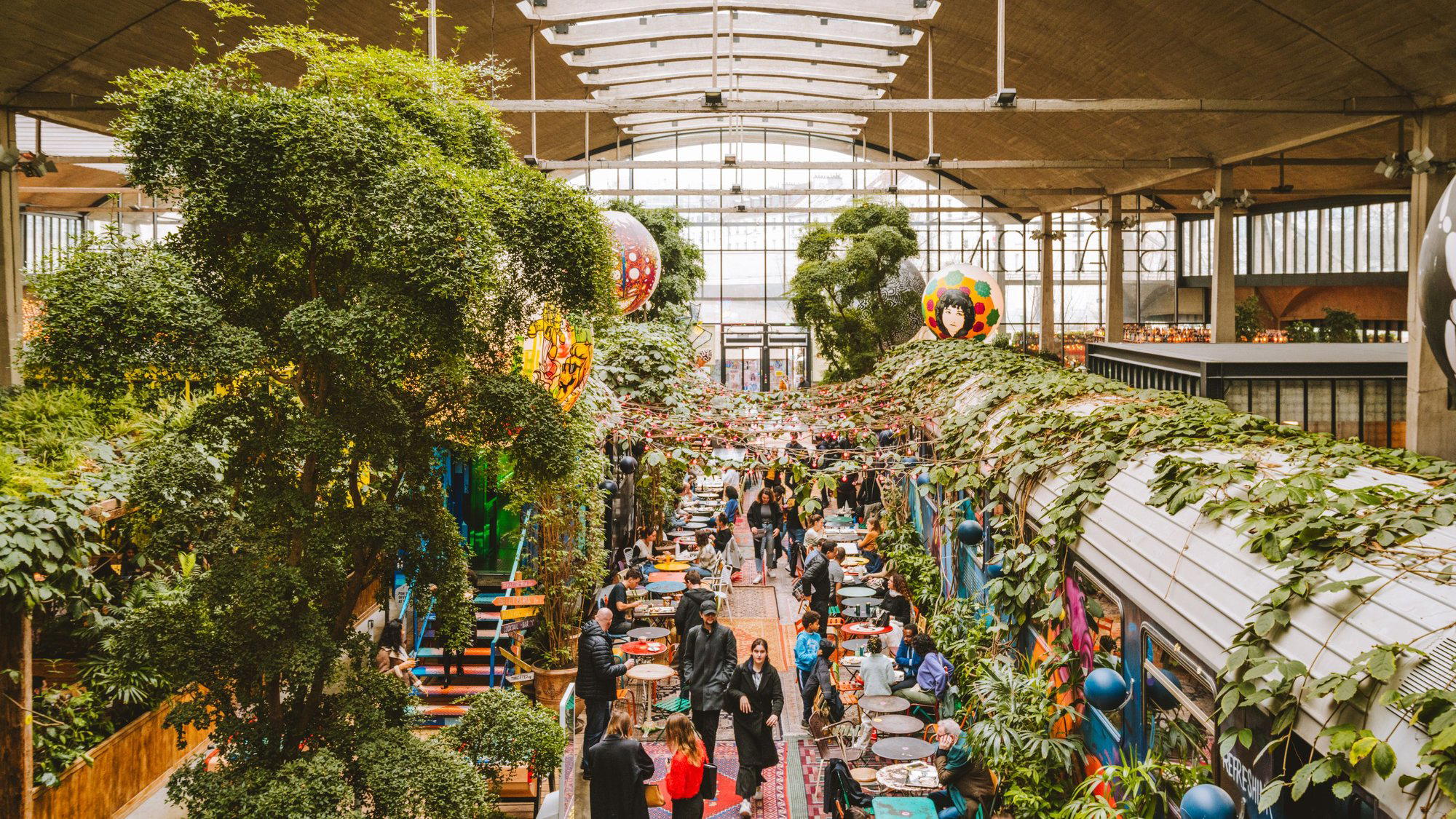
La Felicità occupies a sprawling industrial hall in Paris's 13th arrondissement, at the address that anchors the Station F startup campus. The format is part Italian food market, part communal canteen, scaled to a footprint few venues in the city can match. It sits in a different register from the €€€€ gastronomic houses of the 7th and 8th, trading ceremony for scale and accessibility.

Pearl is the En Primeur Club membership app — saves, bookings, and concierge access live there. Same editors, same standards.
- Address
- 5 Parv. Alan Turing, 75013 Paris, France
- Hours
- Mon 8:30 AM–11:30 PMTue–Thu 8:30 AM–12 AMFri 8:30 AM–1:30 AMSat 12 PM–1:30 AMSun 12–11:30 PM
- Website
- lafelicita.fr
- Directions
- Get directions
The menu
What to order
- Neapolitan pizza
- Fresh pasta
- Truffle pasta
The 13th Arrondissement's Industrial Food Hall Format
Paris has long operated a clear hierarchy in its restaurant culture: the hushed Michelin rooms of the 7th and 8th arrondissements at the leading, the neighbourhood bistro and brasserie tier in the middle, and a relatively thin stratum of large-format, democratic food spaces that sit outside both. La Felicità, at 5 Parvis Alan Turing in the 13th, belongs firmly to that third category. The address puts it inside Station F, the converted Freyssinet railway freight depot that became Europe's largest startup campus when it reopened in 2017. That context matters: the building was not fitted out for dining as an afterthought. The food hall was designed as a central social infrastructure for a campus that operates on a scale most Paris venues cannot touch.
The 13th arrondissement has, over the past decade, accumulated a distinct dining identity that sits apart from the tourist-facing circuits of the Marais or Saint-Germain. The neighbourhood's Chinatown stretches along Avenue d'Ivry and Avenue de Choisy, and a cluster of contemporary cultural institutions, including the Bibliothèque nationale de France's François-Mitterrand site, has pulled a younger, internationally-minded crowd into the area. La Felicità lands squarely within that demographic, and the industrial aesthetic of its setting, exposed steel, soaring ceilings, the bones of a 19th-century freight terminal, reinforces a design language more associated with Berlin or East London than with traditional Parisian dining. For a comparison point on how the French capital's highest-register rooms approach the same city, see our coverage of Alléno Paris au Pavillon Ledoyen and Le Cinq at the Four Seasons Hôtel George V, both operating in a register defined by table spacing, ceremony, and formality that La Felicità has no interest in replicating.
What the Format Actually Delivers
Large-format food halls in European cities have split into two recognisable models over the past decade. The first concentrates premium operators under one roof, curates tightly, and prices at or near the individual restaurant tier. The second prioritises volume, access, and social density, with a wider range of price points and a communal energy that makes them function less like a collection of restaurants and more like a market square. La Felicità operates closer to the second model. The Italian focus, covering pizza, pasta, and the broader trattoria repertoire, gives the offer coherence without imposing the formality of a single-kitchen tasting room.
The Marché des Enfants Rouges in the 3rd is older but far smaller and operates as a genuine outdoor market with food stalls rather than a purpose-built hall. Eataly on the Right Bank skews more toward retail and premium positioning. La Felicità's footprint, the sheer volume of covers, and its integration into a working campus give it a character that is less about the food as destination and more about the food as infrastructure for a particular kind of urban sociability.
For readers whose primary interest is French gastronomy at its more considered registers, the page on L'Ambroisie covers the Place des Vosges institution that represents the classical French dining tradition, while Kei offers a contemporary French-Japanese synthesis in a more intimate format. Both operate on principles of scarcity, craft, and deliberate slowness that run in the opposite direction from what La Felicità is doing.
Service Architecture at Scale
The editorial angle on large-format venues often centres on whether the coordination between kitchen, floor, and the guest experience holds at volume. At the size La Felicità operates, the challenge is less about the sommelier-chef-front-of-house triangle that defines a 30-cover gastronomic room and more about how a venue creates coherent hospitality across hundreds of simultaneous covers. The Italian food hall model handles this partly through format simplicity: a defined menu range, a clear station structure, and an expectation that guests move through the space rather than being guided through it. The communal tables and the organised counter system shift responsibility for pacing and sequencing toward the guest rather than the service team. That is not a failure of the model; it is the model.
Compare this with how collaboration between front-of-house and kitchen functions at, say, Arpège, where Alain Passard's kitchen and the dining room operate in close dialogue, or at Mirazur in Menton, where the progression of a meal is choreographed across multiple hours. La Felicità is not competing on that terrain. Its service architecture is calibrated for a different outcome: high throughput, low friction, and a room energy that depends on density rather than intimacy.
Placing La Felicità in France's Broader Dining Map
Paris generates the most international attention in the French dining conversation, but the country's most significant gastronomic addresses are distributed widely. Flocons de Sel in Megève, Troisgros in Ouches, Auberge de l'Ill in Illhaeusern, Bras in Laguiole, Paul Bocuse outside Lyon, AM par Alexandre Mazzia in Marseille, Assiette Champenoise in Reims, Au Crocodile in Strasbourg, and Auberge du Vieux Puits in Fontjoncouse all represent a tradition of destination dining rooted in specific places and kitchens. La Felicità belongs to none of that lineage. It is a city-infrastructure project that happens to serve food, which, in its own way, is a more honest answer to a question those temples of gastronomy rarely have to address: what does a city of three million people eat on a Tuesday at lunch?
For readers building a Paris itinerary that moves across multiple registers, our full Paris restaurants guide maps the city by neighbourhood and format, from the 13th's food hall tier up through the brasserie circuit and into the upper Michelin brackets. Internationally, readers comparing the large-format communal dining model across cities may find useful reference points in our coverage of Le Bernardin in New York City and Atomix, both of which represent the opposite end of the formality and scale spectrum.
Know Before You Go
- Address: 5 Parvis Alan Turing, 75013 Paris, France
- Location context: Inside Station F, the converted Freyssinet freight depot on the edge of the 13th arrondissement, near the Bibliothèque François-Mitterrand
- Format: Large-scale Italian food hall with communal seating; counter-service and station-based ordering
- Price range: Below the €€€€ bracket of Paris's gastronomic rooms; accessible pricing in line with casual Italian trattoria formats
- Nearest transport: RER C Bibliothèque François-Mitterrand, or metro line 14 Bibliothèque François-Mitterrand
- Booking: Walk-in format typical for food hall operations of this type; no evidence of mandatory advance reservation
- Leading for: Groups, casual lunches, campus visitors, or anyone seeking an alternative to the formal Paris dining circuit
Frequently asked questions
Where is La Felicità located?
La Felicità is located at 5 Parv. Alan Turing, 75013 Paris, France, Paris.
Is La Felicità suitable for a large group dining out in Paris's 13th arrondissement?
The large-format food hall model at 5 Parvis Alan Turing is one of the few dining formats in Paris that genuinely accommodates groups without requiring a private dining enquiry or a set menu commitment. The shared hall structure and walk-in access make it a practical anchor for parties that would be turned away or squeezed at a conventional Paris restaurant. The 13th's campus setting also provides space that central arrondissement venues cannot match.
What's the must-try dish at La Felicità?
Pizza and pasta anchor the menu at this Italian food hall on Parvis Alan Turing in the 13th arrondissement. The format is trattoria-broad rather than chef-driven and narrow, so the kitchen's strongest output sits in those two categories. Ordering outside them tends to dilute the visit, not extend it.
What's the best way to book La Felicità?
La Felicità operates on the walk-in model standard to food halls of this scale and campus context. Arriving outside peak lunch and dinner windows on weekdays gives the clearest run at seating in a space designed to absorb high footfall.
Credentials Lens
Comparable venues nearby, for context on price, style, and recognition.
| Venue | Cuisine | Price | Notes |
|---|---|---|---|
| La FelicitàThis venue — the venue you are viewing | Italian Food Court | $20–30 | Not listed |
| Ober Mamma | Authentic Neapolitan Trattoria | $20–30 | Oberkampf |
| Colisée 56 | Italian Bistro | $30–50 | 8e arrondissement |
| Le Talon Caché | Authentic Puglian Italian Trattoria | $20–30 | Plaine de Monceaux |
| Amici Miei | Sardinian Italian Trattoria | $20–30 | 11th Arr. - Popincourt |
| Latte Cisternino | Italian Deli Cooperative | Not listed | 10th arrondissement |
Continue exploring
More in Paris
Restaurants in Paris
Browse all →
Bars in Paris
Browse all →
Hotels in Paris
Browse all →
Details
- Lively
- Trendy
- Energetic
- Group Dining
- Casual Hangout
- Family
- Celebration
- Open Kitchen
- Terrace
- Craft Cocktails
- Local Sourcing
- A La Carte
- Small Plates
- Cocktails
Current opening hours
- Monday
- 8:30 AM–11:30 PM
- Tuesday
- 8:30 AM–12 AM
- Wednesday
- 8:30 AM–12 AM
- Thursday
- 8:30 AM–12 AM
- Friday
- 8:30 AM–1:30 AM
- Saturday
- 12 PM–1:30 AM
- Sunday
- 12–11:30 PM
Hours can change for holidays and private events. Last verified .
Electric and bustling industrial space with lively lighting, live music, DJ sets, and a fun, crowded hangout vibe.