
La Ciambella brings the meat-focused traditions of Testaccio into the centro storico, with chef Francesca Ciucci running an offal-forward Roman menu from an open kitchen beneath a skylight-lit dining room. Holding a Michelin Plate in both 2024 and 2025, this is a kitchen where sweetbreads, tripe, and a reworked coda in carrozza sit at the centre of the menu, not the margins. Address: Via dell'Arco della Ciambella, 20, Rome.
Pearl is the En Primeur Club membership app — saves, bookings, and concierge access live there. Same editors, same standards.
- Address
- Via dell'Arco della Ciambella, 20, 00186 Roma RM, Italy
- Phone
- +39 06 683 2930
- Website
- la-ciambella.it
- Directions
- Get directions
 Saves & bookings on Pearl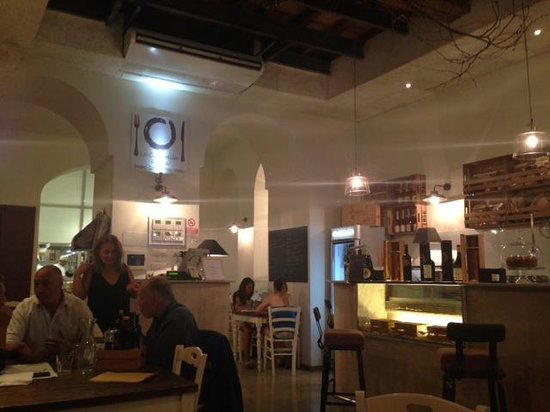
Light, Stone, and the Logic of a Roman Dining Room
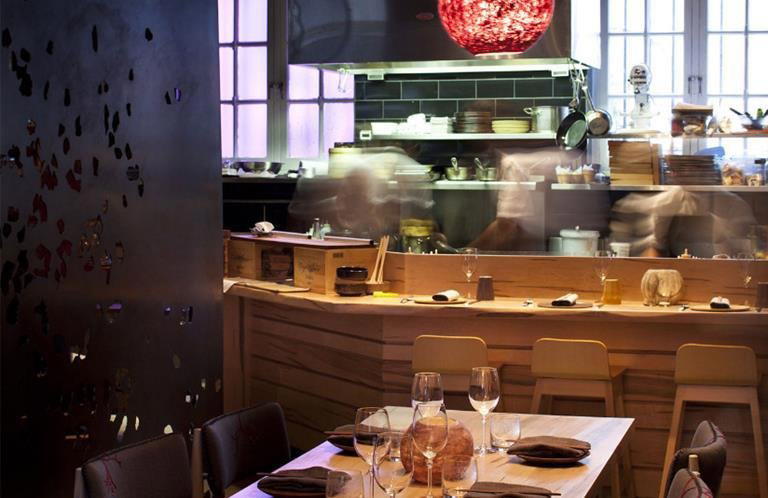
There is a particular architectural language that Rome's most considered restaurants share: travertine, exposed masonry, and a resistance to the theatrical over-decoration that newer openings elsewhere tend to favour. La Ciambella, on Via dell'Arco della Ciambella in the centro storico, reads that language fluently. A large travertine marble counter greets you near the entrance, its pale, porous surface absorbing the ambient light in a way that glass and steel never can. Beyond it, the dining room organises itself around an open-view kitchen, and above everything, a substantial skylight floods the space with natural light that shifts across the course of a meal. In the middle of the day, the room is bright without being stark. By early evening, the quality of that light changes entirely.
This is the kind of space that puts the kitchen at the centre of the room's logic, rather than hiding it as backstage infrastructure. In Rome, where so many neighbourhood trattorias still operate with a curtained pass and a menu committed to memory by regulars, the open-kitchen format carries a different weight than it does in, say, Copenhagen or Tokyo. It signals an intention to be watched, to be legible. At La Ciambella, that openness matches the directness of what comes out of it.
Testaccio Traditions in a Centro Storico Address
Roman cuisine has a well-documented hierarchy of neighbourhoods, and Testaccio sits near stronger examples from the serious-eating conversation. The district's identity was shaped by proximity to the old slaughterhouse, the Mattatoio, which operated there until the late twentieth century, and the butcher shops and trattorias that grew up around it developed the city's most sustained tradition of offal cookery. Dishes like coda alla vaccinara, pajata, rigatoni con la coratella, and tripe prepared alla romana are not novelties in Testaccio; they are the baseline.
Chef Francesca Ciucci is from Testaccio, and her menu at La Ciambella carries that lineage into a different part of the city. Sweetbreads, Roman-style tripe, and her own interpretation of coda in carrozza (an oxtail preparation distinct from the more common coda alla vaccinara) are among the dishes she has built a reputation around. This is not the kind of cooking that treats offal as a gesture toward authenticity while keeping the menu safe with pasta and veal. It occupies the centre of the plate and the centre of the argument.
For broader context on where Rome's meat-focused traditions are kept alive, Checchino Dal 1887 in Testaccio remains the reference point against which other Roman offal kitchens are measured. Armando al Pantheon and Antica Pesa represent the broader category of sustained Roman cooking in the centro storico and Trastevere, while Da Danilo and CiPASSO address different registers of Roman and contemporary Italian at the mid-range. The restaurant sits in a tier defined less by price point than by editorial specificity: a kitchen with a clear geographic and culinary lineage, operating with creative ambition around a traditional core.
What the Michelin Plate Signals
The restaurant has a Michelin Plate in 2024 and 2025. The Plate, introduced by Michelin as a formal designation below the star tier, recognises kitchens producing consistently good food without the additional criteria that govern starred recognition. In Rome, a city with a relatively small number of starred restaurants relative to its dining density, the Plate designation covers a wide range of serious cooking. It is a more useful signal than it might appear at first: it confirms inspection and a quality floor, without implying the kind of tasting-menu formality or price architecture that stars tend to accompany.
At the €€€ price point, the restaurant sits in a different competitive band from the city's starred rooms. La Pergola operates at stronger examples from the Roman market with three stars; Il Pagliaccio and Enoteca La Torre hold two stars each at the €€€€ tier. The restaurant's combination of Plate recognition, traditional subject matter, and mid-high pricing places it in a category that matters to a different kind of visitor: one who wants serious cooking rooted in Roman tradition rather than a contemporary-Italian tasting format.
The Michelin Plate also acts as a useful frame when comparing the restaurant to Roman-influenced kitchens operating in other cities. Il Marchese in Milan and Osteria Romana in Brussels represent how Roman culinary identity travels; the capital itself, by contrast, remains the densest environment in which that tradition operates at its most competitive and uncompromised.
Italy's Broader Table, and Where Rome Sits
Italy's most celebrated restaurants tend to cluster outside Rome: Osteria Francescana in Modena, Le Calandre in Rubano, Enoteca Pinchiorri in Florence, Enrico Bartolini in Milan, and Atelier Moessmer Norbert Niederkofler in Brunico each represent a different strain of Italian fine dining. Rome has historically been less well-represented in the upper tier of national recognition, partly because the city's culinary identity resists the kind of abstraction that tends to attract major awards, and partly because Roman diners have traditionally valued continuity over novelty.
The restaurant operates within that Roman resistance to reinvention, though the creative reinterpretations on Ciucci's menu suggest a kitchen willing to work at the edges of tradition rather than simply reproduce it. Coda in carrozza, for instance, is a less familiar name than coda alla vaccinara, and its presence on the menu signals something: a preference for the less-travelled reference, the dish that requires explanation and context rather than the one that sells itself on name recognition alone.
Know Before You Go
Address: Via dell'Arco della Ciambella, 20, 00186 Roma, Italy
Price range: €€€
Awards: Michelin Plate 2024, Michelin Plate 2025
3 from 948 reviews
Cuisine: Roman, with offal and meat dishes at the centre of the menu
Booking: Reservation recommended; walk-in availability is not guaranteed at this recognition level
Good for: Visitors specifically seeking Testaccio-rooted Roman cooking in a centro storico setting
Style and Standing
Comparable venues nearby, for context on price, style, and recognition.
| Venue | Cuisine | Price | Awards | Notes |
|---|---|---|---|---|
| La CiambellaThis venue — the venue you are viewing | Modern Roman Trattoria | $$$ | Michelin Plate | Not listed |
| Colline Emiliane | Traditional Emilian Pasta | $$$ | Michelin Plate | Trevi |
| Poldo e Gianna Osteria | Roman Osteria | $$$ | Michelin Plate | Campo Marzio |
| NUH Osteria Contemporanea | Modern Italian Osteria | $$$ | Michelin Plate | Tivoli |
| Osteria Fernanda | Modern Italian Bistro | $$$ | Michelin Plate | Gianicolese |
| Antico Arco | Modern Italian Fine Dining | $$$ | Not listed | Gianicolo |
Recognition history
Dated appearances from independent guides and award organizations, with the underlying list record or original source where available.
Michelin Plate
Michelin
Michelin Plate
Michelin
Michelin Plate
Michelin
Continue exploring
More in Rome
Restaurants in Rome
Browse all →
Bars in Rome
Browse all →
Hotels in Rome
Browse all →

At a Glance
- Elegant
- Cozy
- Classic
- Intimate
- Date Night
- Special Occasion
- Business Dinner
- Open Kitchen
- Historic Building
- Extensive Wine List
- Local Sourcing
- Street Scene
Current opening hours
- Monday
- 12–3:30 PM, 6:30–11 PM
- Tuesday
- Closed
- Wednesday
- Closed
- Thursday
- 12–3:30 PM, 6:30–11 PM
- Friday
- 12–3:30 PM, 6:30–11 PM
- Saturday
- 12–3:30 PM, 6:30–11 PM
- Sunday
- 12–3:30 PM, 6:30–11 PM
Hours can change for holidays and private events. Last verified .
Bright room with natural light from a large skylight, open kitchen, Travertine marble counter, and cozy rustic-chic atmosphere.