Our verdict
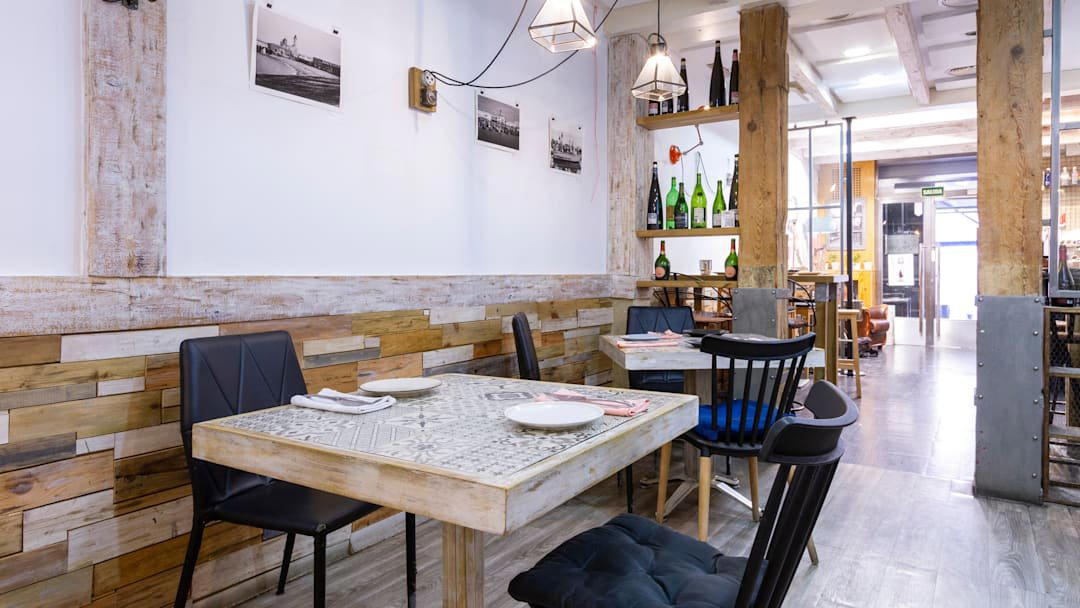
On Calle del Barco in Madrid's Centro district, La Burbujería occupies a corner of the city where neighbourhood bars and specialist wine spots coexist. The name signals something specific: bubbles, in the broadest sense, from cava to champagne to pét-nat, poured alongside small plates calibrated to keep a glass moving. It sits in a tier of Madrid drinking that prioritises product over performance.

Pearl is the En Primeur Club membership app, where members save venues, book tables and use the concierge.
The menu
What to order
- Carrillada de Vaca Guisada a la Cerveza Negra
- Molleja a la plancha
Calle del Barco and the Quiet Case for Bubbles
Madrid's Centro district runs the full spectrum from tourist-facing tapas chains to the kind of specialist bar that requires a little local knowledge to find. Calle del Barco, a short street in the Malasaña-adjacent pocket of 28004, sits closer to the latter. The neighbourhood draws a crowd that moves between concept-driven cocktail bars, natural wine rooms, and older tabernas, and the street itself rewards unhurried exploration. La Burbujería arrives in that context as a focused proposition: a bar and bottle shop built around sparkling wine in its many forms, at a time when Madrid's drinking culture has begun to take the category seriously as something beyond celebration-occasion Cava.
Across Spain, sparkling wine has historically occupied a functional role at the table, the thing opened at a birthday or poured reflexively on New Year's Eve. That dynamic has shifted in the past decade, most visibly in Barcelona's natural wine bars and in the growing presence of grower Champagne, English sparkling, and Spanish Ancestral method bottles in serious Spanish wine lists. Madrid arrived at the conversation slightly later than Barcelona, but it has moved quickly, with a cluster of specialist operators establishing that bubbles can anchor an entire programme rather than appearing as a secondary category. La Burbujería positions itself inside that shift, on a street where the audience already understands the premise.
What the Category Tells You About the Sourcing Logic
A bar structured around sparkling wine makes an implicit argument about provenance. Still wine rooms can rely on a regional identity, a Rioja cellar or a Ribera del Duero producer, and build a list from a single geographic logic. A bubbles-forward programme has to draw from multiple regions and production methods simultaneously: Cava from Penedès, Champagne from grower producers in the Marne, Crémant from Alsace or Jura, Pét-nat from natural producers across France, Spain, and increasingly Italy. That sourcing breadth demands editorial discipline. The lists that work in this format are selected by method and philosophy as much as by geography, favouring producers who farm with intention and use secondary fermentation as a tool for expression rather than volume.
This is where the ingredient-sourcing frame becomes the correct lens for reading a specialist bubbles bar. The question is not simply where the bottles come from, but what production choices are being championed. A list heavy in grower Champagne signals different values than one anchored in large-house labels. A selection that gives serious shelf space to Spanish Ancestral method wines, which undergo fermentation in bottle without disgorgement and often carry a sediment that signals minimal intervention, communicates a preference for transparency in the winemaking process. In Madrid's current specialist bar scene, these distinctions map onto identifiable clusters of operators, and a bar's sourcing choices are its primary critical statement.
The food offer at this kind of venue follows the same logic. Small plates in a sparkling wine context are not incidental, they are calibrated to preserve the acidity and effervescence of the glass. Dishes that would work against a low-acid red, heavy braises, rich cream sauces, function differently alongside a high-acid Blanc de Blancs or a briny Manzanilla-adjacent expression. The kitchen's job is to keep the wine at the centre of the experience, which tends to produce menus strong in preserved fish, raw preparations, charcuterie with textural contrast, and acid-forward vegetable dishes. These are not austere choices, they are technically considered ones.
Where La Burbujería Sits in Madrid's Drinking Tier
Madrid's premium dining tier, occupied by venues like DiverXO, Coque, Deessa, DSTAgE, and Paco Roncero, sets a context of high-investment tasting menus and formal service. La Burbujería operates in a parallel register: specialist, considered, but structured for an evening that moves at the pace of a conversation rather than a choreographed tasting sequence. This is not a compromise position, it reflects a different set of priorities. The bar format allows for a kind of hospitality that a 15-course tasting menu cannot, namely the ability to drop in, adjust the order of the evening, and let the glass guide the decision-making.
Across Spain more broadly, the restaurants setting the critical standard, from El Celler de Can Roca in Girona to Arzak in San Sebastián, Azurmendi in Larrabetzu, Mugaritz in Errenteria, Martin Berasategui in Lasarte-Oria, Quique Dacosta in Dénia, Aponiente in El Puerto de Santa María, Cocina Hermanos Torres in Barcelona, Ricard Camarena in València, and Atrio in Cáceres, tend to treat sparkling wine as part of a broader drinks programme. A bar that inverts that priority and makes sparkling wine the organizing principle is a different kind of specialist. For context, similarly focused sparkling-first programmes have gained critical traction in other cities: internationally, the benchmark for wine-led drinking with comparable precision might be found at venues like Le Bernardin in New York or the rigorous drinks programming at Atomix, where beverage curation carries the same weight as the food. La Burbujería operates at a lower price point than those references, but the categorical seriousness is comparable.
Planning an Evening on Calle del Barco
Centro's 28004 postcode is walkable from Gran Vía and Tribunal metro stations, which makes La Burbujería accessible as either a starting point or a late stop on an evening that moves between neighbourhoods. The Malasaña edge of the area gets busier from around 8pm on weekend nights; arriving earlier gives more room at the bar and a better chance of a seat. For the full list of what Madrid's dining scene offers at every tier, the EP Club Madrid restaurants guide provides the broader picture.
Autumn and winter are the seasons when sparkling wine lists tend to attract the most thoughtful attention in Madrid, as the city's social calendar shifts toward longer indoor evenings and producers release new vintages into the market. A visit between October and February places you in the period when a specialist bar is most likely operating at the depth of its list.
Frequently asked questions
Is La Burbujería better for a quiet night or a lively one?
The format of a specialist sparkling wine bar on Calle del Barco in Madrid's Centro district tends to attract a focused crowd rather than a loud one, guests come with an agenda, which keeps the energy purposeful rather than rowdy. That said, Centro's 28004 postcode sits close enough to Gran Vía that foot traffic fluctuates sharply by hour, so earlier visits skew quieter and later ones livelier.
Where is La Burbujería located?
La Burbujería is located at C. del Barco, 7, Centro, 28004 Madrid, Spain, Madrid.
Does La Burbujería focus on Spanish sparkling wines or international labels?
A bar built around bubbles in Madrid's Centro makes a deliberate argument about range: the category naturally spans domestic Cava and Corpinnat producers alongside Champagne and other international appellations. Given its location in a city without a dominant local sparkling tradition, La Burbujería on Calle del Barco, 7 likely treats geographic breadth as a selling point rather than restricting itself to a single region.
What should I order at La Burbujería?
The bar's entire premise is sparkling wine, so the list rather than any single bottle is the point, a venue structured this way typically spans Cava, Champagne, Pét-Nat, and regional Spanish espumosos rather than leaning on one appellation. Arrive with curiosity about provenance rather than a fixed house favourite, and ask the staff to work through the sourcing logic behind whatever is open by the glass that evening.
Peers You’d Cross-Shop
Comparable venues nearby, for context on price, style, and recognition.
| Venue | Cuisine | Price | Awards | Notes |
|---|---|---|---|---|
| La BurbujeríaThis venue (the venue you are viewing) | French-Mediterranean Fusion | Not listed | Not listed | Not listed |
| Petit Appetit | Authentic French Bistro | $20–30 | Not listed | Almagro |
| Hortensio | Modern French with Latin and Spanish influences | $50–100 | Macarfi 7 Food Rating | Chueca |
| Minut Soufflés & Café | French Soufflé Café | $1–10 | Not listed | Sol |
| Brasserie Lafayette | Classic French Brasserie | $50–100 | Macarfi 7.5 Food Rating | El Viso |
| X BOWL • Noodle House | Authentic Chinese Street Noodles | $30–50 | Not listed | Palacio |