
Kawasaki Daishi’s sweets culture rewards patience over spectacle: temple approach, family trade, and wagashi eaten before the day moves on. Kuzumochi Honpo Sumiyoshi belongs to that older rhythm, with Tabelog 100 recognition for Japanese traditional sweets and a format built around kuzu mochi, café use, and take-out rather than a long restaurant sitting.
Pearl is the En Primeur Club membership app — saves, bookings, and concierge access live there. Same editors, same standards.
- Address
- 4-47 Daishimachi, Kawasaki Ward, Kawasaki, Kanagawa 210-0816, Japan
- Phone
- +81 44-288-4437
- Website
- kuzumochi.com
 Saves & bookings on Pearl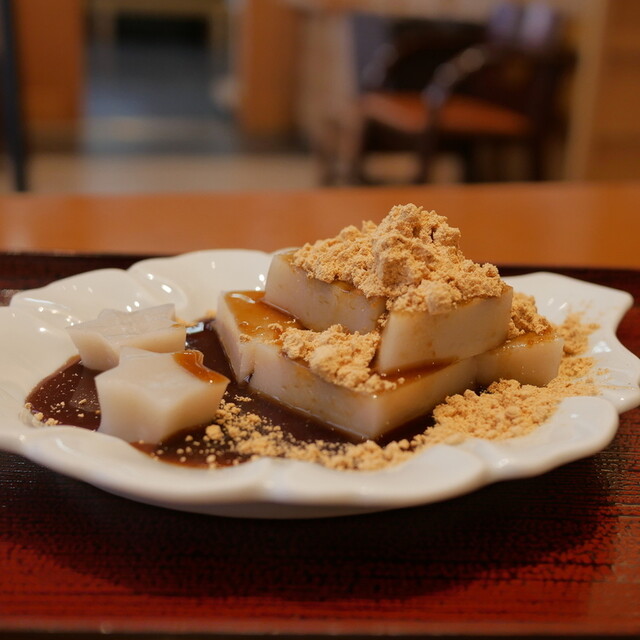
The approach to Kawasaki Daishi changes the appetite before the first order is placed. The rhythm is not restaurant-driven in the metropolitan sense; it is temple-town eating, with visitors moving between prayer, shopping streets, small counters, and boxes of sweets meant to travel home. In that setting, wagashi is less a dessert course than a local habit: quick, portable, seasonally aware, and tied to the flow of the neighbourhood.
Kuzumochi Honpo Sumiyoshi sits inside that tradition rather than apart from it. Its Tabelog 100 selection for Japanese traditional sweets and Japanese sweets cafés in East Japan places it in a category where the benchmark is not luxury plating or chef theatre, but consistency, craft, and local pull. Kawasaki’s dining map has louder signals elsewhere, from ramen queues to yakiniku and commuter-town bakeries, yet the Daishi area keeps a different register: sweets shops and café formats that work around pilgrimage traffic, family visits, and take-home purchases.
Kawasaki Daishi sweets culture favors ritual over restaurant spectacle
Tokyo-area visitors often read Kanagawa through Yokohama, Kamakura, or hot-spring itineraries, but Kawasaki Daishi has its own food logic. The temple approach supports a short-form style of eating: something sweet before returning to the station, a box for the household, a café stop that does not require building the day around a reservation. That makes Japanese sweets here feel closer to civic infrastructure than occasion dining.
Kuzu mochi is especially well suited to this environment. In eastern Japan, the name often refers to a fermented wheat-starch sweet rather than the arrowroot-based version associated with parts of western Japan. The appeal lies in texture, restraint, and contrast with toppings rather than richness. For travellers used to pâtisserie or plated dessert menus, the category asks for a slower reading: sweetness is controlled, portioning is modest, and the pleasure sits in chew, temperature, and the balance of accompaniments.
That distinction matters because Kawasaki’s casual dining range can otherwise look deceptively broad on a map. Sumiyoshiya Sohonten and Pastry shop Tamagawa (Oiwake Bun) occupy a similarly low-spend sweets bracket in Kawasaki, while Ramen Jiro Keikyu kawasaki ten and Matsu no Ki move the city’s everyday dining conversation into heavier, savoury territory. Kuzumochi Honpo Sumiyoshi belongs on the sweets side of that divide, where the decision is less about a full meal and more about how a neighbourhood preserves a particular edible custom.
The café-and-take-out format keeps the experience local
The stronger read here is format. A Japanese sweets café near a temple does not need to behave like a destination dining room, and it loses something when judged by that standard. The value is in the combination of café use and take-out, a structure that lets the same sweet work for several audiences: the temple visitor, the family group, the local buying gifts, and the traveller adding one precise stop to a Kawasaki day.
The Tabelog score of 3.63 gives a useful calibration. In Japan’s user-review culture, that number signals steady recognition rather than viral hype, and the Tabelog 100 sweets selection gives the stronger editorial cue. The category is narrow and craft-specific; inclusion says more about relevance within wagashi and sweets-café circles than about broad restaurant glamour. That is the correct lens. Expect a place governed by product, turnover, and habit, not a room built to stage a long meal.
It also explains why this address belongs in a Kawasaki itinerary differently from the city’s other restaurant stops. For broader planning, Our full Kawasaki restaurants guide maps the city’s dining range, while nearby and category-adjacent pages such as (Shoku) Vietnam, Belmatine, Boulangerie Metier Pa-ku shiti musashi kosugi za ga-den, Buta Boshi, and C'EST UNE BONNE IDEE! show how wide Kawasaki becomes once the temple quarter gives way to commuter corridors and station-side eating.
For travellers building a larger Japan route, the comparison becomes even sharper. Kamakura’s heritage dining, Tokyo’s izakaya-adjacent grill formats, Osaka’s café culture, Kumamoto’s contemporary counters, Sapporo’s curry shops, and Kyoto’s small-format dining all reward different expectations. That wider map includes -Grilled beef Sukiyaki- KAMAKURA TANUKIAN 鎌倉 たぬき庵 in Kamakura. 鮪と炭火焼き うお炭 秋葉原店 in Tokyo.cafe in Osaka.know in Kumamoto, [Curry Senmon Ten] Maruyama Kyoju. in Sapporo, and [ki:] in Kyoto. Outside Japan, Jōdo Saké Bar in Los Angeles and Onigiri Time in Pasadena point to how Japanese formats change when translated for overseas diners.
How to place it in a Kawasaki day
The correct timing is around the neighbourhood, not around a tasting-menu clock. Kawasaki Daishi pulls visitors in the morning and early afternoon, and the sweets stop makes sense as part of that movement: before leaving the temple area, after walking the approach, or as a take-home purchase rather than a full pause. The monthly festival days of the Great Master, on the 20th and 21st, add another layer of local rhythm, with a customer appreciation offer attached to kuzu mochi service at the café.
Planning should stay practical. Reservations are not part of the format, payment is listed as cash-only across cards, electronic money, and QR payments, and parking is not provided, though paid parking is nearby. The site is reachable on foot from Kawasaki Daishi Station via Nakamise Street, with Higashimonzen Station also within walking distance. For visitors staying in the area, Our full Kawasaki hotels guide helps with base selection; drink-led evenings, cellar searches, and non-restaurant planning sit in Our full Kawasaki bars guide, Our full Kawasaki wineries guide, and Our full Kawasaki experiences guide.
The verdict is clear: this is not a detour for diners chasing spectacle. It is a precise Kawasaki Daishi stop for understanding how wagashi functions in a temple neighbourhood, backed by category recognition and a format that serves locals as much as visitors. Treat it as a cultural sweets address, not a conventional restaurant, and the experience makes much more sense.
A Lean Comparison
Comparable venues to calibrate price, style, and recognition.
| Venue | Cuisine | Price | Notes |
|---|---|---|---|
| Kuzumochi Honpo SumiyoshiThis venue — the venue you are viewing | Not listed | $ | Not listed |
| Match Bo Mizonokuchi ten | Takatsu-ku, Wakayama-style ramen | $ | Not listed |
| Mendokoro Futokoro Ya | Not listed | $ | Miyamae-ku, Saginuma, Classic Kawasaki ramen counter |
| Pastry shop Tamagawa (Oiwake Bun) | Kawasaki Ward, Japanese Confectionery | $ | Not listed |
| Ramen Jiro Keikyu kawasaki ten | Not listed | $ | Kawasaki Ward, Kawasaki City, Jiro-style Ramen Shop |
| Menya Deko | Not listed | $$ | Shin-Maruko / Musashi-Kosugi, Niboshi Ramen & Tsukemen |
Recognition history
Dated appearances from independent guides and award organizations, with the underlying list record or original source where available.
Tabelog 100 #77 · No. 77
Tabelog · Tabelog 100 - Japanese traditional sweets / Japanese sweets cafe - EAST - 2023








At a Glance
- Classic
- Cozy
- Modern
- Well Known
- Casual Hangout
- Family
- Solo
- After Work
- Celebration
- Historic Building
- Standalone
- Design Destination
- Local Sourcing
- Street Scene
Current opening hours
- Monday
- 8:30 AM–5 PM
- Tuesday
- 8:30 AM–5 PM
- Wednesday
- 8:30 AM–5 PM
- Thursday
- 8:30 AM–5 PM
- Friday
- 8:30 AM–5 PM
- Saturday
- 8:30 AM–5 PM
- Sunday
- 8:30 AM–5 PM
Hours can change for holidays and private events. Last verified .
A relaxed, traditional Japanese sweets café with a clean, wood-accented washoku-modern design, bright daytime light from the street, and a calm, temple-side atmosphere suited to taking a break before or after visiting Kawasaki Daishi.