
Tabelog 100 #21
Our verdict
Kurosugi sits in Osaka’s serious sushi tier: a 16-seat Dojimahama counter with private rooms, lunch and dinner price bands that separate it from casual sushi bars, and selection for Tabelog Sushi WEST “Tabelog 100” in 2025, 2022 and 2021. The appeal is less spectacle than format discipline: counter seating, fish-led sourcing, sake and wine depth, and a location that suits a planned Kita Ward dining night.

Pearl is the En Primeur Club membership app, where members save venues, book tables and use the concierge.
The menu
What to order
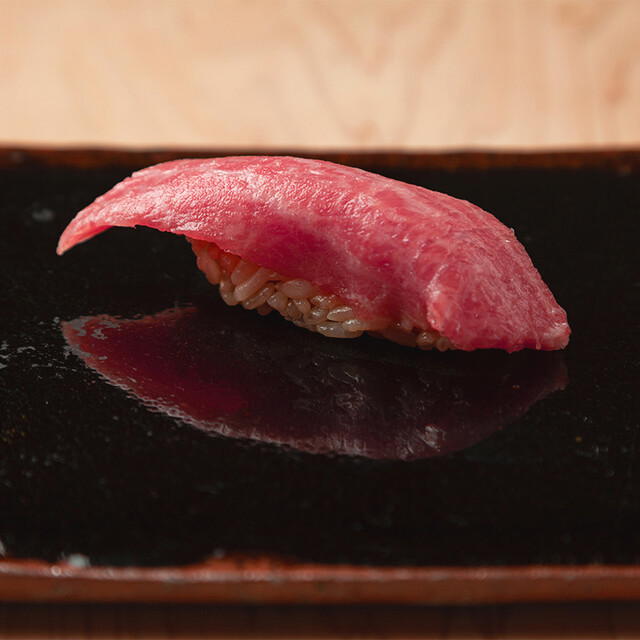
- Edomae nigiri sushi assortment
- Tuna from Yamayuki
- Seasonal sashimi
- Omakase lunch course
- Tamagoyaki
Approaching an Osaka dinner after dark, the city can shift from louder eating districts to a more controlled rhythm: office towers, river-adjacent streets, and dining rooms expecting guests to arrive with intent. Sushi here is not only the city’s casual shorthand. It also sits in a smaller, higher-priced category where timing, reservation discipline and the shape of the meal can matter before the first course.
Kurosugi belongs to that bracket. The restaurant is listed in the sushi category, with a dinner budget of JPY 30,000–39,999 and a lunch budget of JPY 6,000–7,999. That split matters in Osaka. The city is often flattened into takoyaki, okonomiyaki and casual abundance, but it also supports another habit: expensive, appointment-led restaurants structured around a precise meal rather than a spontaneous stop.
Osaka sushi in the city’s reservation-led dining tier
The comparison is not everyday sushi counters near stations, but the more formal Japanese restaurants found across Osaka. In the supplied Osaka peer group, Kitashinchi Shabushabu Sukiyaki Kiraku, Shinchi Yamamoto and Man-u help show the range of serious dining around the city. Kurosugi’s dinner band, JPY 30,000–39,999, puts it in a more selective spend category, while lunch, JPY 6,000–7,999, gives the restaurant a different daytime logic from the city’s expense-account evening rooms.
That split helps travelers planning Osaka around meals rather than landmarks. Lunch can be a controlled entry point into a restaurant otherwise priced for a deliberate dinner, while evening service competes with the city’s formal Japanese dining rooms rather than casual sushi. The restaurant’s 2025 Tabelog Hyakumeiten recognition in the sushi category is the cleanest public signal provided here. It is not a Michelin claim and should not be read as one. It does place the restaurant inside a regional sushi list Japanese diners use to sort serious restaurants.
For a broader read on how this fits the city, Our full Osaka restaurants guide is the better frame than a single-district crawl. Osaka rewards range: a premium sushi booking, other Japanese dining rooms, casual snacks, sweets, and sharper casual stops all coexist in the same city. The point is not to rank them, but to understand Osaka’s breadth, and that sushi at this level occupies a planned slot rather than a spontaneous one.
Meal planning and the Osaka business-dining overlap
Formal sushi can compress preparation, pacing and guest attention into a focused restaurant experience. For Kurosugi, the reliable facts supplied are simpler: it is an Osaka sushi restaurant with a high dinner budget, a more accessible lunch budget, and Tabelog Hyakumeiten recognition in 2025. In Osaka, that positioning matters because formal meals, business dining, celebrations and culinary travel can overlap more fluidly than outsiders sometimes expect.
Occasion planning should be treated carefully rather than assumed. The provided information does not establish specific celebration services, child policies or room details, so travelers should confirm those directly when booking. Read culturally, the safer point is that a restaurant in this price band is best approached as a focused meal, not as a flexible backdrop for every kind of gathering.
Drink positioning should also be kept at the category level unless confirmed directly. The provided facts do not name bottles, a sommelier record or a beverage program, so the reliable conclusion is not label-specific. At this level of Osaka sushi, guests should expect to plan the meal seriously and ask the restaurant about pairings or drinks when reserving.
Travelers building a wider Kansai itinerary can use broader Osaka guides to avoid treating dinner as the only fixed point. In this category, the meal works better when the day stays clean: not too many snacks beforehand, not too much cross-city transit, and no assumption that a premium restaurant will absorb late arrivals casually.
How to read Kurosugi within Japan's wider restaurant map
Japanese restaurant planning increasingly rewards specificity. A traveler comparing regions should not read Osaka sushi as interchangeable with sushi or Japanese dining elsewhere in Japan, or with Japanese formats outside Japan. Other cities and markets can express Japanese food through different habits, price points and expectations. Kurosugi should be read first through the facts that are actually available: Osaka, sushi, a serious dinner budget, a lower lunch budget and 2025 Tabelog Hyakumeiten recognition.
Within Osaka, Kurosugi is not trying to express only the city’s democratic eating culture. It represents another Osaka: planned, compact in feel, expensive, and restrained. The Tabelog score of 3.70 and the 2025 Tabelog Hyakumeiten recognition keep it visible in a competitive sushi category. Add the lunch/dinner budget split, and the decision is clear: this is for travelers who want Osaka’s formal sushi register, not a casual add-on between sightseeing stops. For lighter counterpoints elsewhere in the city, keep the comparison generic: Osaka has many dining rhythms, and Kurosugi belongs to the more deliberate one.
Frequently asked questions
Where do I go for Kurosugi?
Osaka.
What price level is Kurosugi?
Pricing at Kurosugi is listed as Dinner: JPY 30,000 - JPY 39,999; Lunch: JPY 6,000 - JPY 7,999.
When is Kurosugi open?
What's the standout thing about Kurosugi?
The clearest marker is its 2025 Tabelog Hyakumeiten recognition in the sushi category, alongside a listed Tabelog score of 3.70 and a serious lunch-and-dinner price structure for Osaka sushi.
A Lean Comparison
Side-by-side context: comparable cuisine and price.
| Venue | Cuisine | Price | Awards | Notes |
|---|---|---|---|---|
| KurosugiThis venue (the venue you are viewing) | Edomae Sushi Omakase | $150–200 | Tabelog 100 #21 | Not listed |
| LE SUCRE-COEUR Kitashinchi | Not listed | Not listed | Tabelog 100 #33 | JPY 1,000 - JPY 1,999 |
| Kaishoku Shimizu | Modern Kaiseki | $100–150 | 1 Michelin Star | Japanese |
| Kitashinchi Shabushabu Sukiyaki Kiraku | Traditional Wagyu Shabu-shabu & Sukiyaki | $100–150 | Tabelog 100 #35 | JPY 15,000 - JPY 19,999 |
| Man-u | Modern Japanese Oden | $100–150 | Michelin Plate | Oden |
| Shinchi Yamamoto | Modern Japanese Kaiseki Omakase | $300–500 | 1 Michelin Star | Japanese |
Recognition history
Dated appearances from independent guides and award organizations, with the underlying list record or original source where available.
Tabelog 100 #21 · No. 21
Tabelog · Tabelog 100 - Sushi - WEST - 2025















