
Tabelog 100 #28
Our verdict
A basement-level wagashi counter inside JR Nagoya Takashimaya, Kurimukinton Suya Jeiāru nagoya takashimaya sits in the station’s polished gift-food economy rather than the sit-down dessert-cafe circuit. Tabelog selected it for the Japanese traditional sweets / Japanese sweets cafe EAST 100 in 2023, with a JPY 2,000–2,999 range that places it in planned souvenir territory, not casual snack pricing.

Pearl is the En Primeur Club membership app, where members save venues, book tables and use the concierge.
The menu
What to order
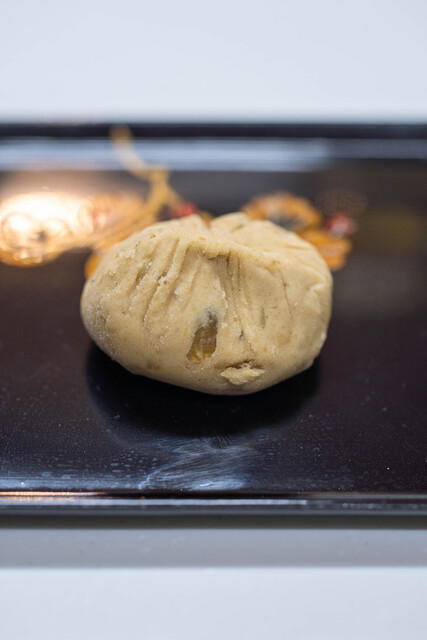
- Kuri-kinton (sweet chestnut paste sweets)
- Seasonal wagashi assortment
Nagoya’s retail food floors have their own tempo: commuters moving with train-time precision, shoppers comparing boxed gifts, and counters built for quick decisions rather than lingering. In that environment, wagashi is not treated simply as dessert after a meal. It is a seasonal gift language, a local calling card, and, for travelers passing through Nagoya, a practical way to carry Nagoya-area sweetness onward.
Kurimukinton Suya Jeiāru nagoya takashimaya belongs to that city retail category where the experience is defined by selection, packaging, and timing. The format is best understood as a focused sweets purchase rather than a long dining-room pause. It is a specialist sweets counter in Nagoya, useful when the itinerary allows a narrow window but the purchase still needs credibility.
Nagoya wagashi, judged by precision rather than spectacle
Nagoya’s dining scene splits into clear bands. There are higher-commitment meals, everyday counters for commuters, and food halls that turn regional food culture into something portable. In the same city orbit, comparison venues show the spread: Taka Fuku Nagoya JR sentoraru tawāzu ten and Nako Tei sit in a different dining bracket, while Kounan JR sentoraru tawazu ten and Le Supreme Jeiāru nagoya takashimaya ten occupy other everyday price bands. A wagashi counter in the JPY 2,000–2,999 range is playing a different game: boxed refinement, gift suitability, and confidence in a narrow category.
The award signal is useful here because traditional sweets can be difficult for visitors to judge from the outside. Recognition in Tabelog’s Hyakumeiten listings in 2023 places the counter within a vetted Japanese traditional sweets conversation rather than the broader retail churn. The Tabelog score of 3.82 also matters in Japan’s rating culture, where small numerical differences often carry more weight than they would on international platforms.
Kurimukinton Suya Jeiāru nagoya takashimaya has its clearest identity in Japanese traditional sweets. The broader point is not novelty; it is discipline. Wagashi often rewards narrow specialization, especially when the purchase is intended as a gift. Travelers who are used to polished sweets displays may need to adjust expectations: the appeal is not a theatrical room or a long menu, but a compact retail ritual where the product, wrapping, and destination all do quiet work.
Why the booking question is a timing question
For this kind of venue, planning is less about securing a table and more about choosing the right moment to pass through Nagoya. The rhythm is tied to a busy retail setting rather than a restaurant service. That makes it convenient for travelers already moving through the city, but it also means the purchase can sit inside an active environment where weekends, holidays, and late-day gift shopping may change the feel quickly.
The practical advantage is directness. A sweets-counter visit removes the uncertainty of a long meal reservation, and the Nagoya setting reduces the need for a separate detour. The trade-off is atmosphere: this is a polished commercial context, not a hushed salon. For travelers who want wagashi with ceremony, a dedicated tea room will read differently. For travelers who want a credible regional sweet before moving on with the day, the format is exactly the point.
The listed price range also fits the category, with Tabelog placing it at JPY 2,000–2,999 and the lunch budget in the same band. That keeps the decision contained: it can be a planned gift purchase, a small premium stop, or a final food souvenir rather than a full meal. The public record also lists Japanese traditional sweets as the category, which helps set expectations before arrival.
Where it fits in a Nagoya food itinerary
The smartest way to read this counter is as part of Nagoya’s portable food culture. The city concentrates retail and high-turnover dining in a way that can feel commercial, but that commerciality is also what makes specialist counters viable. A traveler can move from a formal meal to a sweets purchase within the same broad day plan, which is one reason Japanese food halls remain serious food addresses rather than mere convenience floors.
That context separates Kurimukinton Suya Jeiāru nagoya takashimaya from sit-down restaurants in the same city. Szechuan Restaurant Chin Nagoya, for example, belongs to a different lunch-and-dinner dining rhythm with a different commitment of time and appetite. Here, the decision is narrower: buy wagashi when portability, gift value, and Nagoya convenience matter more than a dining room. It is a strong fit between other city plans, after checkout, or as a controlled final stop on a Nagoya food day.
For broader planning around the city, start with Our full Nagoya restaurants guide, then map the rest of the trip through Our full Nagoya hotels guide, Our full Nagoya bars guide, Our full Nagoya wineries guide, and Our full Nagoya experiences guide. For contrast across Japan and beyond, related restaurant pages include other dining rooms, casual counters, sweets specialists, and bars in major cities, but Kurimukinton Suya Jeiāru nagoya takashimaya is best judged on its own terms: a Nagoya Japanese traditional sweets stop with a 2023 Tabelog Hyakumeiten signal and a JPY 2,000–2,999 listed price band.
Frequently asked questions
Is Kurimukinton Suya Jeiāru nagoya takashimaya okay with children?
The public record provided here does not specify a children policy. Treat it as a Japanese traditional sweets stop in Nagoya and check the venue's official channels for the latest details before visiting with children.
What's the overall feel of Kurimukinton Suya Jeiāru nagoya takashimaya?
It reads as a compact Nagoya wagashi counter rather than a sit-down dessert room. The useful signals are its Japanese traditional sweets category, its JPY 2,000–JPY 2,999 listed price range, its 3.82 Tabelog score, and its 2023 Tabelog Hyakumeiten recognition.
Is Kurimukinton Suya Jeiāru nagoya takashimaya more mid-range or high-end?
Pricing at Kurimukinton Suya Jeiāru nagoya takashimaya is listed as JPY 2,000 - JPY 2,999.
When can I go to Kurimukinton Suya Jeiāru nagoya takashimaya?
Specific opening hours are not provided in the ground-truth record here. Check the venue's official channels or current listings before going.
Where It Fits
Comparable options at the same price tier.
| Venue | Cuisine | Price | Awards | Notes |
|---|---|---|---|---|
| Kurimukinton Suya Jeiāru nagoya takashimayaThis venue (the venue you are viewing) | Traditional Japanese Wagashi & Kuri-kinton Sweets | $10–20 | Tabelog 100 #28 | Not listed |
| Ichibiki | Traditional Unagi | Not listed | Tabelog 100 #34 | Nakamura |
| Teuchi Udon Kato | Japanese Udon | $10–20 | Tabelog 100 #63 | Nakamura |
| Murasakiya | Traditional Japanese Wagashi Cafe | $10–20 | Tabelog 100 #56 | Naka |
| Udon Ryori Sen | Curry Udon & Oden Udon House | $20–30 | Tabelog 100 #82 | Naka |
| 眞善美 | Modern Sichuan Omakase | $500+ | Tabelog Silver #123 | Higashi |
Recognition history
Dated appearances from independent guides and award organizations, with the underlying list record or original source where available.
Tabelog 100 #28 · No. 28
Tabelog · Tabelog 100 - Japanese traditional sweets / Japanese sweets cafe - EAST - 2023
Continue exploring
More in Nagoya




Details
- Quiet
- Classic
- Cozy
- Solo
- Family
- Casual Hangout
- After Work
- Special Occasion
- Standalone
- A La Carte
- Counter Dining
Current opening hours
- Monday
- 10 AM–8 PM
- Tuesday
- 10 AM–8 PM
- Wednesday
- 10 AM–8 PM
- Thursday
- 10 AM–8 PM
- Friday
- 10 AM–8 PM
- Saturday
- 10 AM–8 PM
- Sunday
- 10 AM–8 PM
Hours can change for holidays and private events. Hours as of .
Bright department-store confectionery counter with a clean, traditional Japanese aesthetic focused on neatly arranged boxed sweets and efficient takeout service rather than eat-in dining.