
Nagoya’s ramen culture rewards small rooms, quick turnover, and serious noodle craft over ceremony. Kodawari Men Kobo Tago sits in that compact counter tradition, backed by a 2025 Tabelog 100 Ramen Aichi selection and an eight-seat format that places the cooking team and dining room in close quarters.
Pearl is the En Primeur Club membership app — saves, bookings, and concierge access live there. Same editors, same standards.
- Address
- Japan, 〒454-0972 Aichi, Nagoya, Nakagawa Ward, Niie, 2 Chome 605番地
- Phone
- +81 52-431-8111
- Website
- mobile.twitter.com
 Saves & bookings on Pearl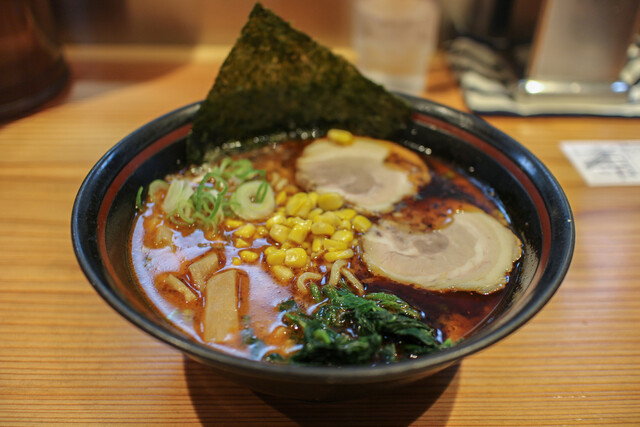
The approach is suburban rather than theatrical: Nakagawa Ward streets, a house-style ramen shop, and a small counter where waiting moves outside when seats are full. That scale matters. In Nagoya, serious ramen often functions less like a European restaurant than a workshop, with room, ticket machine, kitchen, and queue folded into one tight service system.
Kodawari Men Kobo Tago belongs to that tradition. Its 2025 selection for Tabelog 100 Ramen Aichi places it inside the prefecture’s recognized ramen tier, but the format says more: eight counter seats, no private rooms, and a lunch-led rhythm. This is not a tasting-menu proposition. It is a short, focused meal whose value lies in execution, timing, and how cleanly the team moves guests through limited space.
Aichi ramen at counter scale, not dining-room scale
Nagoya’s dining reputation is often reduced to miso katsu, tebasaki, kishimen, and hitsumabushi, but its ramen scene has its own map, dispersed across station-adjacent shops, residential districts, and suburban corridors rather than one visitor-friendly quarter. That dispersal raises the stakes: recognition must travel beyond neighbourhood habit.
In that context, a Tabelog 100 Ramen Aichi selection is useful not as decoration, but sorting data. It marks a shop that has cut through a crowded prefectural category where regulars compare broth concentration, noodle texture, ticket-machine efficiency, and queue discipline with little sentiment. Nearby comparison clarifies the bracket. Tsukemen Maruwa Haruta honten operates in the same low-price ramen economy, while Curry Senmon Ten cafe New Delhi sits in another casual Nagoya lane; neither makes the experience formal, but both show how competitive the sub-¥1,000 end of local dining can be.
The counter-only setup turns kitchen and room into one working unit. Larger restaurants can soften delays and stretch pacing; here, cooking, seat turnover, ticket handling, and guest movement have to align because there is little architectural margin. That is part of serious ramen’s appeal in Japan: craft is not hidden behind a dining room, but measured in repetition under pressure.
Recognition without ceremony
This category refuses to behave like luxury dining even when its audience is exacting. A shop can be selected for a major ramen list and remain cash-only, compact, and governed by rules built for flow rather than hospitality theatre. That tension is especially Japanese: high scrutiny applied to an everyday format.
Kodawari Men Kobo Tago opened in 2015, enough operating history to be judged on consistency rather than novelty. Its Tabelog score of 3.60 sits where specialist attention begins to matter, especially in a category with deep local competition and high review volume across Japan. For travellers, the point is not a trophy meal. It is understanding how a city’s casual dining canon is maintained by repetition, limited capacity, and customers willing to plan around a short service window.
The lack of reservations is part of the experience. It keeps the shop aligned with ramen’s walk-in grammar, where demand is managed by queue behavior and turnover rather than table allocation. In a counter room this small, the guest joins the operating system: arrive, order, eat with pace, and clear space for the next person. Done well, that is not brusque; it is the format’s social contract.
Compared with broader Nagoya dining, this is a narrow mission. Pont-l'Eveque, outside the metro, occupies a more general casual price band, while Yakiniku Fujisan Jimokuji koujou ten sits higher, where group dining and meat ordering alter the rhythm. Ramen at this level is more compressed. The decision is less about lingering than whether a short meal justifies crossing town. The 2025 Aichi recognition makes a credible case that it can, especially for readers mapping the city beyond its central hotel-and-station loop.
How to place it in a Nagoya eating day
Use a small Nagoya ramen counter as an anchor, not an add-on squeezed between appointments. The shop’s geography and compact service reward a deliberate lunch plan: build around the ward, transport timing, and a possible outdoor wait rather than treating it as a flexible snack stop. The nearest rail reference is Haruta Station, and the address sits far enough from the core tourist circuit that the meal reads differently from a station-basement bowl.
Payment and pacing also require planning. Cash-only, no electronic money, no QR-code payments, and no reservations put the burden on preparation. For visitors used to concierge-booked dining, that can feel stripped back. For ramen regulars, it is ordinary. The useful distinction is expectation: this is a recognized specialist counter, not a managed luxury appointment.
For a broader Nagoya itinerary, pair this address with the city’s other low-ceremony food forms rather than forcing it into a fine-dining frame. EP Club readers comparing categories can start with Our full Nagoya restaurants guide, then widen the trip through Our full Nagoya hotels guide, Our full Nagoya bars guide, Our full Nagoya wineries guide, and Our full Nagoya experiences guide. Within the restaurant archive, cross-reading places such as 1022, 451, Aaron, Alan., and All Day Dining Montmartre shows how Japanese city meals handle formality, price, and pace.
Travellers building a Japan-wide casual-dining map can compare the ramen-counter discipline here with other compact or specialist formats: -Grilled beef Sukiyaki- KAMAKURA TANUKIAN 鎌倉 たぬき庵 in Kamakura. 鮪と炭火焼き うお炭 秋葉原店 in Tokyo.cafe in Osaka.know in Kumamoto, (Shoku) Vietnam in Kawasaki, [Curry Senmon Ten] Maruyama Kyoju. in Sapporo, Jōdo Saké Bar in Los Angeles, and Onigiri Time in Pasadena. The comparison is not cuisine equivalence; it is how small formats communicate seriousness without formality.
The critical read is simple: this is a Nagoya ramen address for diners who respect systems. The counter is small, the recognition specific, and the experience depends on accepting compact lunch-service rules. That combination gives Kodawari Men Kobo Tago its editorial weight: it shows how a city’s casual food culture can be exacting without becoming precious.
- 濃厚煮干し担々麺 (rich niboshi tantanmen)
- 冷やし煮干し中華そば (chilled niboshi chuka soba)
- たごジロウ (Jiro-style ramen)
- 特撰味噌らーめん (special miso ramen)
- 台湾塩ラーメン (Taiwan-style shio ramen)
- 超濃厚煮干しの海苔そば (super rich niboshi nori soba)
A Tight Comparison
Comparable venues at the same tier for side-by-side context.
| Venue | Cuisine | Price |
|---|---|---|
| Kodawari Men Kobo TagoThis venue — the venue you are viewing | Nakagawa, Ramen & Tantanmen Shop | $ |
| China Soba Kitagawa | Minami, Ramen & wonton shop | $ |
| MEI | Nishi, japanese | $ |
| Gokubuto Dakuryu Ramen La Keiko Honten | Naka, Thick Rich Ramen Shop | $ |
| Atsuta Miso Ramen Buriyu | Atsuta, Japanese Ramen | $ |
| Naruto Ya | Naka, Ramen & Tsukemen Shop | $ |
Recognition history
Dated appearances from independent guides and award organizations, with the underlying list record or original source where available.
Tabelog 100 #58 · No. 58
Tabelog · Tabelog 100 - Ramen - AICHI - 2025
Continue exploring
More in Nagoya
Restaurants in Nagoya
Browse all →

At a Glance
- Cozy
- Solo
- Casual Hangout
- After Work
- Standalone
- Chefs Counter
Current opening hours
- Monday
- Closed
- Tuesday
- Closed
- Wednesday
- 11 AM–2 PM
- Thursday
- 11 AM–2 PM
- Friday
- 11 AM–2 PM
- Saturday
- 11 AM–2:30 PM
- Sunday
- 11 AM–2:30 PM
Hours can change for holidays and private events. Last verified .
Simple counter-style ramen shop with a casual, no-frills atmosphere where a single chef quietly cooks and serves; lighting is functional rather than decorative, and the focus is firmly on the noodles rather than design.