Our verdict
Occupying a considered address at Place Poelaert in Brussels, ökēn sits within a dining city that rewards close attention. The venue draws from cultural roots that position it against Brussels' broader movement toward identity-driven cooking, where provenance and technique carry more weight than category labels. For travellers already familiar with the city's fine dining tier, ökēn merits a direct look.

Pearl is the En Primeur Club membership app — saves, bookings, and concierge access live there. Same editors, same standards.
- Address
- Pl. Poelaert 6, 1000 Bruxelles, Belgium
- Phone
- +32472130059
- Hours
- Mon–Wed ClosedThu 7:30 PM–1 AMFri 7:30 PM–3 AMSat 7:30 PM–1 AMSun Closed
- Website
- oken.be
- Directions
- Get directions
- Booking
- Book on SevenRooms
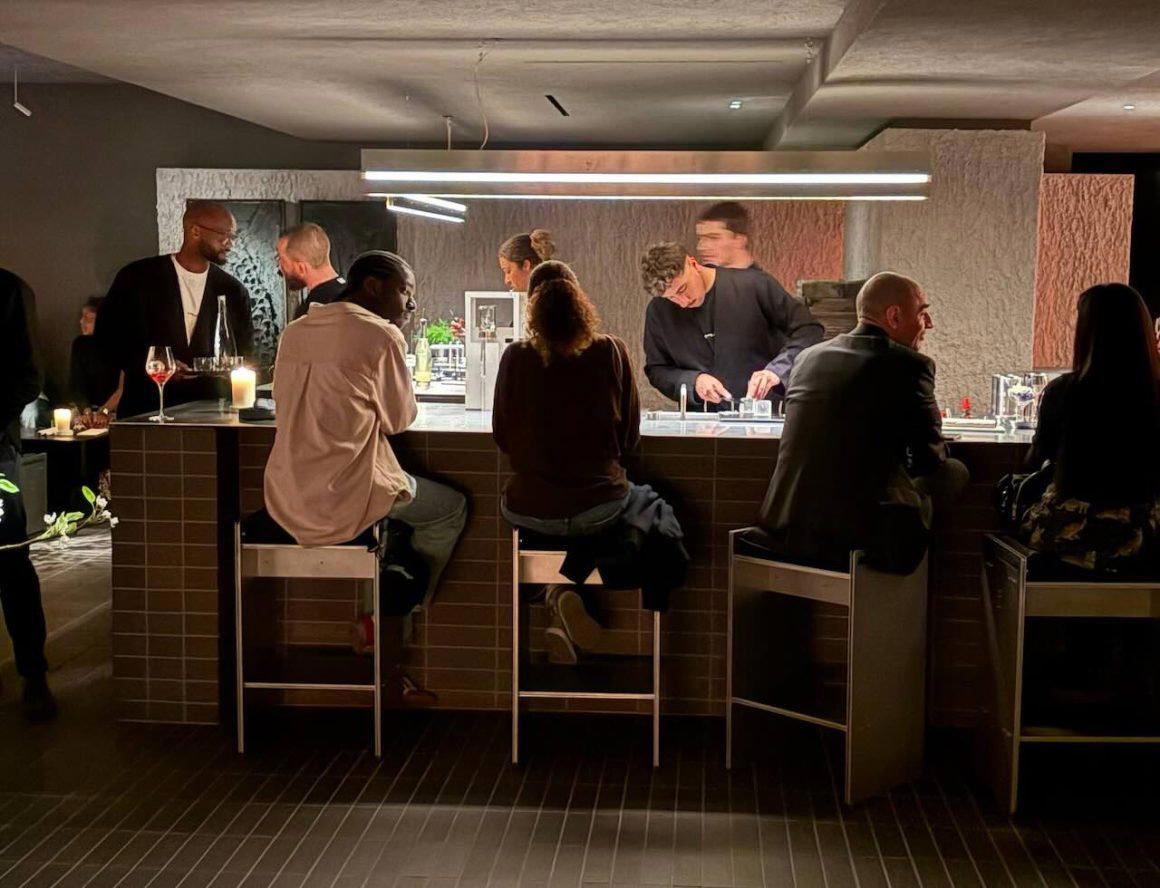
Place Poelaert and the Architecture of Brussels Dining
Place Poelaert occupies one of Brussels' more charged civic addresses, anchored by the Palais de Justice and its vertiginous neoclassical mass. The square sits at the hinge between the upper city's institutional weight and the more human-scaled streets of the Marolles below. Restaurants that settle here inherit a particular kind of seriousness — not the frictionless glamour of the Grand Sablon two blocks north, but something quieter and more considered. ökēn, at number 6, belongs to that register.
Brussels has spent the better part of a decade recalibrating what its dining scene is actually for. The city that once leaned heavily on a French-Belgian canon — the long tradition represented by addresses like Comme chez Soi or the modernised classicism of La Villa Lorraine by Yves Mattagne, has progressively made room for kitchens that resist easy categorisation. ökēn is part of that second wave: a venue whose name signals intent without spelling it out, and whose position at Poelaert places it physically apart from the cluster of galleries and wine bars on Rue de la Régence.
Cultural Roots and the Question of Culinary Identity
Belgian cooking is frequently misread from the outside. The country's cuisine sits at a genuine crossroads, geographically between France, the Netherlands, and Germany, and historically shaped by Burgundian, Spanish, and Habsburg influences that have left real traces in the larder. The result is a food culture that is neither derivative nor self-consciously nationalist, but genuinely hybrid in ways that reward attention. Kitchens in Brussels that take this seriously tend to draw on specific regional materials, North Sea fish, Ardennes game, chicory, white asparagus, aged cheeses from the abbey tradition, while applying technique that may owe as much to contemporary Nordic or Japanese models as to classical French.
This is the context in which ökēn sits. Brussels-based kitchens operate with a slightly different pressure: the capital's dining public is international, politically heterogeneous, and accustomed to comparison. That audience tends to be harder to impress with mere technical competence and more responsive to a clear point of view.
ökēn's address in a city with this level of critical expectation is itself a signal. Venues that open at Poelaert-adjacent locations are not targeting the tourist circuit that concentrates around the Grand Place or the Sablon chocolate shops. They are addressing a diner who already has opinions, who may have already sat at Barge or Eliane, and who is looking for the next argument worth having.
Where ökēn Sits in the Brussels Fine Dining Tier
The Brussels fine dining scene stratifies clearly. At the leading, formally credentialed tables with Michelin recognition and multi-decade reputations, Comme chez Soi and Bozar Restaurant among them, serve an audience that books weeks or months ahead and treats the meal as a special occasion. Below that, a second tier of chef-driven, format-flexible restaurants operates with more agility: shorter menus, more direct sourcing, fewer formal constraints. This is where much of the city's actual culinary energy currently lives.
ökēn appears to operate in or near that second tier, where identity-driven cooking and a willingness to resist categorisation matter more than cover counts or room grandeur. The comparison set is not Comme chez Soi's art nouveau dining room, but rather the smaller, more argumentative kitchens that have defined Brussels dining for the past several years. Internationally, the closest analogues are the kind of precise, culturally grounded restaurants that have reshaped mid-tier fine dining in cities from Copenhagen to Seoul, a lineage that includes places like Atomix in New York, which demonstrated that formal Korean cooking could reframe the terms of what a tasting menu is supposed to do.
For the reader already familiar with Belgium's wider dining circuit, who may have made the trip to Willem Hiele in Oudenburg or Bartholomeus in Heist, ökēn represents a Brussels-based entry point into that same conversation. The city has historically underperformed its regional peers in this register, so a new voice at Poelaert is worth marking.
Planning a Visit
Place Poelaert is accessible from central Brussels on foot from the Sablon quarter, or via tram from the Louise axis. The square's scale can disorient on a first visit, the Palais de Justice tends to absorb the eye, but number 6 sits on the eastern edge of the place, where the building line is lower and the street scale more navigable. Brussels restaurants in this tier sometimes operate on restricted weekly schedules, and demand can outpace visible availability.
For broader planning across the Belgian fine dining circuit, the EP Club guide covers addresses from Castor in Beveren to L'air du temps in Liernu and d'Eugénie à Emilie in Baudour, alongside De Jonkman in Sint-Kruis and La Durée in Izegem. The full Brussels restaurants guide covers the capital's current dining map in detail.
Frequently asked questions
What part of town is ökēn in?
ökēn is located at Pl. Poelaert 6, 1000 Bruxelles, Belgium, Brussels.
Is ökēn close to the Grand Place and other Brussels landmarks?
Place Poelaert 6 sits in the upper town, adjacent to the Palais de Justice and a short walk from the Sablon antiques district — not directly on the Grand Place tourist circuit, which is roughly 1.5 kilometres north down the hill. That separation is part of the address's appeal: it draws a local and intentional dining crowd rather than passing foot traffic. Tram access from the Louise axis makes the journey straightforward from most central Brussels hotels.
What's the best thing to order at ökēn?
Without a confirmed menu in the public record, the safest approach is to ask at the time of booking what the kitchen is currently leading with — many Brussels fine dining tables at this address tier rotate their focus seasonally. ökēn sits at Place Poelaert 6, and the kitchen's positioning within the Brussels fine dining tier suggests a short, considered menu rather than an à la carte list. Confirm specifics directly with the venue before your visit.
What's the best way to book ökēn?
No reservations platform or phone number is publicly listed for ökēn at this time. The address is Place Poelaert 6, 1000 Brussels — arriving in person or checking for a forthcoming website is the most reliable route. Restaurants at this level in Brussels often manage bookings through direct contact rather than third-party aggregators, so persistence pays.
What's ökēn best at?
ökēn occupies a deliberate position within the Brussels fine dining tier — the Place Poelaert address, one of the city's more architecturally charged civic squares, signals intent. Based on available context, the venue reads as a precision-led table rather than a high-volume operation. The Brussels scene stratifies sharply, and a restaurant choosing this location is making a statement about seriousness of purpose.
Can ökēn handle vegetarian requests?
No menu data is confirmed for ökēn, so dietary accommodation cannot be verified here. Brussels fine dining kitchens at this address tier generally accommodate vegetarian requests when notified in advance — check the venue's official channels before booking to confirm what ökēn can offer.
Does ökēn justify its prices?
Place Poelaert is not a location associated with casual-spend restaurants — the civic weight of the address and proximity to the Sablon quarter place it in a bracket where spend per head at comparable Brussels tables typically ranges from €80 upward for a multi-course format. Verify current pricing directly with the venue.
Comparable Spots, Quickly
Comparable venues nearby, for context on price, style, and recognition.
| Venue | Cuisine | Price | Notes |
|---|---|---|---|
| ökēnThis venue — the venue you are viewing | Cocktail Bar with Small Plates | Not listed | Not listed |
| Laurent Gerbaud | Artisanal Belgian Chocolatier | $10–20 | Pl. de Brouckere |
| Arthur Amblard | Sugar-Free Artisan Chocolates | $10–20 | Pl. de Brouckere |
| Cappadocia Kebab | Turkish Kebab & Döner | $1–10 | Boulevard Anspach |
| Edgar's Flavors | Agave Spirits Cocktail Bar | $20–30 | near Avenue Louise |
| Lotus Vert | Authentic Thai & Vietnamese | $10–20 | Bruxelles Centre |