




1 Michelin Star · World's 50 Best #49 · La Liste Top Restaurants
Our verdict
Operating from Place Rouppe since 1926, Comme chez Soi is one of Brussels' most durable addresses for classic French-Belgian cuisine. The Art Nouveau interior, designed with Horta-school detailing, frames a menu built around signature dishes refined across four generations of the Wynants-Rigolet family. Michelin-recognised and ranked by La Liste and OAD, it remains a reference point for traditional haute cuisine in the Belgian capital.

Pearl is the En Primeur Club membership app, where members save venues, book tables and use the concierge.
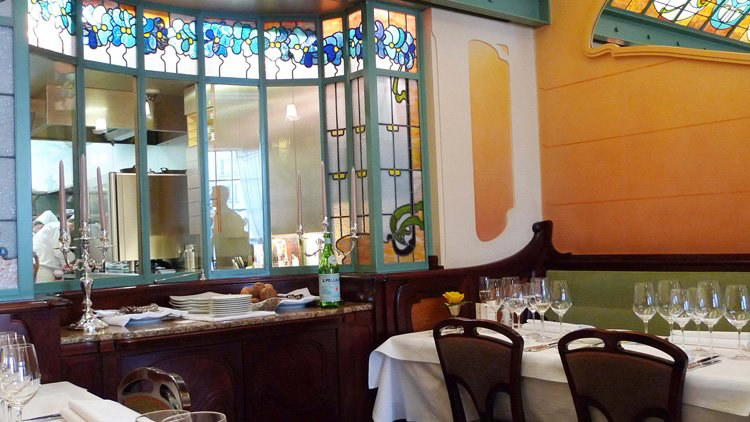
A Room That Precedes the Meal
Place Rouppe sits at the edge of the Midi district, a square that most visitors pass through rather than stop at. The building at number 23 gives little away from the outside, but step inside and the dining room delivers one of the more arresting interiors in Belgian fine dining: curved woodwork, stained-glass panels, and the sinuous ornamental logic of Art Nouveau at its most considered. Victor Horta's influence on Brussels' domestic and civic architecture is well documented, and Comme chez Soi's interior belongs to that tradition, a room where the architecture itself is an argument for a certain kind of dining, unhurried and formally composed.
That physical environment shapes everything that follows. Belgium's classic French-influenced cuisine has always carried a bourgeois seriousness, the belief that a meal is an occasion requiring a proper setting, a structured sequence, and technical precision at the pass. The room at Comme chez Soi makes that argument before a single dish arrives.
Nearly a Century of Continuous Service
Few restaurants in Northern Europe can point to a founding date of 1926 and a continuous culinary identity that hasn't fractured under changing ownership or shifting fashions. Comme chez Soi is now in its fourth generation of family stewardship, with Laurence and Lionel Rigolet carrying forward a lineage established by Pierre Wynants, whose influence on Belgian classical cooking was significant enough to register internationally. The restaurant appeared at number 7 on the World's 50 Best Restaurants list in 2003, and at number 49 in 2006, rankings that reflected Wynants' reputation at the height of that era's critical consensus around French-rooted classical technique.
That historical weight is not merely decorative. In a dining category where continuity is increasingly rare, where chefs cycle through projects and restaurants reinvent themselves every few years, an establishment that has maintained a recognisable culinary identity across generations occupies a specific and increasingly unusual position. The Rigolets, including their son Loïc who now works alongside them, are not curators of a museum piece. The kitchen has absorbed contemporary technique and, on occasion, ingredients from outside the Franco-Belgian canon. But the structural commitment to classical cooking, to sauce work, to precise plating, to dishes like mousse of Ardennes ham and sole fillets in Riesling and shrimp sauce that have been on the menu long enough to become institutional, has not been abandoned.
Chef Rigolet's Approach Within a Classical Frame
The editorial angle on Comme chez Soi that matters most is not the founding story but the creative tension that defines the kitchen today. Classical French-Belgian cuisine, as a category, risks becoming either a performance of nostalgia or a rigid formula. The more interesting question is how a chef working within an inherited tradition exercises genuine authorship without dismantling the structure that gives the tradition its meaning.
Lionel Rigolet's position is instructive here. His reputation rests substantially on sauce craft, a discipline that remains the most technically demanding and least forgiving element of French classical cooking, and one that receives far less attention in contemporary dining discourse than fermentation, fire, or foraged ingredients. Sauce work requires precision in reduction, fat emulsification, and seasoning balance, and it is precisely where classical training either holds or collapses under pressure. That Rigolet's mastery in this area is consistently noted by OAD critics, the restaurant has held rankings of #104 (2025), #105 (2024), and #120 (2023) in OAD's Classical in Europe category, suggests a kitchen that treats these fundamentals as live craft rather than inherited habit.
The La Liste scores offer a complementary data point: 89.5 points in 2025 and 76 points in 2026, alongside the Les Grandes Tables du Monde recognition and a current Michelin star. Taken together, these place Comme chez Soi in a tier of Brussels restaurants where the critical conversation is about depth of tradition and consistency of execution, rather than novelty. La Villa Lorraine by Yves Mattagne occupies a comparable price tier (€€€€) with Michelin recognition, but operates from a modern cuisine framework that points in a different direction. Bozar Restaurant similarly sits within Brussels' fine dining bracket while drawing on a distinct contemporary identity. Comme chez Soi's differentiator is its explicit commitment to the classical lineage, not as a constraint but as a chosen frame within which the kitchen does its most considered work.
The Brussels Fine Dining Context
Brussels occupies a particular position in European fine dining that is easy to underestimate. The city is not Paris, and it does not pretend to be, but its French-influenced restaurant culture runs deep, deeper, arguably, than most Northern European capitals. The Belgian kitchen has its own logic: butter-rich, technically rigorous, attentive to seasonal product from the Ardennes, the North Sea coast, and the agricultural zones of Wallonia. At the upper end of the market, this produces restaurants that compete credibly against French provincial peers without simply imitating them.
The broader Belgian fine dining scene extends well beyond Brussels. Hof van Cleve in Kruishoutem, Boury in Roeselare, and Zilte in Antwerp each represent different regional expressions of high-end Belgian cooking, as do coastal addresses like Bartholomeus in Heist and Willem Hiele in Oudenburg, and Castor in Beveren. Within Brussels itself, the creative end of the market is well served by addresses like Eliane and La Villa in the Sky, while Barge occupies the organic end of the city's contemporary dining conversation. Against this spread, Comme chez Soi's classical position is neither anachronistic nor contrarian, it is a specific bet on the enduring value of a tradition that few kitchens in the city have the generational depth to maintain.
For comparative international reference, the category Comme chez Soi occupies, technically rigorous classical cooking with deep institutional history, maps to a global tier that includes addresses like Le Bernardin in New York City, where classical French seafood technique has been sustained across decades without surrendering to reinvention pressure. The more contemporary avant-garde tier, represented by something like Atomix in New York City, occupies a different critical and experiential space entirely.
The Wine Cellar and the Private Dining Alternative
The restaurant operates a separate space called Riwyne, the wine cellar, which functions as a more contemporary private dining environment. This creates a meaningful split within the same address: the Art Nouveau main dining room and a cellar space with a distinct atmosphere and presumably a more intimate, less formally theatrical dynamic. For guests whose preference is for a less ceremonial experience while still accessing the kitchen's output, this represents a real option worth noting at the booking stage.
Planning a Visit
Comme chez Soi operates Wednesday through Saturday for both lunch (a single seating around noon, with last orders at 1pm) and dinner (service beginning at 7pm, last orders at 8:30pm). The restaurant is closed Sunday, Monday, and Tuesday. At the €€€€ price tier, this is a planned reservation rather than a spontaneous booking, advance planning is advisable, particularly for weekend dinner. The address on Place Rouppe is accessible by metro (Anneessens or Lemonnier stations are nearby) and is within walkable distance of central Brussels. For visitors building a wider Brussels itinerary, the full range of the city's dining, drinking, and accommodation options is covered in our full Brussels restaurants guide, our full Brussels hotels guide, our full Brussels bars guide, our full Brussels wineries guide, and our full Brussels experiences guide.
Frequently asked questions
What price level is Comme chez Soi?
Pricing at Comme chez Soi is listed as €€€€.
What are Comme chez Soi's hours?
Hours at Comme chez Soi: Hours: Monday Closed Tuesday Closed Wednesday 12–1 pm, 7–8:30 pm Thursday 12–1 pm, 7–8:30 pm Friday 12–1 pm, 7–8:30 pm Saturday 12–1 pm, 7–8:30 pm Sunday Closed.
Cuisine and Credentials
A quick peer list to put this venue’s basics in context.
| Venue | Cuisine | Price | Awards | Notes |
|---|---|---|---|---|
| Comme chez SoiThis venue (the venue you are viewing) | Classic French Fine Dining | $200–300 | 1 Michelin Star · World's 50 Best #49 | Not listed |
| La Villa Lorraine by Yves Mattagne | Modern French Fine Dining | $200–300 | Michelin Plate · La Liste Top Restaurants | Modern Cuisine |
| senzanome | Modern Italian Fine Dining | $150–200 | Michelin Plate | Modern Italian, Italian |
| Au Vieux Saint Martin | Traditional Belgian Brasserie | $30–50 | Michelin Plate | French Bistro, Belgian |
| Aux Armes de Bruxelles | Traditional Belgian Brasserie | $50–100 | Michelin Plate | Brasserie, Belgian |
| Hispania | Authentic Spanish Brasserie | $50–100 | Michelin Plate | Catalan, Spanish |
Recognition history
Dated appearances from independent guides and award organizations, with the underlying list record or original source where available.
Michelin 1 Star
Michelin
World's 50 Best Restaurants #49
World's 50 Best
La Liste Top Restaurants
La Liste
Les Grandes Tables du Monde Member
Les Grandes Tables du Monde
Opinionated About Dining Classical in Europe Ranked #119
Opinionated About Dining
Full recognition history (12 entries)
La Liste Top Restaurants
La Liste
Michelin 1 Star
Michelin
Opinionated About Dining Classical in Europe Ranked #104
Opinionated About Dining
Michelin 1 Star
Michelin
Opinionated About Dining Classical in Europe Ranked #105
Opinionated About Dining
Opinionated About Dining Classical in Europe Ranked #120
Opinionated About Dining
World's 50 Best Restaurants #7
World's 50 Best
Continue exploring
More in Brussels
Restaurants in Brussels
All restaurants in Brussels →
Bars in Brussels
All bars in Brussels →
Hotels in Brussels
All hotels in Brussels →
Wineries in Brussels
Browse all →
Comme chez Soi
The wine
- Wine program
- Deep wine list
- Extensive wine list
- Sommelier-led
Details
- Elegant
- Classic
- Sophisticated
- Intimate
- Well Known
- Special Occasion
- Date Night
- Business Dinner
- Historic Building
- Private Dining
- Extensive Wine List
- Sommelier Led
- Tasting Menu
- A La Carte
- Allergy Accommodating
Current opening hours
- Monday
- Closed
- Tuesday
- Closed
- Wednesday
- 12–1 PM, 7–8:30 PM
- Thursday
- 12–1 PM, 7–8:30 PM
- Friday
- 12–1 PM, 7–8:30 PM
- Saturday
- 12–1 PM, 7–8:30 PM
- Sunday
- Closed
Hours can change for holidays and private events. Hours as of .
Elegant Art Nouveau decor with stained glass, Belle Epoque charm, quiet and sophisticated atmosphere.