At Viktualienmarkt 11, Kleiner Ochsnbrater occupies one of Munich's most historically charged market addresses, where the traditions of Bavarian open-air eating remain stubbornly intact. The kitchen draws on the produce markets surrounding it, translating local ingredients through the kind of disciplined technique that has defined Munich's shift from pure regionalism toward a more precise, internationally aware cooking style.
Pearl is the En Primeur Club membership app — saves, bookings, and concierge access live there. Same editors, same standards.
- Address
- Viktualienmarkt 11, 80331 München, Germany
- Phone
- +494989298282
- Website
- kleinerochsnbrater.de
- Directions
- Get directions
 Saves & bookings on Pearl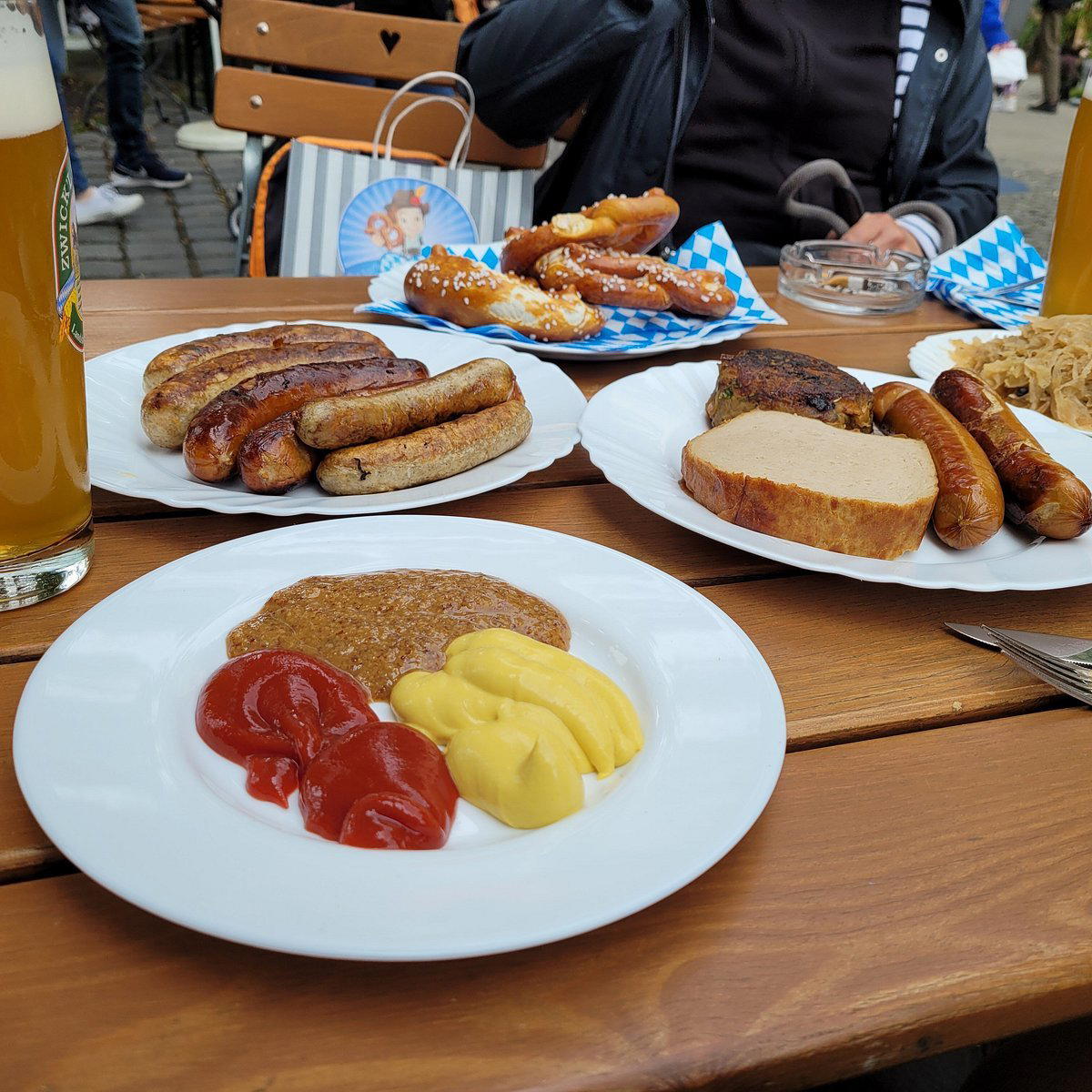
A Market Address That Explains Munich's Cooking Better Than Any Restaurant Guide
Viktualienmarkt is not a backdrop. It is, in a literal sense, the engine room of Munich's food culture, a daily open-air market that has occupied its current site in the city's Altstadt since 1807, supplying restaurants, households, and market-stall kitchens with Bavarian produce through every shift in political and culinary fashion the city has experienced in two centuries. To eat at a counter on this square is to sit at the intersection of that supply chain and the plate, with almost no distance between the two. Kleiner Ochsnbrater is a restaurant in Munich at Viktualienmarkt 11, serving Traditional Bavarian Organic Street Food at a low price tier.
Munich's restaurant scene has two distinct registers. One is the formal fine-dining tier, represented by multi-Michelin-starred rooms like Tantris, Atelier, and Alois - Dallmayr Fine Dining, where tasting menus run at the €€€€ price point and kitchens operate with brigade discipline borrowed heavily from French structure. The other is the market-proximate, ingredient-led eating that the Viktualienmarkt has always anchored, direct, seasonal, and priced for regularity rather than occasion. Kleiner Ochsnbrater occupies the latter category, and that positioning tells you more about what to expect than any single dish description.
Local Ingredients, Technique in Evidence
The broader shift in German cooking over the past fifteen years has been from regionalism as nostalgia toward regionalism as method. The leading examples of this are found not only in celebrated rooms like Tohru in der Schreiberei, where German and Japanese technique meet over Bavarian produce, or JAN, where creative contemporary cooking absorbs local seasons, but also in market-based kitchens that have quietly absorbed modern ideas about sourcing and preparation without ever billing themselves as fine dining. Kleiner Ochsnbrater sits in that quieter category.
At a Viktualienmarkt address, proximity to produce is structural rather than aspirational. The market carries the full range of Bavarian seasonal goods: white asparagus from the surrounding flatlands in spring, wild mushrooms and game from the Alpine foothills in autumn, freshwater fish from regional rivers, and the full spectrum of cured meats and dairy products that define the region's larder. A kitchen at this address draws from that supply by default, which is precisely the kind of ingredient access that restaurants at a remove from the market work hard to replicate. The question is always what technique is applied to those materials, and in Munich's market-kitchen tradition, the answer tends toward the direct: heat, salt, and timing rather than elaborate construction.
Internationally, the model of applying precise technique to local market produce has produced particularly discussed cooking of the past two decades, from the New Nordic tradition (which made a formal doctrine of what Munich market kitchens have always practiced informally) to the Japanese approach visible in Atomix in New York, where local American produce is processed through a Korean technical framework. Within Germany, that intersection of method and indigenous product has been particularly productive in the starred tier: Aqua in Wolfsburg, Schwarzwaldstube in Baiersbronn, and ES:SENZ in Grassau all demonstrate what happens when disciplined kitchens engage seriously with German regional produce. The restaurant operates in a less formally structured register, but shares the same underlying logic: the market is the starting point.
The Viktualienmarkt Context
Eating at the Viktualienmarkt has its own physical grammar. Seating is often open-air or semi-open, the pace is faster than a sit-down lunch service, and the social mix is genuinely varied, market traders, office workers from the surrounding Altstadt, tourists, and long-standing regulars occupying the same benches. This is not the choreographed intimacy of a tasting-menu counter or a wine-forward gastro-bistro. It is a public-square kitchen, and the expectations it carries are calibrated accordingly: the standard is freshness and directness, not elaboration.
That model of market-square eating has parallels across Germany's serious food cities. Restaurant Haerlin in Hamburg represents the formal end of the northern German tradition, while the city's fish market and harbour-adjacent kitchens operate on exactly the same proximity-to-source principle that defines the Viktualienmarkt model. In Berlin, the shift toward ingredient-led, market-conscious cooking is visible even in format experiments like CODA Dessert Dining, which applies technical precision to product categories usually treated as secondary. What distinguishes Munich is that the Viktualienmarkt functions as a continuous, geographically specific anchor, a place where the supply chain and the eating public share the same square.
Germany's upper-tier rooms beyond Munich, including Vendôme in Bergisch Gladbach, Victor's Fine Dining by Christian Bau in Perl, Waldhotel Sonnora in Dreis, Schanz in Piesport, and Bagatelle in Trier, all require advance booking and formal commitment. Market eating at Viktualienmarkt occupies the opposite end of that spectrum: accessible, unscripted, and priced for the rhythm of daily life rather than annual celebration. Both tiers are serious about produce. They differ on format, price, and the relationship between kitchen and guest.
Planning Your Visit
The restaurant is open Tuesday through Saturday, 10 AM to 5 PM. It is walk-in friendly.
| Venue | Format | Price Tier | Booking Required |
|---|---|---|---|
| The restaurant | Market kitchen, open-air | Lower | Walk-in (market hours) |
| Tantris | Formal dining room | €€€€ | Essential, weeks ahead |
| Alois - Dallmayr Fine Dining | Fine dining, tasting menu | €€€€ | Essential |
| Tohru in der Schreiberei | Modern counter dining | €€€€ | Essential |
Reputation First
Comparable venues nearby, for context on price, style, and recognition.
| Venue | Cuisine | Price | Notes |
|---|---|---|---|
| Kleiner OchsnbraterThis venue — the venue you are viewing | Traditional Bavarian Organic Street Food | $ | Not listed |
| S' Maillinger | Traditional Bavarian & Austrian | $ | Neuhausen |
| Gaststätte Großmarkthalle | Traditional Bavarian Gaststätte | $$ | Ludwigsvorstadt |
| Die Küche im Kraftwerk | Modern Alpine German | $$ | Obersendling |
| Marstall Festzelt | Traditional Bavarian Oktoberfest | $$ | Theresienwiese |
| Caspar Plautz | Creative Bavarian Potato Dishes | $ | Altstadt |



At a Glance
- Cozy
- Rustic
- Lively
- Casual Hangout
- Beer Program
- Organic
- Local Sourcing
- Street Scene
Current opening hours
- Monday
- Closed
- Tuesday
- 10 AM–5 PM
- Wednesday
- 10 AM–5 PM
- Thursday
- 10 AM–5 PM
- Friday
- 10 AM–5 PM
- Saturday
- 10 AM–5 PM
- Sunday
- Closed
Hours can change for holidays and private events. Last verified .
Casual market beer garden atmosphere with shaded outdoor seating under venerable trees in summer and tent in winter, soaking up the late afternoon sun amid lively Viktualienmarkt vibes.