Caspar Plautz occupies Stand 38 in the Viktualienmarkt's third market hall, placing it inside one of Munich's most historically loaded food addresses. The stall format strips away the usual restaurant architecture in favour of direct, counter-level commerce, the kind of transaction that has defined the Viktualienmarkt for over two centuries. For visitors oriented around fine dining, it offers a counterpoint: produce-floor eating in its least mediated form.
Pearl is the En Primeur Club membership app — saves, bookings, and concierge access live there. Same editors, same standards.
- Address
- Viktualienmarkt Abt III, Stand 38, 80331 München, Germany
- Phone
- +491796632748
- Website
- casparplautz.de
- Directions
- Get directions
 Saves & bookings on Pearl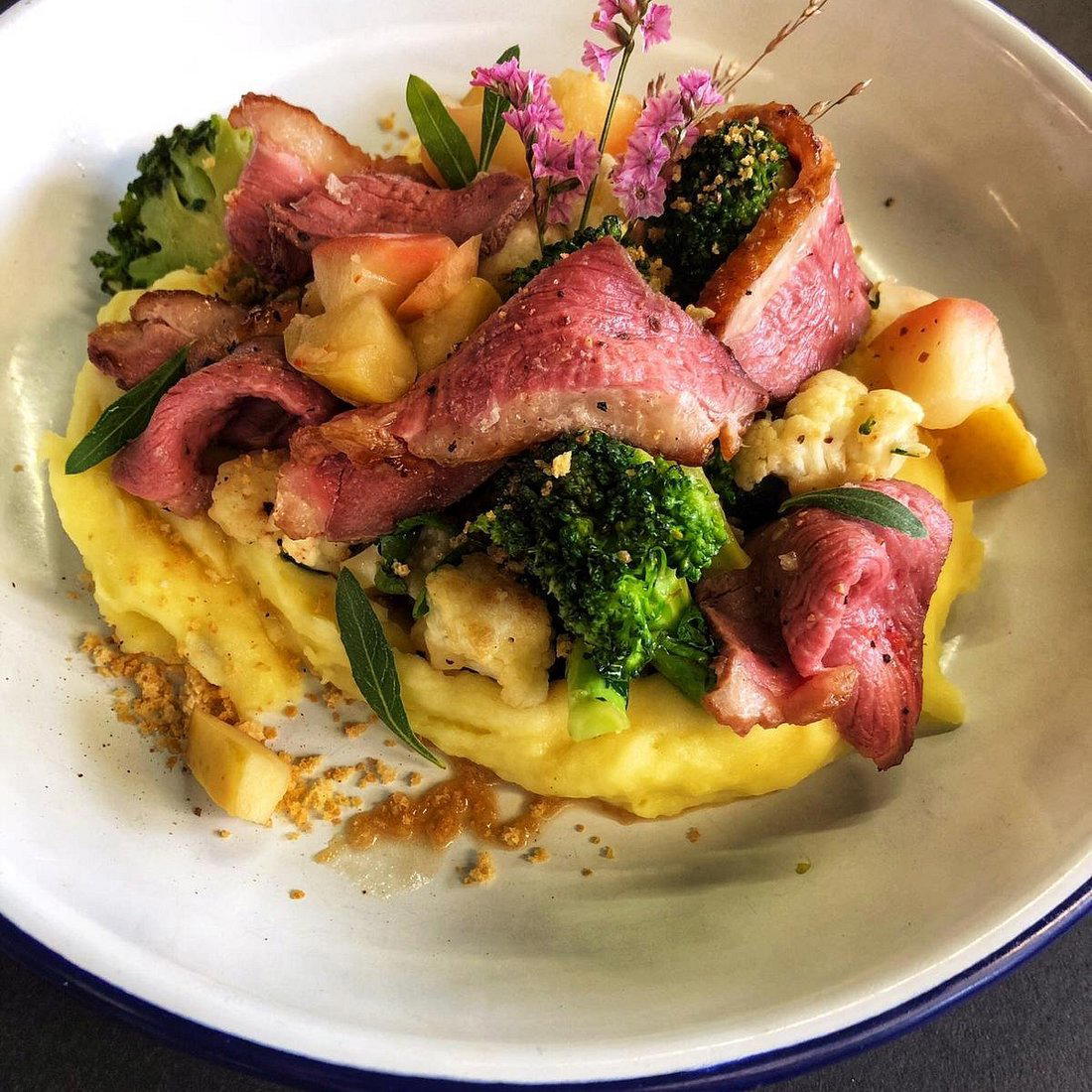
The Viktualienmarkt as Architectural Argument
Munich's fine dining circuit runs a familiar track: tasting menus at JAN, Franco-German ambition at Tantris, the Japanese-German synthesis of Tohru in der Schreiberei, and the Dallmayr legacy channelled through Alois. Each of these venues invests heavily in its physical container: curated lighting, considered seating, rooms that signal intention before a single dish arrives. Caspar Plautz is a casual, walk-in-friendly restaurant in Munich serving creative Bavarian potato dishes at Viktualienmarkt Abt III, Stand 38.
The Viktualienmarkt itself, open since 1807, is one of the few permanent market spaces in a major German city where the built environment has resisted the drift toward food-hall gentrification. Its stalls are small, functional, and arranged in a grid that privileges throughput over lingering. Stand 38 fits that logic: it is a market stall in the original sense, defined by its counter, its product, and the compressed transaction between the two. There is no interior in the restaurant sense, no designed room, no front-of-house choreography, no spatial sequence from entrance to table. The space is the product itself, displayed and sold at close range.
This format matters because it tells you something about how the Viktualienmarkt has retained its operational character while the areas surrounding it have shifted upmarket. The market sits in Munich's historic city centre, surrounded by Michelin-starred rooms and tasting-menu destinations, yet its internal logic remains that of a working food market. Stalls like Caspar Plautz are the reason that character persists: the low-ceiling, high-density, product-forward format is not aesthetic nostalgia but operational continuity.
Counter Commerce and the Geometry of a Market Stall
Germany's market stall tradition differs from its French or Italian equivalents in one specific way: it tends toward specialisation over variety. A good Marktstand in a German city is not a general provisions counter but a focused operation, often built around a single product category executed with depth. The Viktualienmarkt concentrates this tendency, with individual stalls covering cheese, charcuterie, fish, vegetables, and prepared foods in separate dedicated formats rather than combined in a single generalist offer.
Caspar Plautz sits within this specialist tradition. The stall format at Stand 38 is compact by design, which means the physical encounter with the product is immediate. There is no room for the kind of staging that a seated restaurant uses to build anticipation, the product is present at arm's length from the moment of arrival. For the category of eating the Viktualienmarkt supports, this directness is a feature, not a limitation. It mirrors the directness of the transaction itself: you see what is available, you make a choice, you receive it.
This is a different kind of design intelligence than what operates at, say, the hotel dining rooms or destination restaurants that Munich's Michelin tier represents. Those spaces manage distance, between kitchen and table, between raw material and finished plate, between chef and diner. A Viktualienmarkt stall collapses that distance deliberately. The spatial constraint is also a curatorial one: what is in the counter is what matters, and nothing else competes for attention.
Where Caspar Plautz Sits in Munich's Eating Picture
Munich's food scene has two reasonably distinct registers. The first is the tasting-menu circuit, which competes on ambition, technique, and formal dining conventions; Germany's broader fine dining geography includes reference points like Schwarzwaldstube in Baiersbronn, Aqua in Wolfsburg, and Vendôme in Bergisch Gladbach, with Munich contributing its own multi-Michelin addresses to that cohort. The second register is the market and beer garden tradition, which operates outside the tasting-menu framework entirely and is more central to how Münchners actually eat on an ordinary day.
The restaurant belongs to the second register. It is not in competition with the city's creative dining rooms, and it is not trying to be. Its competitive set is other Viktualienmarkt stalls, other quick-service food operations in the city centre, and the broader question of where you eat when you are on foot in Munich and not committed to a reservation. Within that set, location at Stand 38 inside the Viktualienmarkt carries its own authority, the market's provenance and continuity function as a kind of ambient trust signal that individual stalls inherit simply by operating there.
Know Before You Go
Address: Viktualienmarkt Abt III, Stand 38, 80331 München, Germany
Location context: Third hall of the Viktualienmarkt, Munich city centre. Accessible on foot from Marienplatz (S-Bahn/U-Bahn).
Format: Market stall. Counter service. No reservations, no seated interior.
Hours: Tue-Sat 8 AM-5 PM; closed Mon and Sun.
Booking: Not applicable. Walk-in only.
Price range: Market stall pricing in the Viktualienmarkt context is typically moderate relative to Munich's restaurant tier.
Side-by-Side Snapshot
Comparable venues nearby, for context on price, style, and recognition.
| Venue | Cuisine | Price | Notes |
|---|---|---|---|
| Caspar PlautzThis venue — the venue you are viewing | Creative Bavarian Potato Dishes | $ | Not listed |
| Wurstimbiss Teltschik | Traditional Bavarian Sausage Stand | $ | Altstadt |
| Dahoam Restaurant | Traditional Bavarian | $$ | Theresienwiese |
| Wirtshaus im Schichtl | Traditional Bavarian Organic | $$ | Theresienwiese |
| Bamberger Haus | Imperial Austrian-German Court Cuisine | $$ | Milbertshofen |
| Wirtshaus Eder | Traditional Bavarian Gastropub | $$ | Neuhausen |
At a Glance
- Trendy
- Casual
- Casual Hangout
- Solo
- Open Kitchen
- Local Sourcing
- Farm To Table
Current opening hours
- Monday
- Closed
- Tuesday
- 8 AM–5 PM
- Wednesday
- 8 AM–5 PM
- Thursday
- 8 AM–5 PM
- Friday
- 8 AM–5 PM
- Saturday
- 8 AM–5 PM
- Sunday
- Closed
Hours can change for holidays and private events. Last verified .
Casual market stall atmosphere with limited seating; bustling at lunchtime with a lively, energetic food market vibe in the heart of Munich's historic Viktualienmarkt.