Kartika
Kartika sits on Overtoom in Amsterdam's Oud-West district, a neighbourhood where Indonesian and Dutch culinary currents have traded influence for generations. The address alone positions it within a broader conversation about how the city's Southeast Asian dining scene has matured beyond the rijsttafel format into something considerably more considered. Booking ahead is advisable for evening sittings.
Pearl is the En Primeur Club membership app — saves, bookings, and concierge access live there. Same editors, same standards.
- Address
- Overtoom 68H, 1054 HL Amsterdam, Netherlands
- Phone
- +31 20 618 1879
- Website
- restaurantkartika.com
- Directions
- Get directions
 Saves & bookings on Pearl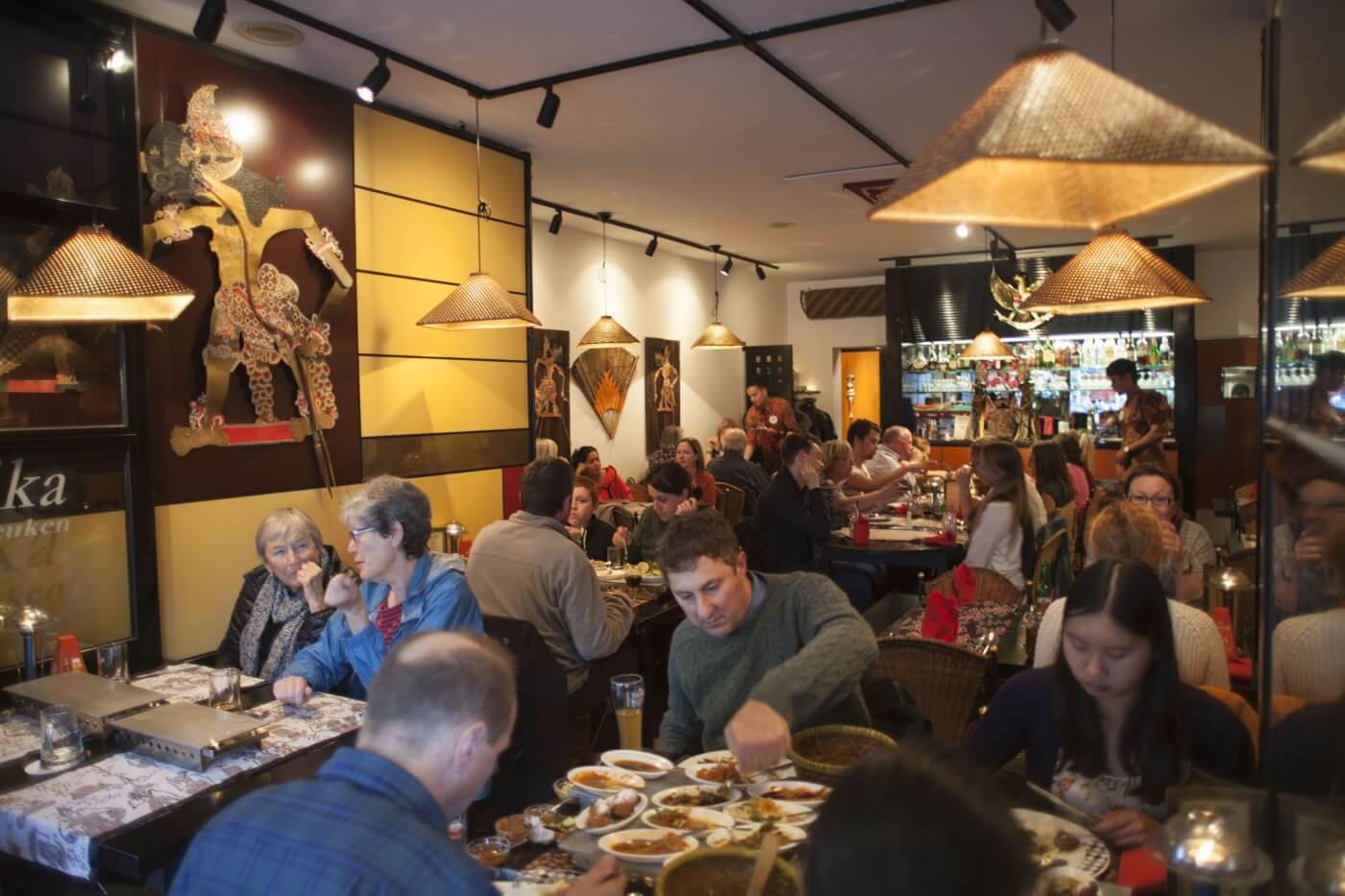
Overtoom and the Indonesian Dining Tradition in Amsterdam
Amsterdam's relationship with Indonesian cuisine is longer and more complicated than most European cities can claim. The colonial connection between the Netherlands and the Indonesian archipelago produced a dining culture that took root in Dutch cities decades before 'Southeast Asian' became a category on any restaurant map. Today, that inheritance plays out in two distinct registers: the large-format rijsttafel houses aimed at tourists near the canal belt, and a quieter tier of neighbourhood restaurants in areas like Oud-West and De Pijp where the cooking tends to be sharper, less performative, and more attuned to what Indonesian food actually is rather than what Dutch diners long assumed it to be. Kartika, on Overtoom at number 68H, belongs to the second category.
Overtoom itself is worth understanding before you arrive. It runs west from Leidseplein toward the Vondelpark's southern edge, a street of working residents rather than visitors, with a mix of independent shops, small cafés, and restaurants that have survived on local trade rather than foot traffic from sightseeing routes. The contrast with the more formal, higher-ticketed end of Amsterdam dining, the Ciel Bleu and Spectrum tier of creative tasting menus, is deliberate. Kartika operates in a register closer to what the French would call cuisine de quartier: food anchored in a specific tradition, served to a community that knows it well.
The Scene That Shapes the Kitchen
Indonesian cooking in Amsterdam has undergone a gradual but legible shift over the past fifteen years. The rijsttafel, that colonial-era format of dozens of small dishes arranged around a central rice, retains its audience, but it no longer defines the category. Younger restaurants and the more serious examples of the established ones have moved toward a tighter reading of regional Indonesian cuisine: Javanese, Sundanese, Padang, Balinese influences treated as distinct traditions rather than elements of a single tourist-friendly omnibus. The result is a dining scene with more internal variation than it had a generation ago, and more contact with the kind of ingredient sourcing and culinary technique that the city's broader fine-dining community, places like Vinkeles and Flore, has normalised.
This matters for understanding where Kartika sits. It is not attempting to be a contemporary creative restaurant in the mould of De Nieuwe Winkel or the kind of farm-to-table Dutch modernism you find at BAK. Nor is it a large heritage operation running rijsttafel at volume. The address and the neighbourhood suggest something in between: a kitchen working within an inherited tradition while paying attention to what has changed around it.
How the Room Works, and Who Makes It Work
In Indonesian dining specifically, that triangle is more consequential than in European fine-dining contexts, because the cuisines of the archipelago present particular pairing challenges. High spice heat, coconut-based curries, fermented soy and shrimp paste flavours, and the layered sweetness of Javanese cooking do not map neatly onto a conventional wine list. Restaurants that take this seriously tend to show it in beverage choices that favour aromatic whites, off-dry Rieslings, and sometimes purpose-built cocktail or spirit programmes. Restaurants that do not take it seriously offer a generic list and leave the diner to work it out.
A sommelier or floor lead who understands Indonesian flavour architecture and can communicate it to a diner unfamiliar with, say, the difference between a rendang and a semur, or between Padang heat and the more restrained spicing of Javanese cooking, is doing something qualitatively different from pouring wine and reciting specials. For context on how that dynamic operates at the high end of Dutch dining more broadly, the tasting-menu operations at De Librije in Zwolle and Inter Scaldes in Kruiningen offer instructive comparison, though both are working in entirely different culinary traditions.
Amsterdam's Indonesian Tier and Where Kartika Fits
To position Kartika accurately within Amsterdam's dining map, it helps to understand what the city's Indonesian restaurant tier actually looks like. At the higher end, a handful of restaurants have attracted press attention for reframing the cuisine with contemporary plating and tasting-menu formats. At the other end, a larger volume of casual operations remain oriented toward the set-menu rijsttafel for groups. The middle tier, serious, neighbourhood-rooted, consistent in execution, is the hardest to sustain and, valuable to the city's dining culture. It is the tier that Bistro de la Mer occupies in a different culinary tradition, and it is the tier where Overtoom's geography places Kartika.
For comparison beyond Amsterdam, the dynamics at work here are recognisable in other cities where a diaspora cuisine has matured through multiple generations: the way some Vietnamese restaurants in Paris or some Japanese restaurants in London have moved from cultural novelty to culinary institution without necessarily acquiring the institutional apparatus of awards or formal recognition. The trajectory at serious Indonesian restaurants in the Netherlands shares that pattern. Venues like De Bokkedoorns in Overveen and De Lindehof in Nuenen show how Dutch regional dining can earn recognition without following the metropolitan playbook, an analogy worth keeping in mind when assessing Kartika's quieter Oud-West position.
Planning Your Visit
Kartika is on Overtoom, a fifteen-minute walk west of Leidseplein or accessible by tram from Amsterdam Centraal, which connects through to the Vondelpark area. The Oud-West neighbourhood rewards arriving with time to spare: the surrounding streets have enough independent character to make the approach worthwhile rather than merely functional. Kartika welcomes walk-ins. It opens Monday through Saturday from 5:00 to 9:30 PM and is closed on Sunday. our full Amsterdam restaurants guide maps the range in detail.
Tribeca in Heeze, De Groene Lantaarn in Staphorst, Brut172 in Reijmerstok, De Treeswijkhoeve in Waalre, and De Lindehof in Giethoorn all sit outside the major cities, serving as a reminder that Dutch culinary ambition is not a purely urban phenomenon. Lazy Bear in San Francisco and Le Bernardin in New York City offer instructive, if stylistically different, comparisons.
Budget Reality Check
Comparable venues nearby, for context on price, style, and recognition.
| Venue | Price | Notes |
|---|---|---|
| KartikaThis venue — the venue you are viewing | $$ | Not listed |
| Bar Centraal | $$ | Bellamybuurt Zuid, Modern Neo-Bistro Small Plates |
| Pacific Amsterdam | $$ | Westergasfabriek, Dutch Grill & International |
| La Brasa | $$ | Westelijke Eilanden, Argentine Steakhouse |
| Oceania | $$ | Scheldebuurt West, Traditional Chinese Seafood |
| Hearth | $$ | Oosterparkbuurt Noordwest, Plant-Based Fusion with Global Influences |
Continue exploring
More in Amsterdam
Restaurants in Amsterdam
Browse all →
Bars in Amsterdam
Browse all →
Hotels in Amsterdam
Browse all →
Wineries in Amsterdam
Browse all →
At a Glance
- Cozy
- Intimate
- Group Dining
- Casual Hangout
- Historic Building
Current opening hours
- Monday
- 5–9:30 PM
- Tuesday
- 5–9:30 PM
- Wednesday
- 5–9:30 PM
- Thursday
- 5–9:30 PM
- Friday
- 5–9:30 PM
- Saturday
- 5–9:30 PM
- Sunday
- Closed
Hours can change for holidays and private events. Last verified .
Softly-lit and cozy with petite seating and cultural puppet decorations.