
Karapincha gives Kobe’s curry scene a compact Sri Lankan counterpoint: a small Oji Koen restaurant focused on curry, vegetables, and vegetarian options rather than steakhouse ceremony or port-city nostalgia. Its repeated Tabelog 100 selections, including Asian cuisine / Ethnic cuisine WEST 2024, place it in a serious regional conversation despite an accessible price band.
Pearl is the En Primeur Club membership app — saves, bookings, and concierge access live there. Same editors, same standards.
- Address
- 1 Chome-2-13 Ojicho, Nada Ward, Kobe, Hyogo 657-0838, Japan
- Phone
- +81 78-805-3039
- Website
- karapincha.jp
 Saves & bookings on Pearl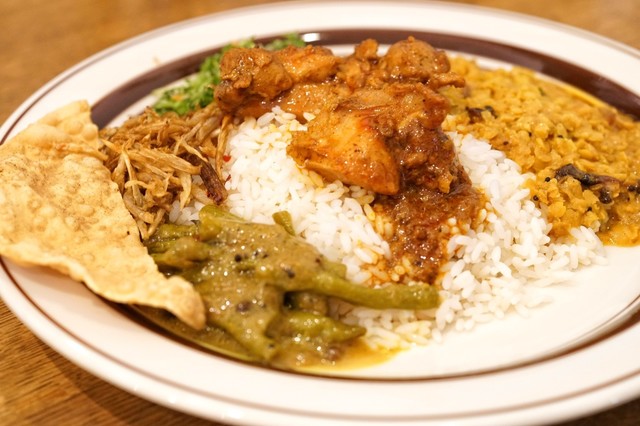
Approaching Kobe’s Oji Koen side, the city changes register. Waterfront polish and the Kitano sightseeing circuit give way to station exits, small shopfronts, residential streets, and lunch rooms where the air inside matters as much as the sign outside. Here, Sri Lankan curry carries a different charge from Kobe’s better-known beef culture: aromatic rather than ceremonial, quick rather than theatrical, and built for diners who know spice can be as precise as knife work.
Karapincha belongs to that smaller Kobe story. Categorised as Sri Lankan and curry, it has a house-restaurant format with only 12 seats, including counter seating. That scale defines the experience: sound stays close, turnover matters, and the room reads as a focused lunch address, not a broad all-day dining room. In a city often framed through wagyu, yoshoku, and port-era Western influence, it is a useful correction. Kobe’s dining culture is wider than beef, and its best casual rooms often prove that more clearly than formal ones.
Sri Lankan curry as Kobe counter-programming
Japanese curry culture usually splits between domestic comfort food, spice-curry experimentation, and South Asian regional cooking. Sri Lankan curry occupies its own lane: rice, vegetables, pulses, coconut, dried spice, and heat layered rather than used as a blunt finish. Karapincha’s focus on vegetables and vegetarian options matters because it sits outside the protein-led habits that dominate many Kobe itineraries. The point is not austerity, but balance, texture, and several preparations changing a plate’s pace without luxury cues.
The recognition gives the modest room extra weight. Karapincha was selected for Tabelog 100 in Asian cuisine / Ethnic cuisine WEST 2024; its history also includes Asian / Ethnic WEST in 2023 and 2022, plus Curry selections from 2017 through 2020. In Japan, those Hyakumeiten lists are useful signals for specialist categories Michelin can miss or flatten. A 3.62 Tabelog score in this category, attached to a small room and narrow service window, points to repeat local use rather than tourist convenience.
That matters in Kobe, where international identity can push visitors toward familiar luxury shorthand: beef rooms, harbor views, hotel dining. Karapincha works the other way, closer to the everyday specialist model: defined cuisine, compact seating, and a price point that invites regulars. In the same city, Kanmidokoro Akachaya and ENISHI operate in a lower snack-and-casual band, Yoshoku SAEKI shares a similar accessible budget range, while Daiei and Moriguchi sit higher. The comparison is less direct competition than dining purpose: spice lunch, yoshoku comfort, sweets, or a fuller evening allocation.
The room rewards attention, not performance
Small curry rooms in Japan depend on atmosphere inseparable from logistics: sightlines to the counter, plate noise, lunch pace, and concentrated spice in a narrow space. Karapincha’s format supports that. Two counter seats and a handful of tables feel closer to a specialist kitchen than a general restaurant. There is no private-room insulation, no banquet posture, and no ceremony required. The sensory order is immediate: aroma first, then colour, heat, and grain.
The address also changes how to read it. Oji Koen is not where most visitors build a first-night Kobe itinerary, which is why a specialist curry room can carry more local meaning there. Nada Ward has residential texture, rail access, and enough distance from the tourist centre to filter out diners chasing postcard Kobe. That does not make the restaurant obscure; repeated Tabelog 100 selection argues otherwise. It makes the room context-specific, with a meal tied to neighbourhood use rather than a performance of Kobe for outsiders.
For travellers building a wider Kobe food map, the contrast helps. Beef planning may point to Aburi Niku Kobo Wakkoku Shinkobe ten or Aburi Niku Kobo Wakkoqu Kitano Sakamoto Ten. Coffee and quieter café culture pull toward Akaneya Coffee Ten, while small local rooms such as Akari and regional South Asian addresses such as Ali's Halal Kitchen show how broad the city’s casual dining field has become. Use our full Kobe restaurants guide for that wider spread; our full Kobe hotels guide, full Kobe bars guide, full Kobe wineries guide, and full Kobe experiences guide round out the city beyond the table.
How to place it in a Japan itinerary
Karapincha works as a lunch built around specificity rather than status. Average spend is JPY 1,000 to JPY 1,999, serious casual eating: low enough for a detour, recognised enough to plan around the opening pattern. Reservations are unavailable, so access is about timing and patience. Credit cards are not accepted, while electronic money and PayPay are listed, a common Japan payment mix still worth treating as part of the practical character.
Read the limits honestly. The restaurant is non-smoking; private rooms and private use are unavailable. The family note is restrictive: no children’s menu, difficulty for junior high school students and younger, and no strollers. That does not make the room inhospitable; it defines the format. A 12-seat curry specialist suits compact dining, solo meals, and small groups that understand tight lunch service. Karapincha is closer to a serious counter than a family restaurant.
For readers comparing regional food stops across Japan, the lesson travels. A Kobe curry specialist belongs with focused casual rooms elsewhere: -Grilled beef Sukiyaki- KAMAKURA TANUKIAN 鎌倉 たぬき庵 in Kamakura for beef sukiyaki, 鮪と炭火焼き うお炭 秋葉原店 in Tokyo for tuna and charcoal grilling.cafe in Osaka for café pacing.know in Kumamoto for another regional register, (Shoku) Vietnam in Kawasaki for Vietnamese cooking, and [Curry Senmon Ten] Maruyama Kyoju. in Sapporo for another curry-led stop. Across the Pacific, Jōdo Saké Bar in Los Angeles and Onigiri Time in Pasadena show the same editorial principle: narrow formats often tell readers more than broad menus.
The case for Karapincha is not that it replaces Kobe beef, sushi, or yoshoku. It sharpens the itinerary with a different sensory grammar: spice over fat, compactness over ceremony, neighbourhood cadence over destination gloss. For travellers who eat to understand a city, that is reason to make room for it.
Quick Comparison
Side-by-side context: comparable cuisine and price.
| Venue | Cuisine | Price | Notes |
|---|---|---|---|
| Karapincha | Sri Lankan rice & curry restaurant and spice shop | $ | Nada |
| Cini CURRY | Pakistani-style Japanese curry | $ | Chūō |
| Ali's Halal Kitchen | Halal Pakistani & Indian Curry House | $$ | Chūō |
| ENISHI | Tantanmen ramen specialist | $ | Nada |
| SAVOY | Japanese Curry | $ | Chūō |
| Tommy's Sannomiya higashi ten | Japanese Bakery & Café | $ | Chūō |
Recognition history
Dated appearances from independent guides and award organizations, with the underlying list record or original source where available.
Tabelog 100 #94 · No. 94
Tabelog · Tabelog 100 - Asian cuisine / Ethnic cuisine - WEST - 2024
Continue exploring
More in Kobe
Restaurants in Kobe
Browse all →

Bars in Kobe
Browse all →




Hotels in Kobe
Browse all →



At a Glance
- Cozy
- Intimate
- Classic
- Solo
- Casual Hangout
- Family
- Group Dining
- After Work
- Standalone
- Design Destination
- Local Sourcing
Current opening hours
- Monday
- Closed
- Tuesday
- Closed
- Wednesday
- Closed
- Thursday
- 11 AM–3 PM
- Friday
- 11 AM–3 PM
- Saturday
- Closed
- Sunday
- Closed
Hours can change for holidays and private events. Last verified .
A small, homey house-restaurant with about a dozen seats, simple décor and the aroma of freshly roasted Sri Lankan spices; atmosphere is relaxed and intimate, more like a neighborhood canteen than a formal restaurant.