Justin's Salt Bread
Justin's Salt Bread brings the Japanese shio pan tradition to New York City, where the soft, butter-layered rolls have built a following among bread enthusiasts who track down the city's most specific bakery formats. The shio pan format, a category that barely registered in the American market five years ago, now commands dedicated queues at a handful of specialist operations. Justin's sits inside that emerging tier.
Pearl is the En Primeur Club membership app — saves, bookings, and concierge access live there. Same editors, same standards.
- Address
- 58 2nd Ave, New York, NY 10003
- Directions
- Get directions
 Saves & bookings on Pearl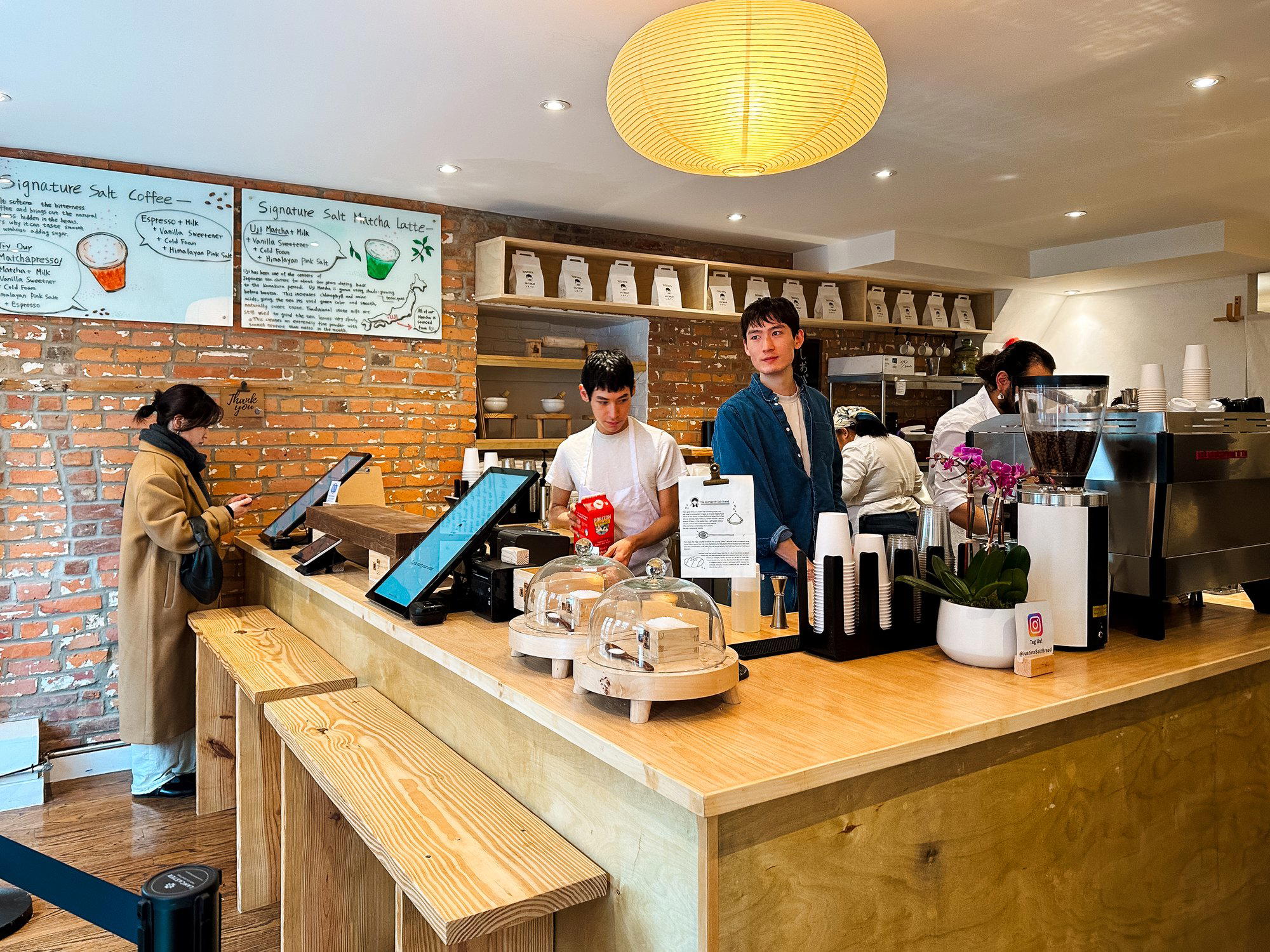
Salt, Butter, and the Architecture of a Roll
Walk into any serious conversation about New York's current bakery moment and the word "shio pan" comes up faster than you might expect. The salt bread format, originating in Japan and popularized through a chain of viral moments on social media, has crossed the Pacific and planted itself firmly in a city that has historically privileged the sourdough boule and the croissant above almost everything else. Justin's Salt Bread is part of a small cohort of New York operations that have staked their identity entirely on this format, at a moment when the city's bread culture is fragmenting into increasingly specific niches.
Shio pan, for those arriving without context, is a soft yeasted roll finished with a significant quantity of salted butter, which pools into the base of the bread as it bakes and creates a crisp, caramelized underside against a pillowy interior. The contrast between the two textures is the central appeal: no single bite delivers the same ratio twice. In Japan, the format became associated with a particular kind of afternoon bakery culture, the sort of place where a single roll functions as a complete small meal rather than a vehicle for something else. New York has absorbed that logic, and Justin's Salt Bread has built its identity around precisely that proposition.
Where This Fits in New York's Bakery Hierarchy
New York's premium dining ecosystem has long been organized around tasting menus and expense-account restaurants: institutions like Le Bernardin, Per Se, and Masa define what the city can do at its most ambitious and resource-intensive end. But the city's bread culture operates on a different register entirely, where quality signals are read not through prix-fixe formats or starred recognition but through specificity of product, consistency of execution, and the willingness of a regular customer base to make a detour for a single item.
Within that framework, the shio pan category is still establishing its own hierarchy. A handful of operations have introduced the format, each approaching the roll's fat content, salt levels, and baking temperature with slightly different priorities. This is broadly analogous to the croissant wars that defined a certain period of New York baking culture, where marginal differences in lamination technique became the subject of serious comparative discussion. Justin's Salt Bread enters that conversation as a specialist rather than a generalist, which positions it differently from a neighborhood bakery that offers salt bread as one item among forty.
The format also creates a natural point of comparison with what other American cities are doing at the ambitious end of their food programs. Operations like Lazy Bear in San Francisco and Blue Hill at Stone Barns in Tarrytown have built their identities around depth of focus in their respective categories. The bakery equivalent of that depth is the single-format specialist, and shio pan lends itself to that model because the product requires enough technical precision to reward obsessive refinement.
The Japanese Bread Tradition Behind the Format
Understanding shio pan requires a brief account of Japanese bread culture more broadly. Japan has an extraordinarily well-developed relationship with soft, enriched breads, a tradition shaped partly by post-war American influence and partly by a domestic baking industry that developed its own technical vocabulary. Milk bread, cream-filled rolls, and melon pan all belong to this tradition, and shio pan sits within it as one of the more minimal expressions: fewer components, more attention to each. The format rewards flour quality, butter provenance, and fermentation timing in ways that more heavily garnished breads can partially obscure.
American bakeries adopting the format have had to decide how closely to adhere to Japanese conventions and where to adapt for local ingredients and expectations. This is the same question that Korean restaurants at the level of Atomix and Jungsik New York have faced when bringing technically exacting cuisine to a market that may know the category only partially. The answer for most serious operations is a high degree of fidelity to source technique combined with sourcing decisions shaped by what is actually available in the local market.
The Broader American Bakery Context
New York is not the only city watching its bakery culture develop new specialized formats. Operations in cities like San Francisco, Chicago, and Los Angeles have also seen the emergence of Japanese-influenced bread formats over the past several years. Ambitious American restaurants such as Alinea in Chicago, Providence in Los Angeles, Addison in San Diego, and Single Thread Farm in Healdsburg have all engaged seriously with Japanese culinary traditions in their respective ways. But the bakery space has moved more slowly, and the shio pan format in particular has only recently developed enough of a domestic following to support specialist operations rather than being a menu item at a larger multi-format bakery.
Internationally, bread culture with this kind of specificity tends to cluster around cities with large communities familiar with the source tradition. The concentration of Japanese food culture in New York has been a factor in the city's readiness to support a shio pan specialist. Restaurants operating with reference to European fine-dining traditions, from The French Laundry in Napa to Alain Ducasse at Louis XV in Monte Carlo, have long understood that a city's ability to support specialized formats correlates directly with the depth of cultural knowledge in its dining public. New York has that depth in relation to Japanese food, which is part of what makes a shio pan specialist viable here in a way it might not be elsewhere.
Planning a Visit
Justin's Salt Bread is at 58 2nd Ave, New York, NY 10003. It is walk-in friendly and open Tue to Fri 9 AM to 6 PM, Sat 10 AM to 7 PM, and Sun 10 AM to 6 PM; it is closed Monday. The restaurant follows regular hours, with Monday closed and daytime service the rest of the week. Arriving with flexible timing and a secondary option in the same neighborhood is a practical approach for any single-format bakery.
Those traveling from elsewhere in the country for the city's food scene might also note that operations with similarly focused formats have developed in other cities: Emeril's in New Orleans, Bacchanalia in Atlanta, and The Inn at Little Washington each represent the kind of singular focus on a defined culinary identity that shio pan specialists are pursuing at the bakery scale. The ambition is different; the underlying logic is not.
Equally, travelers coming from international points of departure, particularly those familiar with serious bread culture at restaurants like 8½ Otto e Mezzo Bombana in Hong Kong, will find that New York's current moment of bakery specialization is producing formats worth tracking alongside its tasting-menu institutions.
Reputation First
Comparable venues nearby, for context on price, style, and recognition.
| Venue | Cuisine | Price | Notes |
|---|---|---|---|
| Justin's Salt BreadThis venue — the venue you are viewing | Japanese Salt Bread Bakery | $ | Not listed |
| Karazishi Botan | New York-Style Ramen Diner | $$ | Carroll Gardens-Cobble Hill-Gowanus-Red Hook |
| Ivan Ramen Slurp Shop | Authentic Japanese Ramen | $$ | Hell's Kitchen |
| Kura | Traditional Japanese Omakase | $$ | East Village |
| Cocoron | Handmade Soba Noodles | $$ | Lower East Side |
| Uogashi | Tokyo-style Omakase Sushi | $$ | Hell's Kitchen |
Continue exploring
More in New York City
Restaurants in New York City
Browse all →

Bars in New York City
Browse all →
Hotels in New York City
Browse all →









At a Glance
- Trendy
- Modern
- Casual Hangout
- Standalone
Current opening hours
- Monday
- Closed
- Tuesday
- 9 AM–6 PM
- Wednesday
- 9 AM–6 PM
- Thursday
- 9 AM–6 PM
- Friday
- 9 AM–6 PM
- Saturday
- 10 AM–7 PM
- Sunday
- 10 AM–6 PM
Hours can change for holidays and private events. Last verified .
Casual, minimalist bakery atmosphere focused on simple, high-quality baked goods.