Jasmine's Caribbean Cuisine
Our verdict
On West 46th Street in Midtown, Jasmine's Caribbean Cuisine sits in one of New York's most concentrated dining corridors, bringing the layered spice traditions of the Caribbean to a city that has long absorbed and reinterpreted immigrant cooking. For visitors tracking where Caribbean food fits within New York's broader immigrant-cuisine conversation, this address on Restaurant Row offers a grounded starting point.

Pearl is the En Primeur Club membership app — saves, bookings, and concierge access live there. Same editors, same standards.
- Address
- 371 W 46th St, New York, NY 10036
- Phone
- (646) 964-5337
- Hours
- Mon ClosedTue–Thu 4–11 PMFri 4–11:30 PMSat 2–11:30 PMSun 2–11 PM
- Website
- jasminecaribbeancuisine.com
- Directions
- Get directions
- Booking
- Book on OpenTable
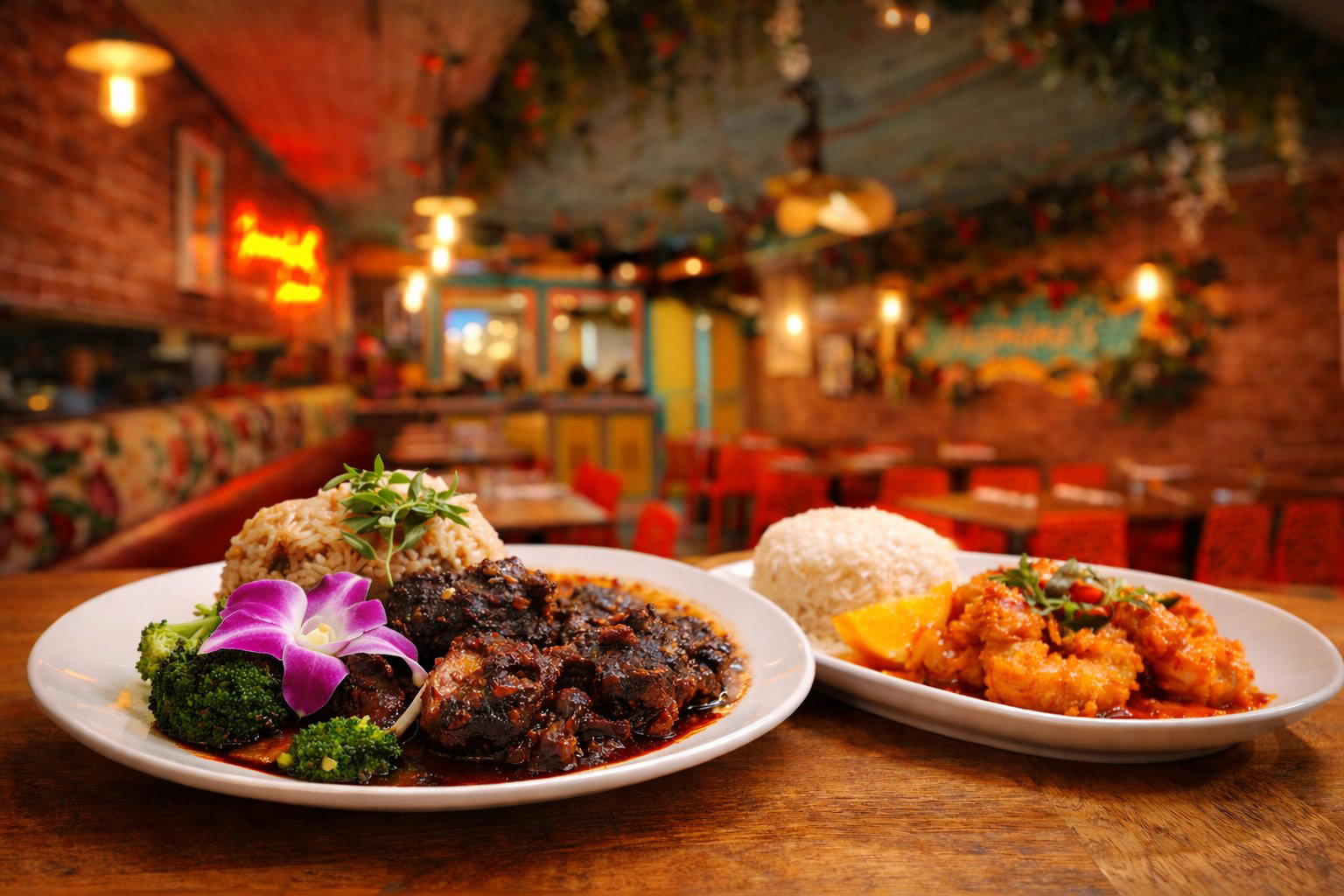
Restaurant Row and the Caribbean Table
West 46th Street between Eighth and Ninth Avenues has carried the nickname Restaurant Row since the 1970s, when the block became a pre-theatre dining destination for Broadway-goers. The strip still functions that way, and it draws a particular kind of restaurant: one that needs to hold its own against tight competition, high foot traffic, and a clientele that often has a curtain time to meet. Caribbean cooking, with its deep tradition of bold seasoning and communal plates, sits somewhat unexpectedly in this corridor, which skews heavily toward European and steakhouse formats. That contrast is part of what makes Jasmine's Caribbean Cuisine worth reading as a signal about where New York's immigrant-cuisine conversation is heading.
New York has absorbed Caribbean cooking for generations, primarily through Brooklyn neighbourhoods like Crown Heights, Flatbush, and Bed-Stuy, where Jamaican, Trinidadian, Guyanese, and Barbadian communities built food cultures that operated largely outside the fine-dining frame. The move toward Midtown, and toward a more composed restaurant format, reflects a broader shift in how diasporic cuisines are being repositioned across American cities. You can trace a parallel pattern in how Korean cooking moved from Koreatown's informal grill houses to the tasting-menu precision of Atomix and the progressive plating of Jungsik New York. The trajectory is not identical, but the underlying logic — taking a cuisine formed by specific immigrant communities and placing it in a context where technique and presentation carry more weight — is recognisable.
Where Local Ingredients Meet Imported Technique
The editorial angle that matters most at a restaurant like this is the intersection of indigenous Caribbean ingredients and the culinary techniques that a New York kitchen absorbs by proximity. Caribbean cooking already carries a sophisticated internal logic: the use of scotch bonnet and habanero peppers for layered heat rather than blunt fire, the slow-braising traditions that extract collagen and fat from goat and oxtail, the souring agents, tamarind, sorel, green mango, that create acidity without leaning on vinegar or citrus in the European sense. These are not simple flavours dressed up for a Western audience. They are the product of centuries of trade-route cooking, shaped by African, South Asian, Indigenous, and colonial European influences arriving on the same islands simultaneously.
What a New York setting adds to that base is access to a wider supplier network, a kitchen culture that cross-pollinates across cuisines, and a dining public trained by restaurants like Le Bernardin and Per Se to expect some degree of technical precision alongside strong flavour. Whether a Caribbean kitchen on Restaurant Row operates at that level of technical ambition or holds closer to the home-cooking traditions that give the cuisine its authority is the question any serious diner should bring to the table.
Across the United States, a number of kitchens are working through exactly that tension. Restaurants like Blue Hill at Stone Barns in Tarrytown and Single Thread Farm in Healdsburg have shown one version of how local-ingredient discipline can anchor a restaurant's identity at the highest tier. In the Caribbean context, the equivalent discipline would mean sourcing plantain, callaloo, breadfruit, and allspice with the same rigour that those kitchens bring to their regional produce, and then applying cooking methods that honour the ingredient rather than domesticate it for a nervous audience.
Midtown as a Frame for Immigrant Cooking
Placing Caribbean food in Midtown rather than in its traditional Brooklyn or Bronx strongholds has real implications for how the cuisine is read. Midtown diners are frequently visitors, expense-account lunchers, and theatre-goers with limited bandwidth for experimentation. That audience shapes menus, and not always in ways that serve the cuisine. The risk, in any immigrant-cuisine restaurant operating in a high-traffic tourist corridor, is that the menu gets calibrated toward safety rather than authenticity, jerk chicken that has had its edge sanded off, rice and peas that are pleasant but not the version a grandmother in Kingston would recognise.
The strongest Caribbean restaurants in New York tend to resist that calibration. They keep the scotch bonnet at full force. They serve the oxtail with the gelatinous richness that makes it worth the time it takes to braise. They offer sorel during the right seasons, and they do not apologise for the colour or intensity of their curry. For context on what ambition looks like at the upper end of the American dining spectrum, Alinea in Chicago, Providence in Los Angeles, and The French Laundry in Napa each demonstrate how a kitchen can hold a defined point of view without compromising for foot traffic. Caribbean kitchens in New York operate with different constraints and a different culinary vocabulary, but the principle of not diluting the cuisine's core identity applies at every price tier.
The Broader Caribbean Dining Conversation in New York
The genre has not, as of yet, attracted the same level of fine-dining codification that Korean cooking has received through venues like Atomix, or that Japanese cuisine commands through counters like Masa. That gap is partly cultural, Caribbean cooking's authority comes from abundance and generosity rather than scarcity and precision, and partly structural, given the way the restaurant industry has historically under-resourced Black-owned and Caribbean-owned kitchens.
For a wider picture of where New York's restaurant culture sits across categories and price tiers, the EP Club New York City restaurants guide maps the full range. For comparison against restaurants working at the intersection of heritage ingredients and technique in other cities, Emeril's in New Orleans, Bacchanalia in Atlanta, and Addison in San Diego each offer a reference point for how regional ingredient identity can anchor a restaurant's positioning. Globally, 8 1/2 Otto e Mezzo Bombana in Hong Kong and Alain Ducasse at Louis XV in Monte Carlo represent the far end of what happens when a cuisine's technique and ingredient sourcing are pushed to their highest expression. Caribbean cooking in New York has not yet produced a restaurant operating at that tier of international recognition, which makes any serious Caribbean kitchen on Restaurant Row part of a longer story still being written.
Restaurants working in similar territory across the country, from Lazy Bear in San Francisco to The Inn at Little Washington, show what happens when a kitchen commits fully to a culinary identity over time. That kind of commitment, sustained over years rather than seasons, is what separates a neighbourhood institution from a dining room that merely occupies a neighbourhood.
Planning Your Visit
Jasmine's Caribbean Cuisine is located at Address: 371 W 46th St, New York, NY 10036, on the Restaurant Row block of Midtown Manhattan, within walking distance of most Broadway theatres. Reservations: Contact details are not currently listed; walk-in availability is likely given the street's high-volume dining format, though pre-theatre hours on weekday evenings tend to fill quickly across the block. Dress: Midtown casual is the working norm on this street. Budget: Timing: Arriving before 6:30 pm on theatre nights gives you more room to eat at a reasonable pace before an 8 pm curtain.
Frequently asked questions
What is the signature dish at Jasmine's Caribbean Cuisine?
Caribbean restaurants at this address level typically anchor their menus around slow-cooked proteins, oxtail, jerk chicken, curry goat, that reflect the cuisine's core braising and spicing traditions. For confirmed dish information, check directly with the restaurant. Given the cuisine type and the Midtown location, the kitchen most likely offers a range of island-origin dishes drawn from Jamaican, Trinidadian, or broader Caribbean cooking traditions.
Do I need a reservation at Jasmine's Caribbean Cuisine?
Booking ahead is advisable if you are attending a Broadway show the same evening. Restaurant Row fills quickly between 5:30 and 7 pm on performance nights, and even mid-range Midtown restaurants can reach capacity during those windows. New York's Caribbean dining scene does not carry the same booking pressure as tasting-menu counters in the $$$$ tier, venues like Masa or Per Se require weeks of lead time, but a call ahead on a theatre night is a practical step worth taking.
What is the standout thing about Jasmine's Caribbean Cuisine?
The standout quality, based on its positioning, is the cuisine itself: a cooking tradition shaped by African, South Asian, and colonial European influences meeting on the same islands over centuries, producing flavour profiles that are deeply layered and not easily replicated by cuisines trained in a single tradition. Caribbean cooking's use of allspice, scotch bonnet, thyme, and souring agents creates a palate that is distinct from anything in New York's European-dominant fine-dining tier. No awards data is currently, so its recognition sits outside the credentialled tier occupied by restaurants like Atomix, but the cuisine's authority does not depend on that kind of endorsement.
Is Jasmine's Caribbean Cuisine good for vegetarians?
Caribbean cooking contains a strong vegetarian tradition, rooted partly in Rastafarian ital cooking and partly in the abundance of starchy vegetables, breadfruit, plantain, yam, callaloo, that anchor the cuisine's carbohydrate base. If the kitchen follows those traditions, vegetarians should find meaningful options beyond token salads. For confirmed menu details, check the restaurant's current offerings directly, as EP Club does not hold current menu data. New York's dining infrastructure means dietary preferences are generally well-accommodated at this price tier across the city.
Does Jasmine's Caribbean Cuisine justify its prices?
What is verifiable is that Restaurant Row operates at a Midtown pricing tier, where rents and operating costs push prices above equivalent food in Brooklyn's established Caribbean neighbourhoods. The relevant comparison is not against the $$$$ tasting-menu tier of venues like Le Bernardin, but against other mid-range Midtown options where Caribbean cooking competes on the strength of its flavour density and portion generosity rather than on technique-led presentation.
How does Jasmine's Caribbean Cuisine compare to Caribbean restaurants in other New York neighbourhoods?
Midtown and Brooklyn represent two distinct frames for experiencing Caribbean cooking in New York. Brooklyn's Crown Heights and Flatbush corridors house the most deeply rooted Caribbean communities in the city, and the restaurants there tend to operate with lower overheads, higher turnover, and menus calibrated entirely for regulars rather than visitors. A Midtown address on Restaurant Row brings a different audience and a different cost structure, which typically produces menus that are somewhat more composed and service formats that lean toward sit-down dining rather than counter service. Neither version is more authentic in an absolute sense, both reflect the cuisine's adaptation to its immediate context, which is itself a Caribbean culinary tradition dating back to the trading-port kitchens of the colonial era.
Fast Comparison
Comparable venues nearby, for context on price, style, and recognition.
| Venue | Cuisine | Price | Notes |
|---|---|---|---|
| Jasmine's Caribbean CuisineThis venue — the venue you are viewing | Authentic Caribbean Cuisine | $30–50 | Not listed |
| Pat'e Palo Bar & Grill | Dominican Caribbean Grill | $20–30 | Inwood |
| Ajo y Orégano | Traditional Dominican & Caribbean | $20–30 | Bronx |
| Good Taste | Authentic Haitian | Not listed | Crown Heights (North) |
| BKLYN BLEND | Healthy Caribbean Juice Bar & Cafe | $10–20 | Bedford-Stuyvesant (West) |
| Paladar | Authentic Hispanic Latin Cuisine | Not listed | Lower East Side |
Continue exploring
More in New York City
Restaurants in New York City
Browse all →
Bars in New York City
Browse all →

Hotels in New York City
Browse all →







Details
- Cozy
- Lively
- Family
- Casual Hangout
- Celebration
- Live Music
- Open Kitchen
- Craft Cocktails
- A La Carte
- Vegetarian Friendly
- Vegan Options
- Gluten Free Options
Current opening hours
- Monday
- Closed
- Tuesday
- 4–11 PM
- Wednesday
- 4–11 PM
- Thursday
- 4–11 PM
- Friday
- 4–11:30 PM
- Saturday
- 2–11:30 PM
- Sunday
- 2–11 PM
Hours can change for holidays and private events. Last verified .
Warm, relaxing atmosphere with bright Caribbean colors, mellow reggae music, and vivacious decor.