Our verdict
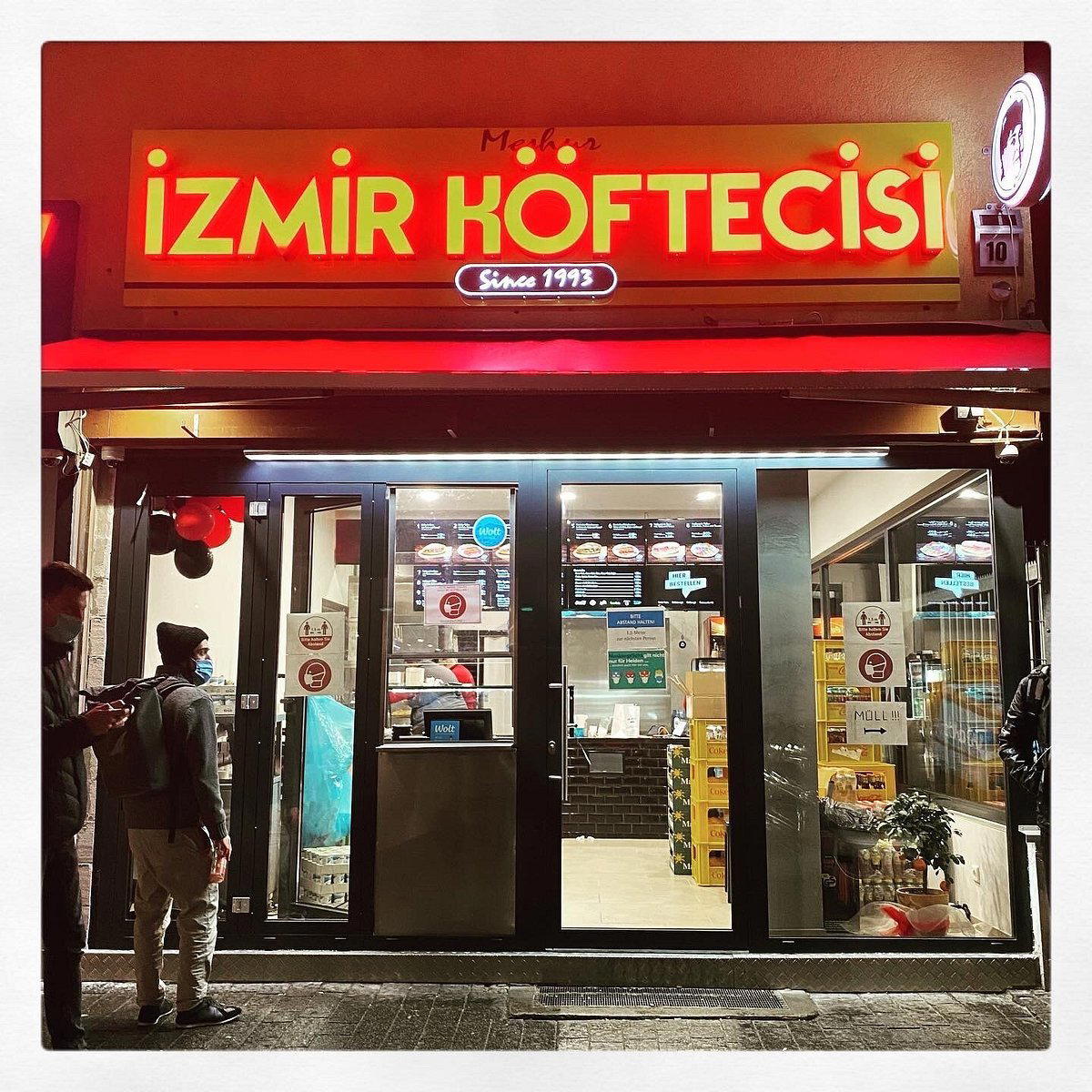
On Reichenberger Strasse in Kreuzberg, Izmir Köftecisi draws a loyal neighbourhood crowd back to the same stools, the same order, and the same unforced rhythm that defines the best Turkish köfte houses in Berlin. The kitchen works a narrow register, köfte done with conviction, and regulars read that as a feature, not a limitation.

Pearl is the En Primeur Club membership app, where members save venues, book tables and use the concierge.
Reichenberger Strasse and the Köfte Tradition in Kreuzberg
Kreuzberg's relationship with Turkish cooking runs deeper than any single restaurant. The neighbourhood became the gravitational centre of Berlin's Turkish community across several decades, and the street-level expression of that presence has always been specific: not the broad pan-Turkish menu aimed at tourists, but the specialist house, the köfteci, the lahmacun counter, the pideci, each working a tight repertoire with accumulated precision. Izmir Köftecisi on Reichenberger Strasse 10 sits inside that tradition, and the regulars who fill its seats operate accordingly. They don't read the menu. They know what they want before they arrive.
That dynamic, the returning local who skips the deliberation and goes straight to the familiar order, is the clearest trust signal a neighbourhood restaurant can earn. It takes years to build and is more instructive than almost any award or listing. Across Berlin's dining scene, where the critical conversation skews heavily toward tasting-menu formats at places like Rutz, Nobelhart & Schmutzig, and FACIL, the köfte house occupies a different register entirely, one measured in frequency of return rather than occasion.
What the Regulars Actually Order
Köfte, in the Turkish culinary canon, is both simpler and more demanding than its profile suggests. The variables, fat ratio, spice balance, char level, the texture at the centre, are narrow in range but immediately legible to anyone who eats the dish regularly. A regular at a köfte house is, in practice, a rigorous critic: they have a calibrated baseline, and any deviation from it registers. The fact that Izmir Köftecisi's tables turn on repeat custom rather than one-time visits implies the kitchen holds that baseline consistently.
The wider context of Turkish food in Kreuzberg is worth stating plainly. The neighbourhood runs the full range from fast-moving döner counters on major arterials to older, quieter specialist houses on side streets. Reichenberger Strasse leans toward the latter end, a residential stretch where the dining rhythm is slower, more embedded in daily life than in tourism. Izmir Köftecisi's address places it in that quieter register, which shapes who walks through the door and, by extension, how the kitchen is calibrated.
The Unwritten Menu
Every long-running neighbourhood restaurant develops an informal layer beneath the printed options, the dishes regulars request by habit, the adjustments made without needing to ask, the understanding between kitchen and customer that only accumulates over time. This is the unwritten menu, and it is arguably more revealing than anything listed on the wall. At a specialist köfte house, that unwritten layer often involves precisely how the köfte arrives: whether the bread is lightly charred or soft, whether the side of fresh tomato and green pepper is considered standard, whether a glass of ayran comes as a matter of course.
These details are not available to the first-time visitor. They are earned through return. That asymmetry is part of what makes neighbourhood specialists like this function differently from the broader Berlin restaurant economy, where tables at CODA Dessert Dining or Restaurant Tim Raue are allocated months in advance to first-time diners willing to plan ahead. Here, the premium is not on booking infrastructure but on accumulated familiarity.
Kreuzberg's Dining Logic
Understanding where Izmir Köftecisi sits requires understanding Kreuzberg's particular dining logic. The district has developed two parallel reputations: one internationally visible, associated with creative restaurant formats and a younger dining culture; and one embedded and local, built around the Turkish and Arab communities whose food institutions have been in place for decades. These two tracks coexist geographically but function independently. The specialist Turkish house is not competing with the tasting-menu counter two streets over. It is serving a different need, a different frequency, and a different type of loyalty.
That distinction matters for any visitor trying to read Berlin's food culture accurately. The Michelin-tracked restaurants, Rutz and its peers, represent one real strand of what Berlin does with food. The köfte house on Reichenberger Strasse represents another, equally real strand, one that doesn't translate into guidebook ratings but generates a different kind of authority: the authority of being indispensable to the people who live nearby.
For a broader map of where these two tracks intersect and diverge across the city, our full Berlin restaurants guide covers both registers. For comparison at the fine-dining end of the German spectrum, the contrast with destination restaurants like Aqua in Wolfsburg, Schwarzwaldstube in Baiersbronn, or Vendôme in Bergisch Gladbach is instructive: those rooms are built around singular visits; Izmir Köftecisi is built around return.
Getting There and Planning Your Visit
Frequently asked questions
What's the address for Izmir Köftecisi?
Izmir Köftecisi is located at Reichenberger Str. 10, 10999 Berlin, Germany, Berlin.
How does Izmir Köftecisi fit into Berlin's broader Turkish food scene?
Kreuzberg holds the densest concentration of Turkish restaurants in Berlin, shaped by decades of Turkish community settlement in the SO36 district. Izmir Köftecisi on Reichenberger Strasse sits inside that tradition rather than apart from it, a neighbourhood köfte counter competing not on novelty but on the quality of a single culinary category that the area has refined over generations. For visitors comparing options near Kottbusser Tor, the distinction is specialisation: this kitchen does one thing rather than many.
What's the signature dish at Izmir Köftecisi?
Köfte is the anchor of the menu, ground meat shaped, spiced, and grilled to a specific fat ratio and char level that defines the kitchen's identity. In the Turkish culinary tradition this dish rewards precision over invention, and long-running Kreuzberg spots like this one tend to hold their formula close. Side orders and accompaniments round out the plate but the köfte itself is the reason regulars return to Reichenberger Strasse 10.
Is Izmir Köftecisi reservation-only?
No booking details are published for the venue, which is consistent with the walk-in culture common to Kreuzberg's neighbourhood grill and köfte counters. Arriving during off-peak hours, mid-afternoon rather than the lunch or early dinner rush, is the practical approach for avoiding a wait at this SO36 address.
What's Izmir Köftecisi best at?
The kitchen's focus is köfte done with the consistency that comes from repetition rather than rotation, a single dish executed daily rather than a broad menu that spreads effort thin. Kreuzberg's Turkish dining scene is one of the densest in Berlin, and venues that survive here over the long term tend to do so on the strength of that kind of disciplined focus.
Can Izmir Köftecisi accommodate dietary restrictions?
Köfte is a meat-centred dish by definition, which limits options for vegetarians or those avoiding red meat. 10 in Kreuzberg.
Does Izmir Köftecisi justify its prices?
No published pricing exists but Kreuzberg's Turkish grill counters, including those in the SO36 section around Kottbusser Tor, operate in a part of Berlin where köfte remains an affordable daily staple rather than a premium dining proposition. The value calculation here is about consistency and craft, not about price positioning against fine dining.
Cost Snapshot
Comparable venues nearby, for context on price, style, and recognition.
| Venue | Cuisine | Price | Notes |
|---|---|---|---|
| Izmir KöftecisiThis venue (the venue you are viewing) | Authentic Turkish Köfte Grill | $10–20 | Not listed |
| Imren Grill | Traditional Turkish Döner Kebab | $1–10 | Kreuzberg, Traditional Turkish Döner Kebab |
| Hasir | Authentic Turkish Grill | $20–30 | Charlottenburg, Authentic Turkish Grill |
| Oggi's Gemüsekebab | Turkish Gemüsekebab | $10–20 | Moabit, Turkish Gemüsekebab |
| Doyum | Turkish Ocakbasi Grill | $10–20 | Kreuzberg, Turkish Ocakbasi Grill |
| Salsabil 2. | Lebanese | $10–20 | Prenzlauer Berg, Lebanese |