
Il Mare puts Odawara’s coastal larder into an Italian frame, with fish and local vegetables carrying the argument rather than imported luxury cues. Its Tabelog Italian EAST “Tabelog 100” selections in 2021, 2023, and 2025 place it in a serious regional set, while the Hayakawa setting keeps the focus close to the market and the water.
Pearl is the En Primeur Club membership app — saves, bookings, and concierge access live there. Same editors, same standards.
- Address
- Japan, 〒250-0021 Kanagawa, Odawara, Hayakawa, 1 Chome−11−6
- Phone
- +81 465-24-1510
- Website
- il-mare.co.jp
- Directions
- Get directions
 Saves & bookings on Pearl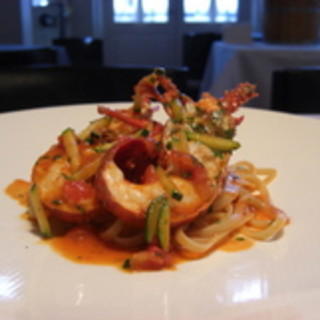
Hayakawa is the part of Odawara where the sea is not decorative background. The station, the port, and the daily trade in fish sit close enough together that a restaurant working in Italian grammar has an immediate question to answer: will it treat the coast as scenery, or as its main supply line? Il Mare belongs to the second camp. The point is not Italian cooking transplanted whole from Tokyo or Yokohama, but a Kanagawa coastal reading of it, where fish, vegetables, and wine shape the meal more than ceremony does.
That matters because Odawara’s food identity is split between quick regional institutions, sweets, eel, bakeries, and destination restaurants that ask for more time. A traveller can map that spread through Uirou, Menan Chitose, Moriya Sei Pan Ten, Tomoei, and Ichiyajo Yoroizuka Farm. Il Mare occupies the more deliberate end of that range: Italian, reservation-only, compact in scale, and recognised in Tabelog’s Italian EAST “Tabelog 100” in 2021, 2023, and 2025. In a city often treated as a rail stop between Tokyo and Hakone, that recognition gives the restaurant a sharper role, a reason to pause in Hayakawa rather than pass through.
Odawara fish, Italian structure, and a room built for a slower meal
Japanese Italian cooking has long been strongest when it lets local produce set the rhythm. In coastal Kanagawa, that means fish is not an optional garnish to pasta and secondi; it is the argument. Il Mare’s public positioning is explicit about fish and local vegetables, and that sourcing angle is what separates it from a generic ristorante format. The Italian frame gives shape, sequence, acidity, and wine logic, while the Odawara context supplies the reason for being there in the first place.
The scale reinforces that reading. An 18-seat room changes the economics and the mood: this is not a high-volume harbour lunchroom, and it is not a theatrical counter built around one chef biography. It sits in the quieter category of small regional restaurants where the kitchen’s buying decisions carry disproportionate weight. Tabelog’s score of 3.72 and repeated Italian EAST “Tabelog 100” selections are useful signals here, not because numbers explain taste, but because they place the restaurant among recognised Italian addresses across eastern Japan rather than merely among local seaside options.
Odawara’s advantage is immediacy. Tokyo restaurants can purchase excellent seafood, but Hayakawa can make locality legible without needing to announce it loudly. The more persuasive meal in this category is usually the one that avoids overcomplication: a course progression that lets fish, vegetables, and wine do the work. The restaurant’s all-course, chef’s-choice format fits that logic. It reduces à la carte indecision and makes the market relationship more central than a static list of dishes.
Where it fits in a compact Odawara itinerary
For visitors building a food day around Odawara, the contrast is useful. Uirou and Menan Chitose sit in a lower price band and answer a different need: local texture, shorter stops, and a sense of everyday Odawara. Ichiyajo Yoroizuka Farm occupies a produce-and-dessert lane at a mid-range spend. Tomoei brings the city’s eel tradition into the picture. The restaurant asks for a longer sitting and a larger budget, but it also gives the city’s seafood a different vocabulary. That is the case for including it in a trip, especially for travellers who already know the sushi and kappo routes and want to see how Italian technique behaves near a Japanese fishing port.
The comparison also keeps expectations honest. This is not the place to compress between train transfers or treat as a casual fallback. It is better understood as the anchor meal of the day, with the rest of Odawara arranged around lighter stops. For broader planning, Our full Odawara restaurants guide gives the restaurant context, while Our full Odawara hotels guide, Our full Odawara bars guide, Our full Odawara wineries guide, and Our full Odawara experiences guide help decide whether the meal belongs in a day trip or an overnight stay.
The restaurant also points to a broader pattern in Japan’s regional dining: serious restaurants outside major city centres increasingly compete through specificity rather than spectacle. The reference points are not only other Italian restaurants; they are local traditions, transport patterns, and the question of why a diner should eat this style of food here. That same planning logic applies when comparing regional meals elsewhere, from -Grilled beef Sukiyaki- KAMAKURA TANUKIAN 鎌倉 たぬき庵 in Kamakura to (Shoku) Vietnam in Kawasaki. 鮪と炭火焼き うお炭 秋葉原店 in Tokyo.cafe in Osaka.know in Kumamoto, and [Curry Senmon Ten] Maruyama Kyoju. in Sapporo. Outside Japan, the same editorial test still applies: Jōdo Saké Bar in Los Angeles and Onigiri Time in Pasadena are interesting only when read through place, format, and audience, not as isolated names on a list.
Who should choose it
The restaurant makes the strongest case for diners who care about ingredient origin and are comfortable with a composed meal rather than a quick coastal plate. The wine emphasis also matters: fish-led Italian cooking can fall flat when the drinks program is an afterthought, and the restaurant’s public notes put wine close to the centre of the experience. For travellers, the appeal is precision. Odawara has plenty of ways to eat locally; this one interprets locality through Italian structure and a small-room format.
The practical conclusion is simple. Choose it when Odawara is part of the trip rather than a corridor to somewhere else, and when the meal can carry the afternoon or evening on its own. The reward is not novelty for its own sake. It is a clear regional proposition: Hayakawa seafood and local vegetables, handled through Italian courses, in a restaurant with enough external recognition to justify planning around it.
At-a-Glance Comparison
Comparable venues by cuisine and price in the same metro.
| Venue | Cuisine | Price | Notes |
|---|---|---|---|
| Il Mare | Seasonal seafood-focused Italian set-course dining by Odawara Fishing Port | $$$ | Hayakawa |
| Ichiyajo Yoroizuka Farm | Farm-to-table patisserie & bistro café | $$ | Hayakawa |
| Tomoei | Traditional Japanese Unagi | $$$$ | Kazamatsuri |
| Uirou | Traditional Japanese wagashi & cafe | $ | Honcho |
| Uirou Ekimae chouzai yakkyoku | Traditional Japanese sweets & café | $ | Sakaecho |
| メシモ | Modern Local French | $$$ | 栄町 |
Recognition history
Dated appearances from independent guides and award organizations, with the underlying list record or original source where available.
Tabelog 100 #9 · No. 9
Tabelog · Tabelog 100 - Italian - EAST - 2025
Continue exploring
More in Odawara
Restaurants in Odawara
Browse all →
Bars in Odawara
Browse all →

Hotels in Odawara
Browse all →
Wineries in Odawara
Browse all →
At a Glance
- Scenic
- Romantic
- Intimate
- Elegant
- Date Night
- Special Occasion
- Celebration
- Business Dinner
- Group Dining
- Waterfront
- Panoramic View
- Standalone
- Extensive Wine List
- Local Sourcing
- Farm To Table
- Sustainable Seafood
- Waterfront
Current opening hours
- Monday
- Closed
- Tuesday
- 12–2 PM, 5:30–8 PM
- Wednesday
- 12–2 PM, 5:30–8 PM
- Thursday
- 12–2 PM, 5:30–8 PM
- Friday
- 12–2 PM, 5:30–8 PM
- Saturday
- 12–2 PM, 5:30–8 PM
- Sunday
- 12–2 PM, 5:30–8 PM
Hours can change for holidays and private events. Last verified .
A quiet, reservation-only coastal dining room overlooking the fishing port, with a relaxed but refined atmosphere that emphasizes the sounds and scents of the sea and an intimate, special-occasion feel.