Hasapika Central Market occupies a charged address at Aristogitonos 1, steps from Athens's historic central market district, where the line between butcher, fishmonger, and restaurant has always been thin. The sourcing logic here is the meal itself: what arrives on the table is inseparable from what came off the trucks that morning. For anyone reading Athens through its food supply chain, this is a useful stop.
Pearl is the En Primeur Club membership app — saves, bookings, and concierge access live there. Same editors, same standards.
- Address
- Aristogitonos 1, Athina 105 51, Greece
- Phone
- +302160707026
- Website
- linktr.ee
- Directions
- Get directions
 Saves & bookings on Pearl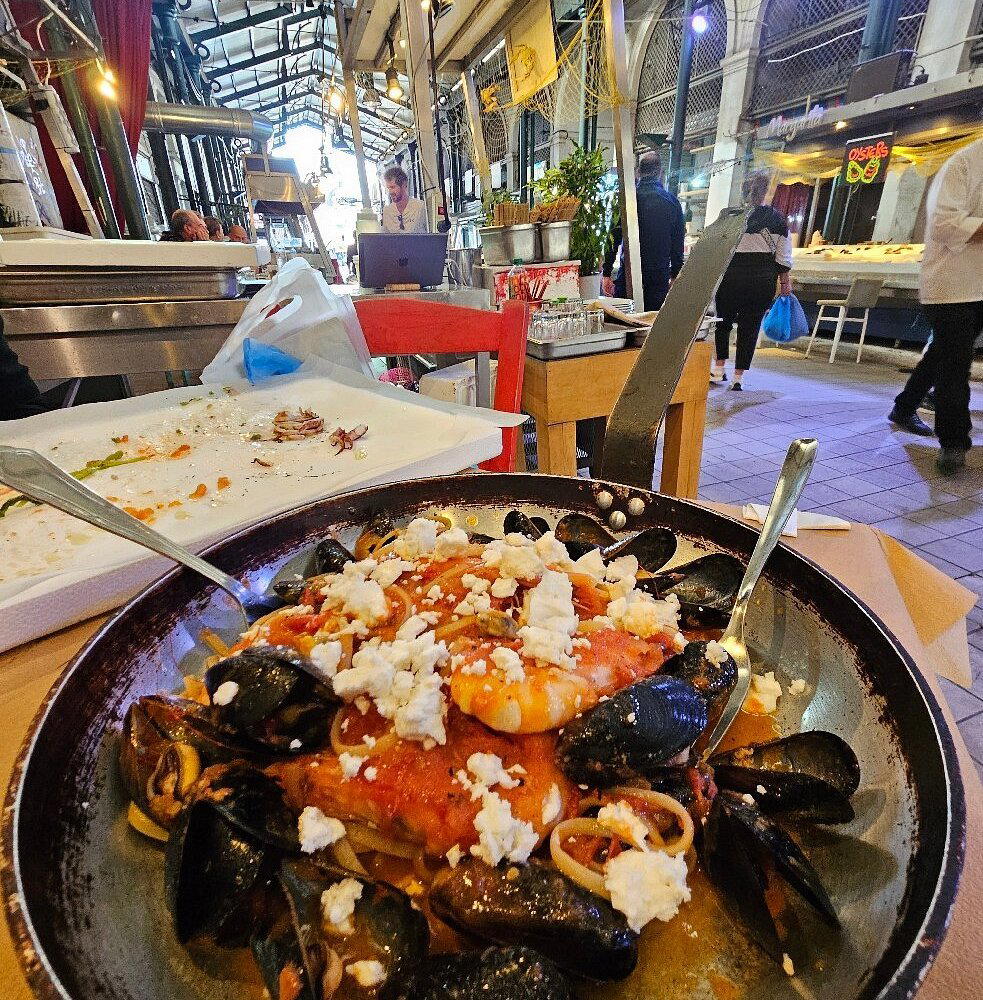
Where the Supply Chain Becomes the Menu
The area around Aristogitonos 1 in central Athens operates on a different clock from the rest of the city. By the time most restaurants are taking their first lunch reservations, the central market district has already completed half a working day: carcasses have been broken down, ice has been restocked, and the smell of salt and cold iron hangs in the covered passages. Hasapika Central Market sits inside this world rather than adjacent to it, which defines everything about what eating here means.
In Greek, hasapika refers to the butchers' quarter, a term rooted in the Ottoman-era trade guilds that once organized Athens's meat trade by district and craft. That lineage matters because it signals what kind of place this is: not a restaurant that happens to source well, but an establishment whose identity is continuous with the market infrastructure around it. The sourcing is not a program or a philosophy statement. It is the operational condition of the building.
Athens's Central Market and the Logic of Provenance
The Varvakios Agora, the central market complex that has anchored this part of Athens since the 1880s, remains one of the few urban food markets in southern Europe where wholesale and retail trade coexist in the same covered halls. Meat, offal, poultry, and fish all move through buildings that have changed in character but not in function over more than a century. What distinguishes this district from the curated market halls now common in northern European capitals is the absence of curation: the product is there because the supply chain put it there, not because a concept demanded it.
Restaurants positioned inside or directly adjacent to working wholesale markets occupy a specific tier in any city's dining structure. They tend to offer shorter menus, faster turnover, and ingredient quality that is structurally higher than comparable price-point venues elsewhere in the city, because the margin spent on sourcing in other restaurants is replaced here by proximity. In Athens, where the central market district has resisted the gentrification that has reshaped Monastiraki and Psiri over the past decade, that proximity remains intact.
For comparison, consider how the fine-dining end of Athens has moved. Hytra and Botrini's operate at price points of €€€ and €€€€ respectively, building seasonal Greek menus around sourcing relationships that are managed over months and communicated through tasting menus. Delta and Hervé approach ingredient provenance through a creative or modern lens. Hasapika Central Market represents a different position in that structure: the sourcing relationship is immediate and physical rather than curated and narrated. You are, in a literal sense, eating what the market had that day.
The Dish Logic of a Market Kitchen
Market-adjacent kitchens in Greek cities have traditionally organized their menus around offal and secondary cuts, because those are the parts of the animal that move fastest through wholesale channels and spoil soonest. In Athens specifically, the central market has always been a place where kokoretsi, patsas, and grilled offal were available at hours when the rest of the city was still closed. This is not a trend or a nose-to-tail revival in the contemporary sense. It is a functional adaptation to the supply chain that predates the current interest in whole-animal cooking by several generations.
Grilled meats cut to order, lamb and pork prepared with minimal intervention, and fish priced by weight against the morning's catch are the structural categories that define kitchens in this district. What changes from venue to venue is execution rather than concept, because the concept is fixed by geography. The question for any visitor is not what the kitchen is trying to do, but how well it does what the location demands.
Broader Greek dining, from seafood-focused spots like Jimy's Fish in Piraeus to coastal venues like Lake Vouliagmeni and Alykes in Palaio Faliro, operates on the same sourcing logic at different price tiers. The central market district simply compresses that logic into its most direct form.
Planning a Visit
The central market district runs on market hours, which means early to mid-morning through early afternoon for peak activity. Visitors arriving for lunch will find the market environment still active but winding down. The address at Aristogitonos 1 places Hasapika Central Market within a short walk of Monastiraki metro station, making it accessible without navigating the surrounding street grid by car. Dress expectations in this part of the city are informal by any standard: the clientele at market-district restaurants ranges from market workers on a break to deliberate visitors who made the trip specifically for this kind of eating. Booking infrastructure in market-district venues across Athens typically skews toward walk-in; arriving at the opening of the lunch service is the standard approach.
For visitors building a broader Athens itinerary, Makris Athens offers a creative counterpoint at a different price tier. The EP Club's full Athens restaurants guide maps the city's dining across neighbourhoods and price points. Further afield in Greece, Cacio e Pepe in Thira, Lure in Oia, Feredini in Santorini, and Aktaion in Firostefani represent the island end of Greek sourcing-driven dining. For comparison outside Greece, Le Bernardin in New York and Atomix in New York show how similar sourcing-first commitments operate at the formal fine-dining tier. Other regional references: Beauvoir in Katakolo, Cash in Kifisia, and Knossos Greek Taverna in Gouves complete a picture of how ingredient provenance functions across different Greek dining contexts.
In Context: Similar Options
Comparable venues nearby, for context on price, style, and recognition.
| Venue | Cuisine | Price | Notes |
|---|---|---|---|
| Hasapika Central MarketThis venue — the venue you are viewing | Japanese Seafood Fusion from Central Market | $$ | Not listed |
| Sushimou | Authentic Japanese Omakase | $$$ | Syntagma |
| Po' Boys | Authentic Southern BBQ | $$ | Psyri |
| Ivis4 Restaurant | Modern Mediterranean | $$ | Psyri |
| ARCADIA RESTAURANT | Traditional Greek Taverna | $$ | Makrygianni |
| 12 Piata | Modern Greek gastro‑tavern (12 meze plates) | $$ | Koukaki |
Continue exploring
More in Athens
Restaurants in Athens
Browse all →
Bars in Athens
Browse all →
Hotels in Athens
Browse all →


At a Glance
- Lively
- Trendy
- Rustic
- Energetic
- Casual Hangout
- Group Dining
- Open Kitchen
- Local Sourcing
Current opening hours
- Monday
- 11 AM–5 PM
- Tuesday
- 11 AM–5 PM
- Wednesday
- 11 AM–5 PM
- Thursday
- 11 AM–5 PM
- Friday
- 11 AM–5 PM
- Saturday
- 11 AM–5 PM
- Sunday
- 12 AM–6 PM
Hours can change for holidays and private events. Last verified .
Rough-and-ready, high-energy market atmosphere with fresh seafood displays, lively crowds, and alternative industrial setting.