Feredini sits in Oia, the caldera-rim village that defines Santorini's upper dining tier. With the Aegean as backdrop and the island's volcanic terroir shaping what arrives on the plate, it occupies the space where Greek ingredient tradition meets the specific drama of this particular address. Book early; Oia tables at this end of the market move quickly in high season.
 Discover on Pearl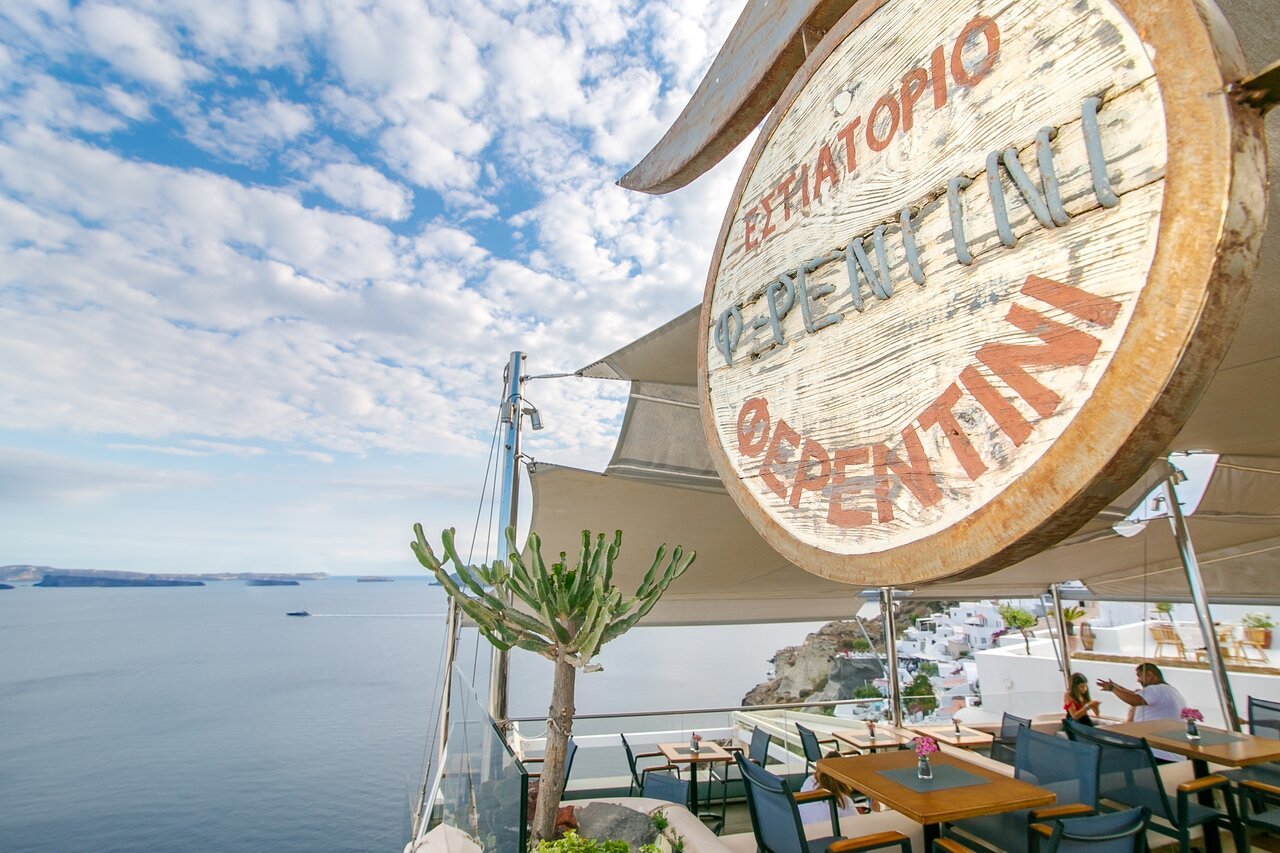
Arriving at the Caldera Rim: What Oia Frames Before You Eat
Oia operates at a different register from the rest of Santorini. The whitewashed lanes narrow until the Aegean opens below you, and the light at any hour carries the particular quality that comes from reflected water and dark volcanic stone. Restaurants here are not competing on neighbourhood foot traffic the way they would in Fira; they are competing on what that specific position above the caldera does to an evening. Feredini, set within Oia's 847 02 postcode, sits inside that framework. The address is not incidental to the experience; it is structural to it.
Oia's dining scene has sorted itself over the past decade into roughly two tiers: the sunset-terrace venues that fill on volume and visibility, and the smaller, quieter operations where the sourcing and the cooking are doing the serious work. Feredini belongs to the latter category. The caldera view is there if the layout permits it, but the more instructive question for a table at Feredini is what the kitchen is doing with the raw materials the island and the surrounding waters provide.
The shortlist, unlocked.
Hard-to-book tables, cellar releases, and concierge-planned trips.
Get Exclusive Access →The Ingredient Question: Why the Aegean Provenance Matters Here
Santorini's agricultural identity is more distinct than most Greek islands. The volcanic soil produces Assyrtiko grapes with a mineral edge that has made the island's wines a reference point across Greece and beyond. The same soil shapes the island's cherry tomatoes, Fava Santorinis (the split yellow pea that has protected designation of origin status), and white aubergines, all of which carry a flavour concentration that reflects the stress-grown intensity of produce raised in dry, mineral-rich ground. Any kitchen in Oia that takes sourcing seriously is working with an ingredient set that already has strong regional identity built in.
The waters around the Cyclades supply seafood that forms the backbone of serious Greek table cooking. Octopus, sea bream, red mullet, and various small fish from the Aegean have been central to this cuisine for centuries. At the level of dining Feredini occupies, the distinction between vessels is which kitchen is sourcing close, buying frequently, and doing less to obscure what the ingredient already is. The Aegean's seafood does not need architectural intervention; it needs timing, temperature, and a kitchen that knows when to stop. For context on how that philosophy plays out at the higher end of Greek fine dining, Delta in Athens offers a useful mainland reference point, and Selene has spent years making the case for Santorini-sourced ingredients at a formal level.
Oia in Context: How Santorini's Dining Tier Works
Santorini draws a specific category of traveller: international, often returning, and willing to spend at the upper end of the Greek islands market. That visitor profile has pulled the island's dining upward, but unevenly. The most-photographed addresses on the caldera rim can charge on scenery alone, and some do exactly that. The more interesting operations, including Feredini, are the ones where the cooking would earn its place in a less dramatic setting.
Comparison is instructive here. Oia's peer set on the island includes places like Thalami and Salt & Pepper, which occupy different positions on the casual-to-formal spectrum. Mama's House and Blue Note extend the range further. Feredini sits within this field as a distinctly Oia address, shaped by the village's particular atmosphere rather than by the broader island's more tourist-facing energy. For those building a multi-island itinerary, comparable sourcing-focused operations elsewhere in the Cyclades include Almiriki in Mykonos, and for a different Greek island register, Olais in Kefalonia is worth examining. Our full Σαντορίνη restaurants guide maps the wider scene with more granularity.
At the broader end of the Greek fine-dining spectrum, the Ionian coast has its own tradition: Etrusco in Kato Korakiana operates with a different sensibility shaped by Italian influence. Cycladic cooking and Ionian cooking are not interchangeable, and Feredini is firmly of its archipelago. For resort-integrated dining in the region, Myconian Ambassador and Myconian Utopia Resort offer Mykonos-side comparisons, while Avaton in Halkidiki and Old Mill in Elounda represent the northern Greek and Cretan luxury dining registers respectively. Aktaion in Firostefani remains the closest geographic peer on the caldera itself.
Sourcing as Editorial Position: What Greek Island Cooking Signals in 2024
Greek cuisine has moved decisively away from the taverna-as-default framing that held for decades in international coverage. The shift was not sudden, but it has accelerated: Athens earned its first Michelin stars, the islands attracted chefs who had trained in France and Scandinavia, and the PDO ingredient system gave local produce formal recognition that translated into restaurant menus. Santorini's fava and cherry tomatoes now appear on plates in the same way that specific French regional ingredients anchor menus in Lyon or Burgundy. The provenance is the argument.
At the international reference level, the sourcing-first philosophy that defines serious seafood restaurants from Le Bernardin in New York to Lazy Bear in San Francisco rests on the same premise: the ingredient's origin is information, and that information belongs on the table. In the Cyclades, where the ingredient story is geographically compressed and the supply chain is short by necessity, kitchens like Feredini's are working with ingredients whose provenance is already embedded in the landscape outside the dining room window. That is an advantage, but it is also a discipline: proximity to good ingredients raises the standard for what the kitchen is expected to do with them. To Psaraki in Vilcahda demonstrates how that discipline plays out at the informal, harbour-facing end of the spectrum on the same island.
Planning a Table: What to Know Before You Go
Oia is Santorini's most densely visited village, and the stretch of caldera-facing restaurants fills from June through September with very little slack. Feredini's position in the village means that booking ahead, particularly for weekend evenings in peak season, is a practical requirement rather than a precaution. The village itself is leading reached from the main island road that runs north from Fira; the walk through Oia's lanes from the bus terminus takes roughly ten minutes. Arriving slightly before your reservation is worth the effort: the pre-dinner light on the caldera between seven and eight in the evening is a specific thing, not a marketing claim, and the difference between catching it and missing it is usually a matter of twenty minutes.
Frequently Asked Questions
- Is Feredini suitable for children?
- At Oia prices and in a setting calibrated to the adult, caldera-dinner market, Feredini is not the natural choice for families with young children. Santorini has more accommodating options at the informal end of the market.
- What should I expect atmosphere-wise at Feredini?
- If you are arriving without a specific award credential to benchmark against, expect what Oia's address delivers as standard: a quieter, more composed atmosphere than Fira, oriented toward the view and the evening. If the kitchen is working at the level the Oia premium implies, the food will justify the setting rather than depend on it.
- What do regulars order at Feredini?
- Order from the island first. Santorini fava, the local tomatoes, and whatever the Aegean is supplying that week are the correct starting points at any serious Oia kitchen. The cuisine tradition here points toward seafood and local produce rather than meat-forward plates; follow that signal and the ordering logic takes care of itself.
- How does Feredini fit into Santorini's broader dining scene for wine-focused visitors?
- Santorini's wine identity is dominated by Assyrtiko from the volcanic caldera slopes, and any Oia restaurant operating at the upper tier of the market will carry local producers alongside broader Greek and international selections. For wine-focused visitors, the island itself is the context: the same volcanic terroir that shapes the food also shapes the glass, and a table at Feredini is a reasonable point of entry into that pairing, sitting as it does at the geographic and culinary centre of the Assyrtiko story.
Quick Comparison
These are the closest comparables we have in our database for quick context.
| Venue | Cuisine | Price | Awards | Notes |
|---|---|---|---|---|
| Feredini | This venue | |||
| Mama's House | ||||
| Salt & Pepper (Αλάτι & Πιπέρι) | ||||
| Thalami (Θαλάμι) | ||||
| Blue Note |
Need a table?
Our members enjoy priority alerts and concierge-led booking support for the world's most difficult tables.
Get Exclusive AccessThe shortlist, unlocked.
Hard-to-book tables, cellar releases, and concierge-planned trips.
Get Exclusive Access →