
Tabelog 100 #34
Our verdict
Hakata Tonkotsu Masao brings Hakata-style ramen into Kusatsu’s suburban dining circuit, with a small counter-and-table format and repeat selection in Tabelog Ramen WEST 100 for 2023, 2024, and 2025. Its value lies in regional specificity: Kyushu ramen culture translated for Shiga diners rather than softened into generic station-area noodles.

Pearl is the En Primeur Club membership app, where members save venues, book tables and use the concierge.
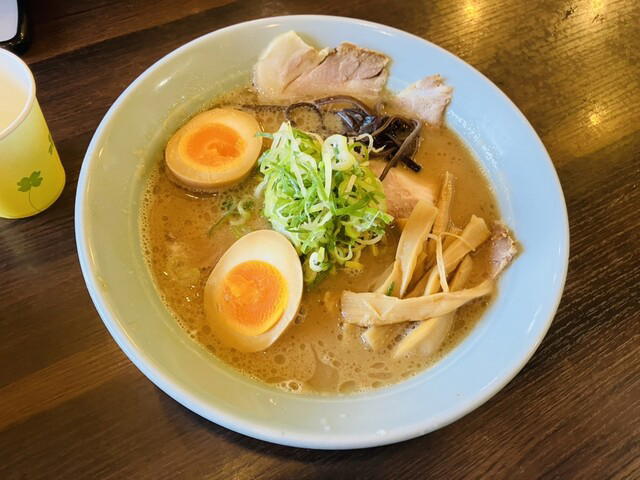
The menu
What to order
- Hakata tonkotsu ramen
- Fermented yobimodoshi tonkotsu soup ramen
- Motsu-ton (offal hotpot-style tonkotsu)
- Karaage (fried chicken)
- Mentaiko rice
Approaching a focused ramen shop in Kusatsu resets expectations before the bowl arrives. This is not polished dining built around luxury signals; it belongs to Kansai’s everyday rhythm of practical meals, repeat visits, solo diners, and rooms scaled for regulars rather than spectacle. Here, ramen has to carry directness while fitting a city where daily dining is practical, price-sensitive, and judged quickly.
Hakata Tonkotsu Masao sits in that useful category: a specialist ramen address whose credibility comes from focus, not ceremony. Its 2025 recognition in Tabelog’s Hyakumeiten listings, alongside a Tabelog score of 3.65, gives it a stronger public marker than many casual ramen shops in Shiga. The point is not performance, but whether a ramen shop can keep its identity and still work as everyday food in Kusatsu.
Ramen in Shiga depends on discipline, not decoration
Ramen is often judged by the speed and clarity of the meal as much as by the bowl itself. The appeal is narrow in the best sense: a defined kitchen format, quick service, and stripped-down expectations that privilege repetition over reinvention. In Kusatsu, that directness competes with wider casual dining, cafés, and local set-meal patterns.
Kitchen handling is therefore more than romance. Ramen rewards consistency: the bowl’s character depends on preparation, timing, and the kitchen’s tolerance for a focused format. Committing to a specialist ramen identity also means committing to a routine harder to disguise than a broader, menu-led restaurant. Diners read the result quickly: the bowl has depth and cohesion, or it does not.
Motsu-nabe and kara-age alongside ramen place the shop in a familiar Japanese casual-dining pattern, where a ramen specialist can support group and family use without becoming a generalist diner. That matters in Kusatsu, whose dining scene includes bakeries, bars, Western-leaning counters, and neighbourhood restaurants. For a broader view, Our full Kusatsu restaurants guide is the better map, with nearby names such as Kogetsu, Fukunaga, SPANISH BAR PLOMO, and other local dining rooms showing how varied the local table can be.
A focused room changes how the ramen is judged
Ramen culture rewards compression. A focused ramen room shifts judgment toward pace, kitchen rhythm, and whether the bowl has enough clarity to justify a trip beyond a purely convenient meal. Hakata Tonkotsu Masao sits in the casual ramen register rather than the big-occasion model. That scale of expectation shapes the mood: quick meals, repeat customers, and solo diners can all make sense, but the bowl remains the center of attention.
The Tabelog score of 3.65 is useful in Japan’s review culture, where casual shops with strong local followings often sit below the numbers associated with destination sushi or kaiseki. More important is the 2025 Hyakumeiten recognition, which places the shop inside a broader curated conversation, not only a Kusatsu one. Awards do not improve a bowl, but they do separate a suburban specialist from the long tail of convenient noodle shops.
Against Kusatsu’s broader dining range, the value proposition is clear. SPANISH BAR PLOMO occupies a different night-out category, while W. Bolero Moriyama honten works in a pastry-and-café register. Ramen sits elsewhere: lower spend, faster turnover, and a tighter expectation that the core bowl carry the meal. Hakata Tonkotsu Masao is less about variety than whether one casual ramen idea is executed consistently enough to earn recognition.
How to place it within a Kusatsu food day
Kusatsu rewards diners who think in categories rather than checklists. Ramen here competes not only with ramen, but with bakeries, casual Western food, izakaya-leaning rooms, and the practical eating patterns of a commuter city in Shiga. This shop is a useful anchor for a low-friction meal built around a specific ramen brief, and a sharper choice when the brief is a quick bowl rather than a long evening or multi-course plan.
For travellers building a wider itinerary, Kusatsu works better when restaurants are paired with the city’s hospitality and leisure layers. The restaurant map sits alongside Our full Kusatsu hotels guide, Our full Kusatsu bars guide, Our full Kusatsu wineries guide, and Our full Kusatsu experiences guide. For readers comparing casual Japanese specialities across cities, the contrast is useful: other everyday formats elsewhere show how modest food styles can become destination-worthy when the basic idea is handled with care.
The editorial case for Hakata Tonkotsu Masao is narrow and persuasive: it gives Kusatsu a ramen address tied to a defined casual format, backed by 2025 Hyakumeiten recognition, without asking diners to treat a quick bowl as luxury performance. Anyone seeking elaborate service or a long-form tasting experience should look elsewhere. Anyone interested in how a focused ramen shop reads within Kusatsu will find the signal here: clear category, casual scale, and a bowl-led format where preparation matters more than decoration.
Further casual-dining comparisons sharpen the point. Across different food cultures, modest formats raise the same question: when a casual restaurant succeeds, is it because of styling, or because the core ingredient logic has been taken seriously? In Kusatsu, this ramen shop argues for the latter.
Frequently asked questions
Is Hakata Tonkotsu Masao suitable for children?
Hakata Tonkotsu Masao is a casual ramen venue in Kusatsu. Families should confirm current seating and suitability directly with the restaurant before visiting.
What's the overall feel of Hakata Tonkotsu Masao?
It reads as a compact, no-fuss ramen house rather than a formal dining room. The 2025 Tabelog Hyakumeiten recognition gives it enough pedigree to justify attention from ramen-focused diners.
What's the pricing like at Hakata Tonkotsu Masao?
Pricing at Hakata Tonkotsu Masao is listed as - JPY 999 - JPY 999, with both lunch and dinner budgets listed at - JPY 999.
What are the opening hours for Hakata Tonkotsu Masao?
Current opening hours for Hakata Tonkotsu Masao should be confirmed directly with the restaurant before visiting.
What's Hakata Tonkotsu Masao's location?
Kusatsu.
A Quick Peer Check
Comparable venues by cuisine and price in the same metro.
| Venue | Cuisine | Price | Awards | Notes |
|---|---|---|---|---|
| Hakata Tonkotsu MasaoThis venue (the venue you are viewing) | Hakata-style Tonkotsu Ramen | $10–20 | Tabelog 100 #34 | Not listed |
| Kogetsu | Traditional Japanese Kaiseki | $100–150 | Not listed | Oji |
| 馳走 とし藤 | Traditional Japanese Kaiseki | $30–50 | Not listed | Kusatsu |
| Pan du Marche | Japanese artisan bakery | Not listed | Tabelog 100 #7 | Kusatsu |
| Glicine | Seasonal Italian (Omi beef–focused) | $100–150 | Tabelog 100 #58 | Kusatsu |
| SPANISH BAR PLOMO | Spanish Bar & Tapas | $30–50 | Tabelog 100 #57 | Kusatsu |
Recognition history
Dated appearances from independent guides and award organizations, with the underlying list record or original source where available.
Tabelog 100 #34 · No. 34
Tabelog · Tabelog 100 - Ramen - WEST - 2025
Continue exploring
More in Kusatsu
Restaurants in Kusatsu
All restaurants in Kusatsu →
Bars in Kusatsu
Browse all →

Hotels in Kusatsu
Browse all →
Wineries in Kusatsu
Browse all →
Details
- Lively
- Cozy
- Solo
- Casual Hangout
- After Work
- Family
- Standalone
- Local Sourcing
- A La Carte
- Counter Dining
Current opening hours
- Monday
- 11 AM–2:30 PM
- Tuesday
- 11 AM–2:30 PM
- Wednesday
- 11 AM–3 PM, 5–9 PM
- Thursday
- 11 AM–3 PM, 5–9 PM
- Friday
- 11 AM–3 PM, 5–9 PM
- Saturday
- 11 AM–2:45 PM, 5–10 PM
- Sunday
- 11 AM–2:45 PM, 5–9 PM
Hours can change for holidays and private events. Hours as of .
A compact, house-like neighborhood ramen shop with a casual, no-smoking dining room of counter and small tables, focused on bowls of rich Hakata tonkotsu ramen rather than decor.