Grotta Azzurra
One of Little Italy's most enduring addresses, Grotta Azzurra at 177 Mulberry Street has operated through multiple eras of the neighbourhood's transformation, from mid-century Italian-American heyday to today's compressed dining strip. The room carries the weight of that history in its bones, positioning it differently from the polished Italian concepts that now populate Manhattan's broader restaurant scene.
Pearl is the En Primeur Club membership app — saves, bookings, and concierge access live there. Same editors, same standards.
- Address
- 177 Mulberry St, New York, NY 10013
- Phone
- +12129258775
- Website
- bluegrotta.com
- Directions
- Get directions
 Saves & bookings on Pearl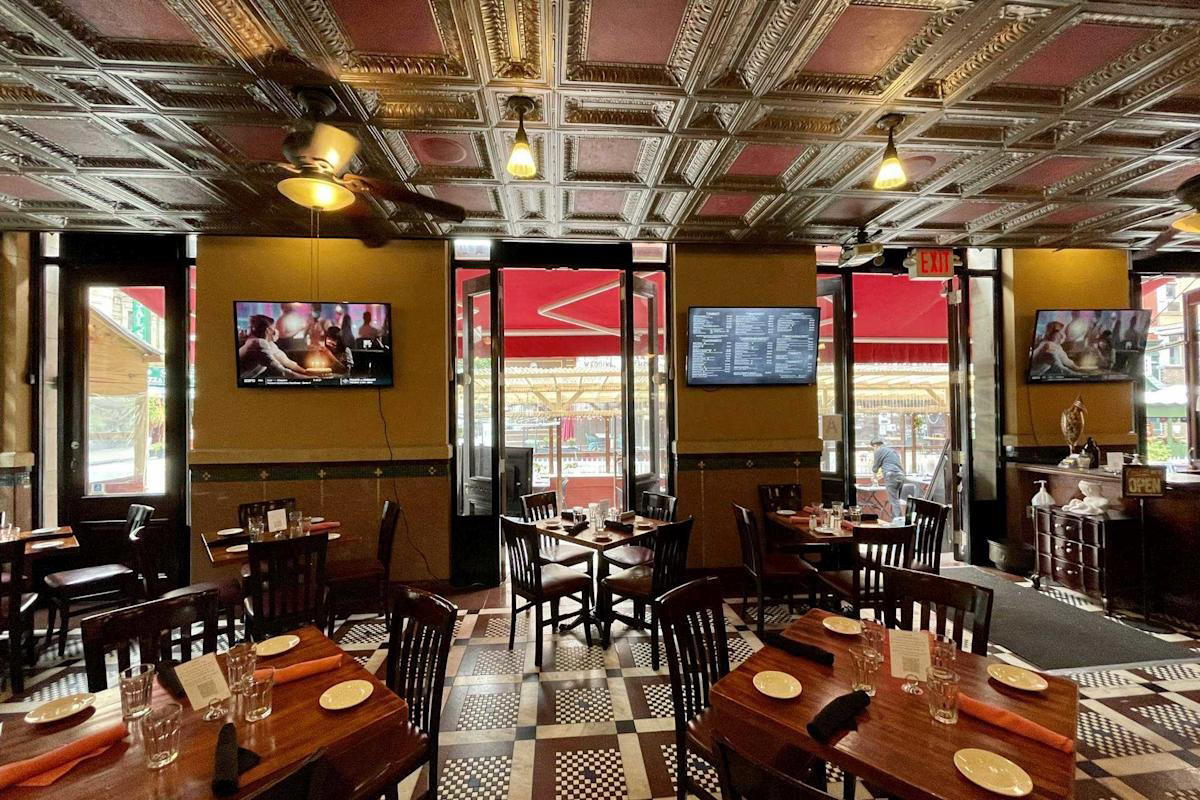
Mulberry Street, Before the Renovation Cycle
Walk south on Mulberry Street past the tourist-facing trattorias and the mood shifts around the block where Grotta Azzurra sits. Little Italy has contracted sharply over the past four decades, what was once a neighbourhood of thirty-odd blocks has been absorbed on three sides by Chinatown's expansion and SoHo's northward creep, leaving a narrow corridor of Italian-American institutions clustered between Canal and Broome. Grotta Azzurra, at 177 Mulberry, occupies a physical and historical position near the centre of that corridor, and the room reflects it.
The address has a reputation that predates the current wave of chef-driven Italian concepts now distributed across the West Village, the Flatiron, and the far west side. That generational gap between Little Italy's Italian-American dining tradition and Manhattan's contemporary Italian restaurant scene is one useful frame for understanding what Grotta Azzurra represents and why it continues to draw a specific kind of diner.
How the Neighbourhood Shaped the Format
Italian-American restaurants in this stretch of Mulberry have always operated differently from the uptown or midtown models. The cuisine that defined the neighbourhood through the mid-twentieth century was Southern Italian in origin, Neapolitan and Sicilian primarily, adapted by immigrants who arrived between 1880 and 1920 and cooked for communities, not critics. The red-sauce canon that became associated with American Italian dining came from that period: pasta with tomato and garlic, braised meats, shellfish preparations, dishes built for sustenance and shared at long tables.
What distinguishes the older Little Italy addresses from the newer Italian concepts scattered across Manhattan is precisely that connection to a communal, neighbourhood-scale tradition rather than a chef's tasting-menu vision. Venues like Le Bernardin or Per Se represent the contemporary fine-dining trajectory; the restaurant sits in a different lineage entirely, one that values familiarity and repetition over seasonal reinvention.
The Evolution Question: Staying Versus Changing
One interesting editorial question about any long-running neighbourhood institution is how much it has changed versus how much it has preserved. For the restaurant, that tension has played out across several decades in a neighbourhood that itself underwent enormous demographic and economic pressure. Little Italy's restaurant strip survived not by attracting new immigrant communities, that process reversed, but by becoming a destination for nostalgia-driven dining, for visitors seeking an experience that signals a specific chapter of New York history.
This dynamic runs through the American dining scene more broadly. Compare the restaurant's situation to Emeril's in New Orleans, which built its identity around a chef personality and has had to recalibrate as that personality became historical rather than current. Or to Bacchanalia in Atlanta, which has navigated decades of change by staying tightly focused on its original farm-to-table positioning. The question is always whether an institution's durability reflects genuine relevance or comfortable inertia.
At the restaurant, the answer appears to involve both. The physical room, low ceilings, dim lighting, the general atmosphere of somewhere that has not been redesigned recently, functions as the primary product alongside the food. Diners who come here are partly paying for the preservation of an environment that no longer exists at scale anywhere in Manhattan. That is not a criticism; it is a category distinction.
Placing It in the Current New York Scene
Manhattan's contemporary Italian dining scene has bifurcated sharply. On one side sit the high-concept, often expensive operations: chef-driven pasta programs, natural-wine-focused osteria formats, white-tablecloth Michelin-tracked rooms. On the other sit the neighbourhood survivors, places that predate the chef-celebrity era and operate on volume, loyalty, and institutional familiarity rather than critical validation. Atomix and Masa represent the former category's extreme end, maximally intentional, award-tracked, and priced accordingly. The restaurant sits on the opposite axis.
That positioning is not a liability. There is a durable market in New York for restaurants that function as social institutions rather than culinary events. The same logic applies to Blue Hill at Stone Barns in Tarrytown, which has built an identity around agricultural mission as much as cuisine, or to The Inn at Little Washington, where the room and the occasion are as much the product as the plate. Context and atmosphere carry weight in ways that do not always show up in award tallies.
What the restaurant cannot offer, and does not attempt to, is the precision-driven, technically ambitious experience you would get from Jungsik New York or the ingredient-sourcing narrative central to venues like Single Thread Farm or Alinea. Its comparable set is narrower and more historical: the Italian-American institution category, where the comparison points are other Mulberry Street addresses and the memory of what this neighbourhood used to contain at scale.
The Broader Italian-American Institution Category
Internationally, the long-running Italian restaurant as institution has its own reference points. 8 1/2 Otto e Mezzo Bombana in Hong Kong operates at the opposite end of the formality spectrum, Michelin three-starred, architect-designed, priced against Alain Ducasse at Louis XV, but both venues illustrate how Italian dining can operate as cultural statement as much as culinary exercise. The category is wide enough to contain both extremes.
What they share is the weight of expectation that arrives with established reputation. At the restaurant, that expectation is shaped by neighbourhood mythology as much as by any specific dish or kitchen credential. The room delivers an experience that is fundamentally about place and persistence, about a version of New York that has otherwise been renovated or repriced out of existence.
- Maine Lobster with Linguine, Clams and Mussels
- Spaghetti Bolognese
- Penne Arrabbiata
- Lasagna
- Veal Milanese
- Osso Buco
Where the Accolades Land
Comparable venues nearby, for context on price, style, and recognition.
| Venue | Cuisine | Price | Notes |
|---|---|---|---|
| Grotta AzzurraThis venue — the venue you are viewing | Authentic Southern Italian Trattoria | $$ | Not listed |
| Original Vincent's | Classic Italian Seafood | $$ | SoHo-Little Italy-Hudson Square |
| Taverna Di Bacco | Authentic Italian Trattoria | $$ | East Village |
| Trattoria Pesce Pasta | Northern Italian Seafood Trattoria | $$ | West Village |
| Paul & Jimmy's Ristorante | Traditional Italian | $$ | Gramercy |
| River Deli | Sardinian Italian | $$ | Brooklyn Heights |
Continue exploring
More in New York City
Restaurants in New York City
Browse all →

Bars in New York City
Browse all →
Hotels in New York City
Browse all →








At a Glance
- Classic
- Well Known
- Romantic
- Cozy
- Date Night
- Group Dining
- Celebration
- Special Occasion
- Private Event
- Wine Cellar
- Historic Building
- Private Dining
- Extensive Wine List
Current opening hours
- Monday
- 12–9 PM
- Tuesday
- 12–9 PM
- Wednesday
- 12–9 PM
- Thursday
- 12–9 PM
- Friday
- 12–10 PM
- Saturday
- 12–10 PM
- Sunday
- 12–9 PM
Hours can change for holidays and private events. Last verified .
Warm, inviting atmosphere designed to evoke the famous Blue Grotto of Capri, with brick-lined interiors and a nostalgic Italian charm that transports guests to the Mediterranean.