
Fushue belongs to Tokyo’s small-counter Chinese dining tier, where the room matters as much as the course structure. Its Tabelog Chinese TOKYO 100 selection in 2021, 2023, 2024, and 2026 signals durable local recognition rather than a passing listing-cycle spike, with a compact counter format and wine emphasis shaping the experience.
Pearl is the En Primeur Club membership app — saves, bookings, and concierge access live there. Same editors, same standards.
- Address
- 3 Chome-5-16 Higashinihonbashi, Chuo City, Tokyo 103-0004, Japan
- Phone
- +81 3-6661-9811
- Website
- instagram.com
 Saves & bookings on Pearl
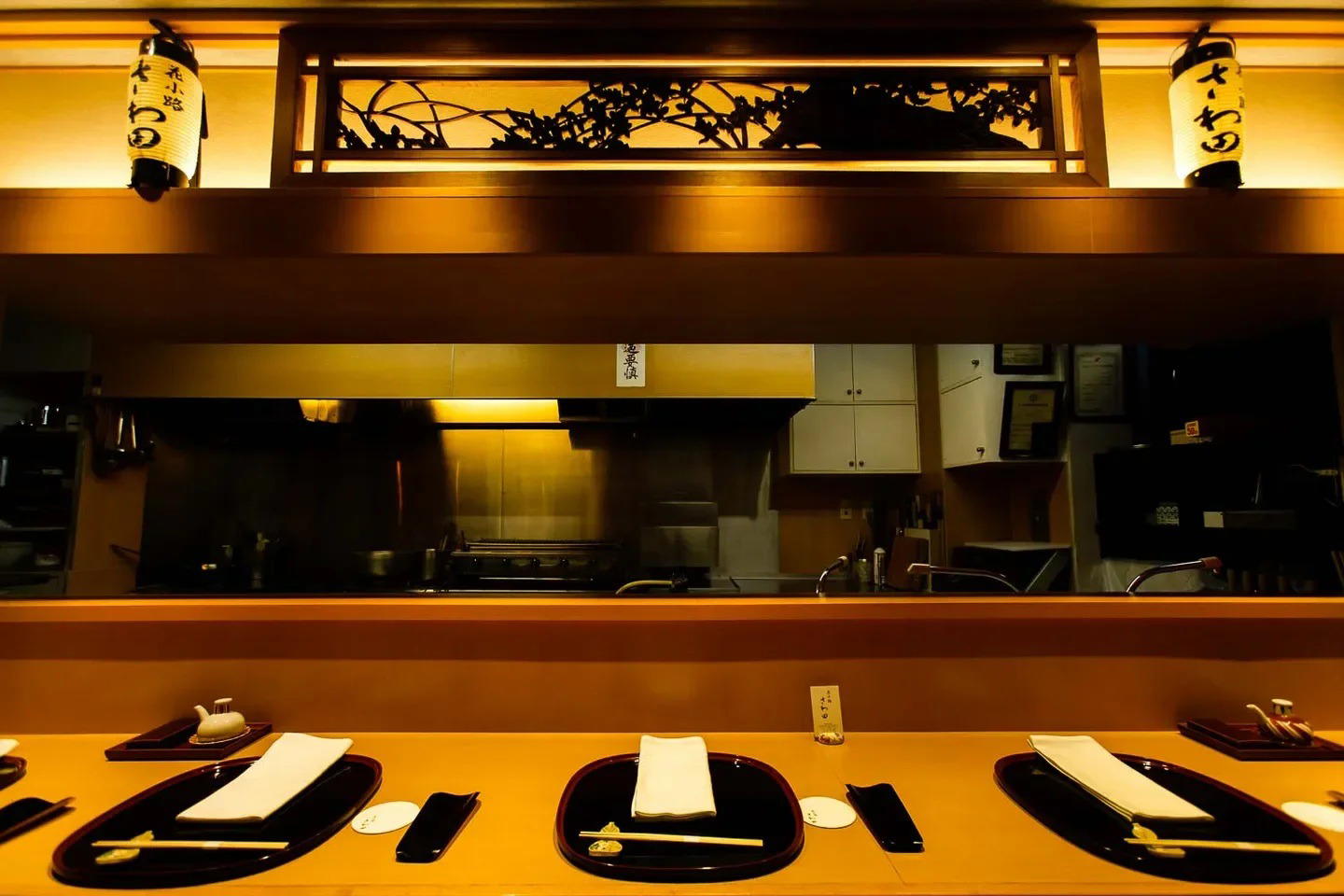
Higashinihonbashi changes tone quickly after office hours. Around Bakuroyokoyama, the streets carry wholesalers, small commercial buildings, and station exits rather than the theatrical dining corridors of Ginza or Roppongi. In that setting, Fushue reads as a small-room Chinese counter, not a banquet restaurant: compact, controlled, and built around proximity. Conversation stays close, service moves across a short counter, and the meal feels less like a large-table feast than a focused evening in a narrow Tokyo dining room.
That distinction matters in Tokyo Chinese cooking. The city supports grand hotel Cantonese rooms, Sichuan specialists, gyoza counters, neighborhood noodle shops, and wine-aware modern Chinese restaurants, but the smaller course-led format has become its own category. It borrows Japanese counter discipline without turning Chinese food into sushi theater. Diners watch timing, heat, and pacing at close range while the cuisine keeps its grammar: sauce, texture, aroma, and progression from lighter openings to richer late-course cooking.
A nine-seat counter places Chinese cooking inside Tokyo's small-room dining culture
Tokyo’s counter culture is usually framed through sushi, tempura, and yakitori, yet Chinese restaurants have adapted it with particular precision. A nine-seat counter changes how a Chinese meal behaves. Large platters and round-table abundance give way to sequence, temperature control, and a narrower social register. The room is quieter not for lack of ambition, but because it has fewer moving parts. Fushue sits squarely in that intimate category, with counter seating rather than private-room ceremony.
The comparison set helps. Sushi Ichijo occupies the sushi lane of Tokyo’s small-counter seriousness, while Shutei Yuzawa and Yugetsu reflect other adult evening dining at similar spend levels. Fushue belongs to the Chinese side of that conversation, where the measure is format discipline rather than luxury signposting. It has been selected for Tabelog’s Chinese TOKYO 100 in 2021, 2023, 2024, and 2026, suggesting sustained attention within one of Tokyo’s most competitive cuisine categories.
That recognition places it outside the tourist shorthand of “Tokyo Chinese” as either ramen-adjacent comfort or hotel dining. Higashinihonbashi is not a default first-night visitor neighborhood, which works in the restaurant’s favor editorially. The area rewards diners who know Tokyo’s serious food scene is not confined to prestige districts. For a broader map, Our full Tokyo restaurants guide gives the wider frame, from casual specialist rooms to tightly booked counters.
Lunch noodles, dinner courses, and the split personality of the room
The schedule creates two readings of the same place. Lunch is narrower and more casual, with noodles served only on selected weekdays. Dinner becomes course-only, moving the evening closer to Tokyo’s reservation-led small restaurants than to an à la carte Chinese room. The split is not incidental: in Tokyo, lunch often acts as the accessible public face of a serious restaurant, while dinner carries the full expression of pacing, wine service, and counter rhythm.
The wine note matters. Chinese food in Tokyo has increasingly moved beyond beer, Shaoxing wine, and tea pairings as default assumptions. Smaller wine-emphasis rooms belong to a contemporary style of dining, where spice, vinegar, sweetness, fermented depth, and frying must be handled by the glass list as much as by the kitchen. Fushue’s stated focus on wine places it in that modern category, even without grand-cellar language.
Room shapes the audience. Counter seating rewards diners comfortable with close quarters and a meal following the kitchen’s tempo. This is not for a sprawling group dinner, restless family meal, or a table that wants to improvise through a long dish list. It suits two diners comparing notes, friends who care about pacing, or a solo diner comfortable in Tokyo’s counter tradition. The maximum party size reinforces the deliberate constraint.
Readers building a Tokyo itinerary should not treat the city as one continuous luxury category. A night like this pairs better with contrasting formats across the week: grilled fish and charcoal cooking at . 鮪と炭火焼き うお炭 秋葉原店, Shinjuku dining at 12/10 Shinjuku ten, yakitori at 124. KAGURAZAKA (Yakitori), or a lighter café stop at 2D Cafe. Curry specialists such as 3 Chome no Curry Ya San show the other side of Tokyo’s tightly focused dining habits.
How to place it within a Tokyo itinerary
Use Fushue as a calibrated evening rather than a prestige trophy. Its value lies in compressing Chinese cooking into a small Tokyo counter, with Tabelog’s Chinese TOKYO 100 recognition giving external validation and the room itself setting expectations. Diners seeking spectacle, table-side theater, or hotel-level formality will misread it. Those who care about format, cadence, and the city’s quieter specialist addresses will understand the appeal faster.
Higashinihonbashi works as part of an east-side plan. The neighborhood sits outside better-known luxury hotel and nightlife circuits, so the evening benefits from a deliberate route rather than a casual detour. For lodging context, Our full Tokyo hotels guide helps place the area against more familiar bases. For after-dinner planning, Our full Tokyo bars guide maps the city’s drinking options, while Our full Tokyo experiences guide suits travelers building days around museums, markets, and neighborhood walks. Wine-focused readers can also scan Our full Tokyo wineries guide, though Tokyo’s wine culture appears more often through restaurants and bars than vineyard visits.
Across Japan, the same lesson appears differently: small formats often carry more personality than larger rooms. Compare the regional spread through -Grilled beef Sukiyaki- KAMAKURA TANUKIAN 鎌倉 たぬき庵 in Kamakura,.cafe in Osaka,.know in Kumamoto, (Shoku) Vietnam in Kawasaki, [Curry Senmon Ten] Maruyama Kyoju. in Sapporo, and [ki:] in Kyoto. The logic extends internationally through tightly defined specialists such as Jōdo Saké Bar in Los Angeles and Onigiri Time in Pasadena.
The editorial call is simple: choose this for a compact, adult, wine-aware Chinese meal in eastern Tokyo, not a broad survey of Chinese regional cooking. The counter, course structure, and repeated Tabelog recognition define the proposition. In a city crowded with louder dining signals, restraint is the argument.
Comparison Snapshot
Comparable venues at a glance for context.
| Venue | Cuisine | Price | Awards | Notes |
|---|---|---|---|---|
| FushueThis venue — the venue you are viewing | Chinese restaurant | $$ | , | |
| Nihao | Chinese dumpling house (gyoza specialist) | $$ | , | Shibuya |
| chuukaryouri tokutake | Modern Chinese & Ramen | $$ | , | Sumida |
| Asia Kappou Rengetsu | Gyoza-focused Japanese-Chinese dumpling house | $$ | , | Minato |
| 銀座奥田 | Chinese | $$ | , | Chūō |
| ENGINE | Chinese with Japanese influence | $$ | , | Shinjuku |





At a Glance
- Group Dining
- Casual Hangout
- After Work
- Standalone