
Fukuo Shoten belongs to Tokyo’s compact wagashi circuit rather than the city’s restaurant theater: handmade Japanese sweets, take-out service, and a place on Tabelog’s 2023 Tokyo Hyakumeiten list for Japanese traditional sweets and sweets cafes. In Kanda Sudacho, it reads as a low-friction stop for travelers interested in how Tokyo treats confections as craft rather than dessert afterthought.
Pearl is the En Primeur Club membership app — saves, bookings, and concierge access live there. Same editors, same standards.
- Address
- 1 Chome-34-4 Kanda Sudacho, Chiyoda City, Tokyo 101-0041, Japan
- Phone
- +81 3-3251-1635
- Website
- fukuo-shouten.keeping.jp
 Saves & bookings on Pearl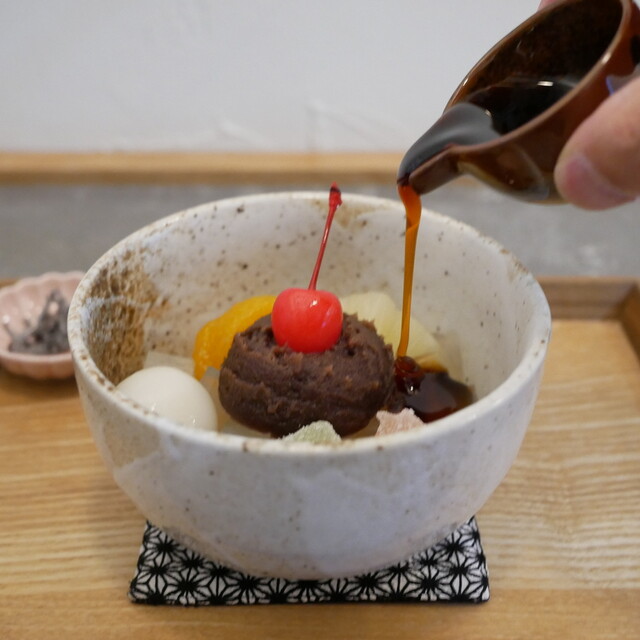
Approaching Kanda Sudacho, Tokyo changes register: less Ginza polish, less Shinjuku vertical noise, more errands, offices, old addresses, and small specialist shops that reward attention over spectacle. In that setting, wagashi makes sense. Visitors may treat Japanese sweets as something to buy with tea, but in Tokyo they form their own map of counters, sweets cafes, seasonal makers, and take-out specialists, where the progression is not a Western tasting menu but texture, sweetness, and restraint.
Fukuo Shoten sits within that older Tokyo logic. Its public identity is narrow and useful: a cafe featuring Japanese sweets, currently centered on take-out rather than a conventional seated cafe format. The distinction is category discipline. This is not a restaurant dessert counter or a pastry shop borrowing French visual codes. It belongs to the wagashi and kanmidokoro tradition, where bean paste, rice flour, agar, syrup, and seasonal cues follow their own grammar. Recognition on Tabelog’s 2023 Tokyo Hyakumeiten list for Japanese traditional sweets and sweets cafes places it among venues judged within that specialist field, not against coffee chains or plated-dessert rooms.
Wagashi in Kanda: small-format sweets with a sequence of restraint
The tasting progression here differs from a multi-course restaurant menu. Wagashi often moves through quiet contrasts: cleaner sweet before denser one, softer texture before firmer, tea companion before a more self-contained confection. Even without formal courses, the category rewards ordering with an arc. Treating the stop as a quick sugar purchase misses the point; the better frame is a compact study in how Tokyo compresses craft into a few pieces carried away in paper or box.
That compression matters in a city where dessert culture divides into grand hotel patisserie, parfait salon, department-store gift counter, kissaten sweet, and wagashi shop. Fukuo Shoten belongs to the last, a category with fewer English-language shortcuts and little tolerance for excess. The price signal, below the four-figure yen threshold, reinforces the appeal: serious craft without the financial choreography of sushi, tempura, or kaiseki. Among Tokyo’s casual specialist peers, it sits closer to the low-cost everyday end represented by Takayama Coffee and KAMAYOSHI than to higher-spend stops such as Nemurian or the mid-tier comfort of Curry Notoriko and THE GRABBER hamburger pub.
The award context matters because wagashi is difficult to rank from outside. Michelin and global restaurant lists rarely give it the visibility they give counter dining. Tabelog’s Hyakumeiten selections, while not a star system, are meaningful within Japan’s user-review and category-specific culture. A 3.69 score in this field signals sustained local interest without turning the place into a luxury performance. For visitors, the useful reading is specialist credibility, modest format, and a grounded neighborhood context.
Take-out changes the rhythm, but not the editorial value
The current take-out emphasis changes how to visit. Instead of assessing service pacing, room design, or beverage pairing, judgment shifts to selection, timing, and how the sweets fit into the day. Tokyo excels at this kind of food experience: a concise stop between train lines, a purchase carried to a hotel room, a sweet after lunch rather than after a formal dinner. Kanda Station, Awajicho, and Ogawamachi create an easy rail triangle, making the shop more useful within a wider Chiyoda or Akihabara route than as a single-destination outing.
Practical editorial lesson is that premium travel in Tokyo does not always mean longer meals or harder reservations. Some of the city’s sharpest food experiences are small, inexpensive, and highly specific. A wagashi stop can sit between a charcoal-driven meal at . 鮪と炭火焼き うお炭 秋葉原店, a Shinjuku counter such as 12/10 Shinjuku ten, or a yakitori evening at 124. KAGURAZAKA (Yakitori). It also pairs with cafe culture, from stylized rooms such as 2D Cafe to older curry-and-coffee rhythms at 3 Chome no Curry Ya San.
For planning, treat this as a daytime specialist stop, not a dinner substitute. That is not a flaw; it is the category’s operating logic. Travelers who build Tokyo itineraries only around evening seats miss this layer of the city, where craft appears in modest units and the meal’s narrative can happen between formal meals.
Where it fits in a Tokyo itinerary
Fukuo Shoten is strongest for travelers who know Tokyo food culture is not only chef-led counters. It suits a morning or afternoon around Kanda, Awajicho, Ochanomizu, or Akihabara, especially when the day needs a precise culinary stop rather than another full restaurant booking. The defining idea is wagashi as disciplined progression: not a named signature dish, not chef mythology, but Japanese sweets treated as their own category.
That makes it a useful counterweight to how visitors often consume Tokyo. High-end dining dominates itineraries, yet everyday specialists explain just as much about taste, seasonality, and restraint. For broader planning, use Our full Tokyo restaurants guide for dining structure, Our full Tokyo hotels guide for neighborhood base decisions, Our full Tokyo bars guide for evening pacing, Our full Tokyo wineries guide for wine-led detours, and Our full Tokyo experiences guide for cultural context beyond meals.
The same editorial principle travels outside Tokyo. Regional Japanese dining often rewards narrow focus over breadth, whether beef sukiyaki at -Grilled beef Sukiyaki- KAMAKURA TANUKIAN 鎌倉 たぬき庵 in Kamakura, cafe culture at.cafe in Osaka, or contemporary small-format cooking at.know in Kumamoto. The wider Japanese and Japanese-influenced map also includes (Shoku) Vietnam in Kawasaki, [Curry Senmon Ten] Maruyama Kyoju. in Sapporo, [ki:] in Kyoto, Jōdo Saké Bar in Los Angeles, and Onigiri Time in Pasadena. Read that way, the restaurant is not a minor snack stop. It is a compact argument for Tokyo’s specialist culture, where a few sweets can carry as much information as a longer menu.
Price and Positioning
Comparable venues at a similar level for quick context.
| Venue | Cuisine | Price | Notes |
|---|---|---|---|
| Fukuo ShotenThis venue — the venue you are viewing | Not listed | $ | Not listed |
| Hekkelun | Not listed | $ | Toranomon/Shinbashi, Classic Japanese Kissaten |
| Nihonbashi Nagato | Not listed | $ | Chūō, Traditional Edo-style Japanese wagashi (sweets) |
| Paris Ogawa Ken Shimbashi ten | Minato, Japanese Bakery Café | $ | Not listed |
| Asakusa Naniwaya | Not listed | $ | Taitō, Traditional Japanese taiyaki & kakigori café |
| Karinto Kozakura | Not listed | $ | Taitō, Traditional Japanese karinto & wagashi shop |
Recognition history
Dated appearances from independent guides and award organizations, with the underlying list record or original source where available.
Tabelog 100 #61 · No. 61
Tabelog · Tabelog 100 - Japanese traditional sweets / Japanese sweets cafe - TOKYO - 2023








At a Glance
- Quiet
- Cozy
- Classic
- Solo
- Casual Hangout
- After Work
- Standalone
- Local Sourcing
Current opening hours
- Monday
- Closed
- Tuesday
- 10 AM–7 PM
- Wednesday
- 10 AM–7 PM
- Thursday
- 10 AM–7 PM
- Friday
- 10 AM–7 PM
- Saturday
- 10 AM–5 PM
- Sunday
- Closed
Hours can change for holidays and private events. Last verified .
A small, quiet shop with just a few counter seats, feeling more like a classic neighborhood sweet shop and factory than a modern cafe, with a calm, low-key atmosphere focused on simple wagashi and takeaway jelly products.