El rincón de Katrina sits in Carabanchel, one of Madrid's most culturally layered working-class districts, where neighbourhood dining operates at a remove from the city's Michelin circuit. The address on Calle Francisco García places it squarely in the local fabric rather than the tourist corridor, making it a reference point for understanding how Madrid eats beyond the centro.
Pearl is the En Primeur Club membership app — saves, bookings, and concierge access live there. Same editors, same standards.
- Address
- C. Francisco García, 19, Local, Carabanchel, 28025 Madrid, Spain
- Phone
- +34919481422
- Website
- elrincondekatrina.es
- Directions
- Get directions
 Saves & bookings on Pearl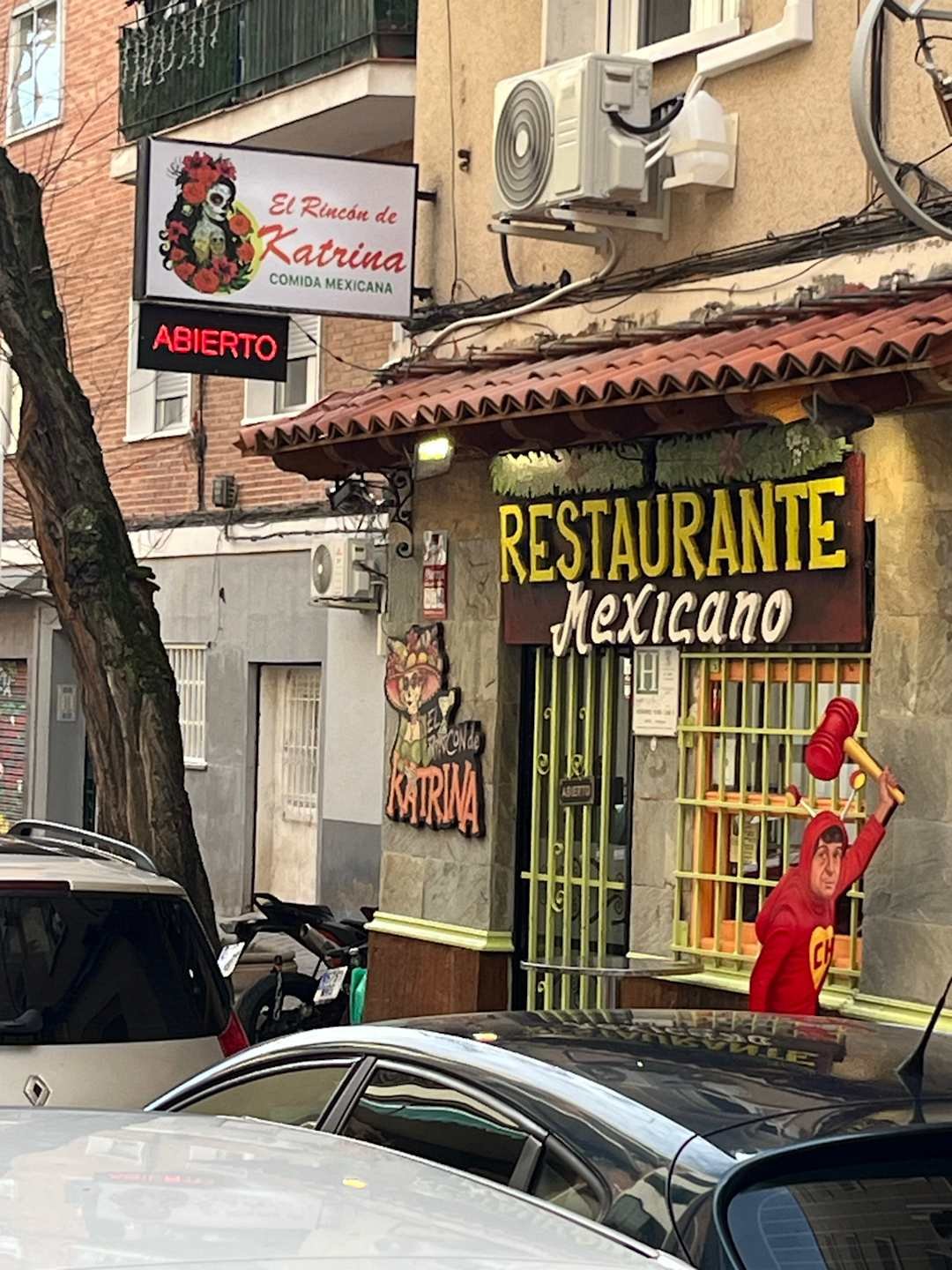
Carabanchel and the Other Madrid
Madrid's dining conversation defaults quickly to the axis running from Salamanca through Chueca to the centre, where the city's Michelin-starred circuit concentrates. DiverXO, Coque, Deessa, and DSTAgE occupy a rarefied tier where tasting menus run to triple figures and bookings open months in advance. But Madrid has always had a second dining culture running parallel to that circuit, one built around neighbourhood fidelity rather than critical recognition, and Carabanchel is among its clearest expressions. El rincón de Katrina, addressed on Calle Francisco García in the Carabanchel district, sits inside that tradition rather than against it.
Carabanchel was for decades defined by its working-class identity and, historically, by waves of internal Spanish migration that brought regional cooking traditions from Extremadura, Castilla-La Mancha, and Andalucía into the same postal code. That layering is still legible in the neighbourhood's restaurant stock, where the frame of reference is home cooking done with conviction rather than technique performed for external judges. The district has attracted younger residents over the past decade as rents in Lavapiés and Malasaña pushed further up, bringing with it a modest but real diversification of the dining offer, without erasing the neighbourhood's underlying character.
The Cultural Weight of the Neighbourhood Restaurant
Spain's neighbourhood restaurant tradition carries specific obligations that its fine dining counterpart does not. A barrio spot answers to a daily clientele that returns not because of a reservation secured months ahead, but because the food holds up on a Tuesday and the welcome is consistent. That accountability to regulars produces a different kind of discipline than the one operating at, say, Paco Roncero, where the spectacle of the room and the precision of the tasting menu are the product. Here, the product is something closer to trust.
Spanish neighbourhood dining has its own canonical formats: the menú del día, the tapas counter, the raciones table. These formats are not simply affordable versions of fine dining stripped of technique. They represent a distinct set of values in which abundance, generosity, and repetition across a community are as important as any individual plate. The name El rincón de Katrina, meaning roughly Katrina's corner, places the venue in that tradition of personalised, proprietor-anchored local hospitality that defines the genre across Spain.
For context on where neighbourhood dining sits relative to the country's fine dining output, it helps to note what surrounds Madrid in the broader Spanish scene. Spain's three-star tier includes properties like Quique Dacosta in Dénia, Arzak in San Sebastián, Azurmendi in Larrabetzu, and Martin Berasategui in Lasarte-Oria. These are the export face of Spanish cuisine. The neighbourhood restaurant is its interior face, less photographed but no less structurally important to how Spanish food culture reproduces itself across generations.
What the Address Signals
Calle Francisco García is a residential street, not a dining destination in the way that Calle de Ponzano has become in recent years, with its pintxos bars drawing queues on Thursday evenings. Carabanchel operates on a different frequency. Restaurants here do not typically feature in the international food press, are rarely among the venues cited in hotel concierge recommendations, and have little exposure to the kind of tourism that has transformed parts of Madrid's food scene into something partly performed for outside audiences. That relative obscurity is not a failure of quality but a reflection of geography and clientele. The neighbourhood feeds itself.
Spain's broader dining geography rewards this kind of attention. Some of the most instructive eating in the country happens at venues with no awards, no social media presence calibrated for reach, and no menu in English: a pattern visible from Cádiz to Zaragoza, and from Aponiente's home in El Puerto de Santa María down to the unfussy tapas bars that surround it. Madrid's Carabanchel belongs to that geography.
Madrid's Neighbourhood Dining in Wider Perspective
Understanding what El rincón de Katrina represents requires placing it against the full range of what Madrid offers. At the leading end, the city competes with Barcelona's Cocina Hermanos Torres, Girona's El Celler de Can Roca, Valencia's Ricard Camarena, and the Basque Country's Mugaritz for international fine dining attention. Extremadura's Atrio in Cáceres adds another axis. That fine dining tier generates the press and the international booking traffic. But the neighbourhood tier is where the ratio of price paid to cultural experience skews most favourably for anyone willing to leave the centro.
Internationally, the pattern holds too. Neighbourhood restaurants in cities as different as New York, where Le Bernardin defines the formal ceiling, and San Francisco, where community-anchored formats like Lazy Bear have built serious followings, often outperform their prices and their press coverage when you are looking for an honest account of how a city feeds its residents rather than its visitors.
For a full orientation to what Madrid's restaurants offer across price tiers and neighbourhoods, the EP Club Madrid restaurants guide maps the city's dining from Michelin circuit to barrio counter.
Planning Your Visit
El rincón de Katrina is located at C. Francisco García, 19, Local, Carabanchel, 28025 Madrid. Carabanchel is served by metro lines 3 and 5, with Carabanchel and Eugenia de Montijo stations providing the most direct access from the city centre. Reservations: No booking information is currently available through EP Club; visiting directly or calling ahead is advisable for first-time visitors to any neighbourhood spot of this type. Dress: No dress code has been recorded; Carabanchel restaurants generally operate on casual neighbourhood norms.
Continue exploring
More in Madrid
Restaurants in Madrid
Browse all →
Bars in Madrid
Browse all →

Hotels in Madrid
Browse all →


At a Glance
- Cozy
- Rustic
- Casual Hangout
- Group Dining
- Local Sourcing
Current opening hours
- Monday
- Closed
- Tuesday
- 1–5 PM, 8 PM–12 AM
- Wednesday
- 1–5 PM, 8 PM–12 AM
- Thursday
- 1–5 PM, 8 PM–12 AM
- Friday
- 1 PM–1 AM
- Saturday
- 1 PM–1 AM
- Sunday
- 1 PM–12 AM
Hours can change for holidays and private events. Last verified .
Warm and welcoming pedacito de México with a cozy, traditional atmosphere.
Know Before You Go
- Getting there
- C. Francisco García, 19, Local, Carabanchel, 28025 Madrid, Spain