
Tabelog 100 #18
Our verdict
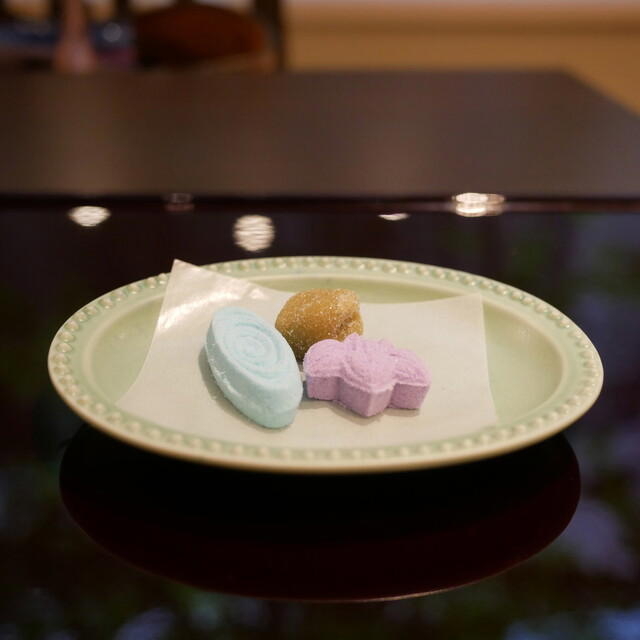
Daigokuden Honpo Honten is a Kyoto wagashi and Japanese sweets café in Nakagyo-ku, recognized in the Tabelog 100 Japanese traditional sweets / Japanese sweets café WEST selection for 2023. The appeal is less about spectacle than format: a long-established Kyoto sweets address with take-out, café seating, kakigori in its category mix, and a reputation that places it within the city’s serious confectionery circuit.

Pearl is the En Primeur Club membership app, where members save venues, book tables and use the concierge.
The menu
What to order
- Kohaku Nagashi (amber jelly)
- Warabi mochi
- Kakigori (shaved ice)
- Wakaayu seasonal sweets
In Kyoto, confectionery culture moves at a lower register than the city’s kaiseki rooms. The signs are quieter: sweets counters, seasonal gift boxes, families collecting take-out, café seats turning through the afternoon. Daigokuden Honpo Honten belongs to that Kyoto grammar of wagashi, where reputation is built through repetition rather than theatre, and where a small sweet can carry as much local meaning as a formal meal.
Kyoto visitors often over-index on multi-course dinners, then treat sweets as a souvenir category. That misses how the city actually eats. Wagashi shops and kanmidokoro cafés sit between daily life, temple-going, department-store gifting, and tea culture. They reward a different kind of attention from other Kyoto dining rooms, where the meal is the main event. Here, the point is a shorter stop with cultural density: Japanese traditional sweets, a café format, and a rhythm that suits Kyoto between shopping, transit, and appointments.
Kyoto wagashi with critical recognition rather than restaurant theatrics
The useful context is the award category. Daigokuden Honpo Honten was recognized by Tabelog Hyakumeiten in 2023, a sweets-focused recognition that matters because wagashi is not judged on the same cues as fine dining. There is no chef-led tasting menu narrative to decode, no wine pairing arms race, no counter performance. The signals are narrower: consistency, local trust, product identity, and whether the café format can hold its place beside take-out trade.
That makes the recognition meaningful in a city where traditional sweets are not a novelty. Kyoto has old confectionery lineages, tea-school demand, temple-route snacking, and a constant flow of domestic travelers buying edible gifts. Selection in a sweets-focused list puts the shop in a competitive lane closer to other Kyoto confectionery specialists than to kaiseki rooms such as Jiki Miyazawa or broader Japanese dining rooms such as Kan. The comparison is not about cuisine similarity; it is about how Kyoto rewards specialization. A narrow category can carry more authority here than a long menu trying to satisfy every visitor.
The café’s category mix also matters. Japanese traditional sweets and a sweets café are the core identity, with kakigori included in the listed scope. In Kyoto, shaved ice is not only a summer relief category; it has become a way for established sweets houses and cafés to meet contemporary demand without abandoning their confectionery base. That tension between preservation and café culture is the point. The more disciplined addresses avoid turning wagashi into a photo prop and instead use the room as an extension of the sweets counter.
A Kyoto sweets stop in a city that separates snack, gift, and meal
Daigokuden Honpo Honten operates in Kyoto, where eating is fragmented by design. The city pulls in office workers, shoppers, hotel guests, and day-trippers moving between stores, transit, and narrow streets. A sweets café in this setting does not need to behave like a destination restaurant. It functions as a pause, a gift stop, and a local reference point, with seated café use serving a different purpose from a full meal.
This is where Kyoto can be difficult for first-time visitors. The city’s culinary prestige is often framed through formal dinners, but much of its daily quality sits in smaller formats: casual snacks, specialist addresses such as Okuniya Mambei, lunch-counter cooking, confectionery counters, and specialist cafés. In that ecosystem, a sweets café occupies a practical middle ground. It is not a hushed temple of gastronomy, and it is not a generic casual stop. It is a category specialist with enough structure to sit down, slow the pace, and recalibrate before the next part of the day.
That kind of format is a useful clue to how Kyoto’s older food culture adapts. Traditional sweets addresses can serve both regulars and travelers without presenting themselves as full reinventions. Café use gives wagashi a broader audience while keeping the confectionery identity intact. For travelers, that matters because it turns sweets from something boxed for later into something experienced in the city’s actual flow.
How to place it within a Kyoto itinerary
The sharper move is to treat this as a sweets course, not as a substitute for lunch or dinner. Pair it with Kyoto walking, retail, or a hotel check-in day rather than forcing it into a restaurant-heavy evening. For fuller planning across the city, use Our full Kyoto restaurants guide, then separate the rest of the trip by category: Our full Kyoto hotels guide, Our full Kyoto bars guide, Our full Kyoto wineries guide, and Our full Kyoto experiences guide. Kyoto works better when these layers are planned separately rather than collapsed into one long dining checklist.
Within Japan’s broader casual-dining map, the lesson is similar: strong food cities are built from specialists as much as restaurants with long menus. A traveler comparing formats can see the same pattern across unnamed cafés, sweets counters, curry shops, grilled-meat specialists, and other focused casual formats: category clarity is often more useful than breadth. Even outside Japan, focused Japanese formats often travel differently from full-service restaurant ambition.
The editorial case for Daigokuden Honpo Honten is therefore specific. It is a recognized Kyoto sweets address in a city that takes confectionery seriously, with a format centered on Japanese traditional sweets, café use, and kakigori. For travelers who already have temples, shopping, and a major dinner on the day’s schedule, that is exactly the kind of stop that makes Kyoto feel less like an itinerary and more like a functioning food city.
Frequently asked questions
What's Daigokuden Honpo Honten's location?
Kyoto.
How much does it cost to eat at Daigokuden Honpo Honten?
Pricing at Daigokuden Honpo Honten is listed as JPY 1,000 - JPY 1,999 View spending breakdown.
Can I walk in to Daigokuden Honpo Honten?
The venue is best understood as a Kyoto sweets stop built around Japanese traditional sweets, café use, and kakigori, rather than as a full lunch or dinner destination.
What's the signature at Daigokuden Honpo Honten?
The clear draw is Japanese traditional sweets, with kakigori also listed in the Tabelog category set. Its 2023 Tabelog Hyakumeiten recognition gives that sweets counter real local weight in Kyoto.
A Pricing-First Comparison
Comparable venues to place this listing in its category.
| Venue | Cuisine | Price | Awards | Notes |
|---|---|---|---|---|
| Daigokuden Honpo HontenThis venue (the venue you are viewing) | Traditional Japanese Wagashi & Sweets Café | $10–20 | Tabelog 100 #18 | Not listed |
| Gion Duck Noodles | Duck Ramen with French-Japanese Fusion | $20–30 | Tabelog 100 #58 | Higashiyama, Duck Ramen with French-Japanese Fusion |
| Shubaku | Japanese Soba | Not listed | Tabelog 100 #67 | Uji, Japanese Soba |
| Kichi Kichi (ザ・洋食屋 キチキチ) | Japanese Omurice | $20–30 | Not listed | Gion/Pontocho, Japanese Yoshoku (Omurice) |
| Bar Gaudi | Modern izakaya & Spanish-style standing bar | $20–30 | Tabelog 100 #36 | Shimogyō, Modern izakaya & Spanish-style standing bar |
| GRILL DEMI | Japanese Western-style hamburg steak (yoshoku) | $10–20 | Tabelog 100 #80 | Nakagyō, Japanese Western-style hamburg steak (yoshoku) |
Recognition history
Dated appearances from independent guides and award organizations, with the underlying list record or original source where available.
Tabelog 100 #18 · No. 18
Tabelog · Tabelog 100 - Japanese traditional sweets / Japanese sweets cafe - WEST - 2023
Continue exploring
More in Kyoto
Restaurants in Kyoto
All restaurants in Kyoto →



Bars in Kyoto
All bars in Kyoto →



Hotels in Kyoto
All hotels in Kyoto →


Wineries in Kyoto
Browse all →
Details
- Classic
- Cozy
- Quiet
- Well Known
- Solo
- Family
- Casual Hangout
- Historic Building
- Standalone
- A La Carte
- Tea
- Coffee
Calm, traditional wagashi shop atmosphere with a relaxed café space created after the 2019 renovation, offering a cozy, unhurried environment suited to enjoying Japanese sweets and tea.